What You Need to Remember About Focus
-
01
Think Big, Not Small Stop focusing only on checking things off your list. Start focusing on creating real value through deep thinking. Top roles require you to protect your concentration time, not constantly jump to answer small pings.
-
02
Group Your Small Jobs Keep your focus strong by grouping all your minor chores into one specific time slot. This stops tiny tasks from making your brain tired when you need to work on hard projects.
-
03
Measure What Counts Judge your success by how much you complete on your biggest goals, not by how many easy items you cross off. Having an empty email inbox usually just means you were busy with unimportant things, not that you advanced your career.
-
04
Focus on Big Progress Make time for the challenging, slow work that leads to real growth and new ideas. Big career impact comes from long-term plans, not from being the fastest person to reply to an email.
The False Idea of Being Busy
Most workers spend their days trying to finish small tasks quickly. They treat the "Two-Minute Rule" as a perfect guide, thinking that dealing with tiny jobs right away is the only way to stay organized. They think a clear inbox means they are working very well.
But the real problem is this: you are hurting your career by focusing on small things. In an important job, nothing is truly "quick." Even if an email takes two minutes to write, the mental cost of switching your attention is huge. Every time you stop a big project to handle a minor thing, your brain leaves behind "attention residue." Research from the University of California, Irvine found it takes an average of 23 minutes to regain full focus after a single interruption. That's not a two-minute cost. It's an hour of lost work before lunch.
If you follow this rule blindly, you aren't being productive. You are letting unimportant requests steal your most valuable hours. You are training yourself to be someone who is great at busywork but poor at the deep thought needed for major achievements. You will end the week with an empty list but no real progress in your career, having traded chances to grow for quick feelings of success.
"You shouldn't become a slave to spending your day doing two-minute actions. This rule should be applied primarily when you are engaging with new input, not as a constant interrupt during focused work."
— David Allen, author of Getting Things Done
What Is the Two-Minute Rule?
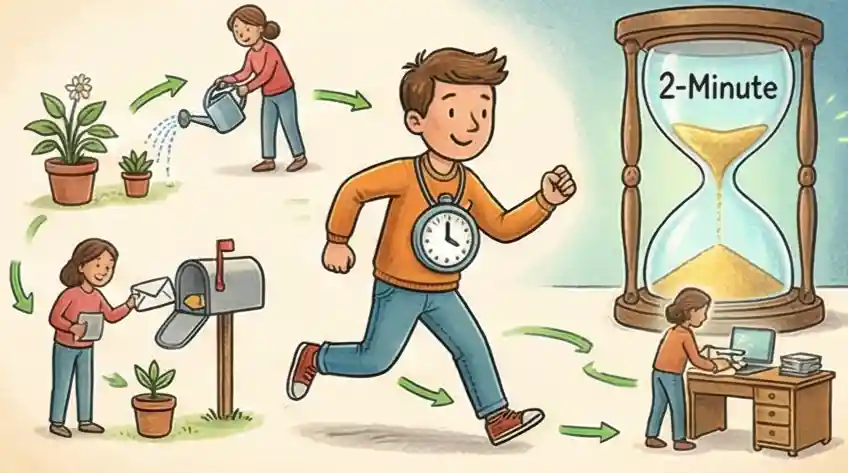
The Two-Minute Rule comes from David Allen's Getting Things Done (GTD) system. The rule states: if a task takes less than two minutes to complete, do it immediately instead of adding it to your to-do list. The logic is that tracking and revisiting a tiny task costs more mental energy than just doing it now.
The rule works well for truly trivial actions at low-focus moments: filing a document, replying to a one-line question, or deleting an email. The problem starts when people apply it during deep work hours, using it as permission to interrupt concentrated thinking dozens of times per day. That's where productivity breaks down.
How Technology Looks at Productivity
When we build systems, like software hiring tools (ATS), we don't reward "activity"; we look for Strong Patterns of Meaningful Work (Semantic Clustering).
Jumping Around vs. Staying Focused
Mental WorkloadThink of your brain like a computer database. When you use the "Two-Minute Rule" during deep work, you cause Data Fragmentation. Stopping a hard project for a quick email forces your brain to clear out the old information and load entirely new information. According to a 2024 study at MIT's Attention Lab, continuous partial attention raised error rates by 37% and reduced working memory accuracy by 20%. The switch cost is far higher than the two minutes you "saved."
What Hiring Software Looks For
Hiring TechHiring tools use NLP (Natural Language Processing) to scan your work history for clear signs that you can stick with one hard problem. If your daily work is just a string of tiny, separate jobs, your professional results look like weak, unconnected points that don't tell a clear story.
The Price of Small Jobs
How Importance is MeasuredThe system sees a lack of "Semantic Density" — it can't find proof that you stayed focused on important work. The software doesn't care how many boxes you checked; it cares if you spent your brainpower solving one big problem that helps the company long-term. Atlassian estimates that task switching costs the global economy $450 billion annually in lost productivity, a figure that reflects how deeply fragmented work habits have become across organizations.
If you spend your day chasing quick dopamine hits from small tasks, you are lowering your value as a worker. You aren't becoming an expert; you are becoming a basic worker that can easily be replaced by simple software.
Productivity Myths That Waste Your Time
You should quickly add your new job tasks to your resume whenever you have a spare moment.
Even "small" updates can mess up your formatting, which wastes more than two minutes. More importantly, just listing what you did without showing the good results makes your resume look boring—like a simple checklist instead of a success story.
Use Cruit’s Resume Tool to turn your quick ideas into strong, results-focused points instantly, making the update fast and helpful.
Just send a fast, two-minute message on LinkedIn to "stay in touch."
Messages that show no real thought are often ignored by busy people or seen as spam. Real networking requires knowing what you want to say and why, which is hard to do well if you are rushing to meet a two-minute deadline.
Cruit’s Networking tool helps you write good, personal messages based on your goals, so your outreach is useful rather than just fast.
Don't worry about writing down small good things now; you’ll easily remember them when you need them for reviews or interviews.
Your memory is not perfect; you will likely forget the good things you did months ago. Trying to dig through old emails later to find these details wastes hours, which defeats the point of trying to be fast now.
Use Cruit’s Journal Tool to quickly write down wins as they happen; the AI saves them in a searchable way, so you always have your best stories ready when you need them.
Quick Check: Stop Drowning in Small Work
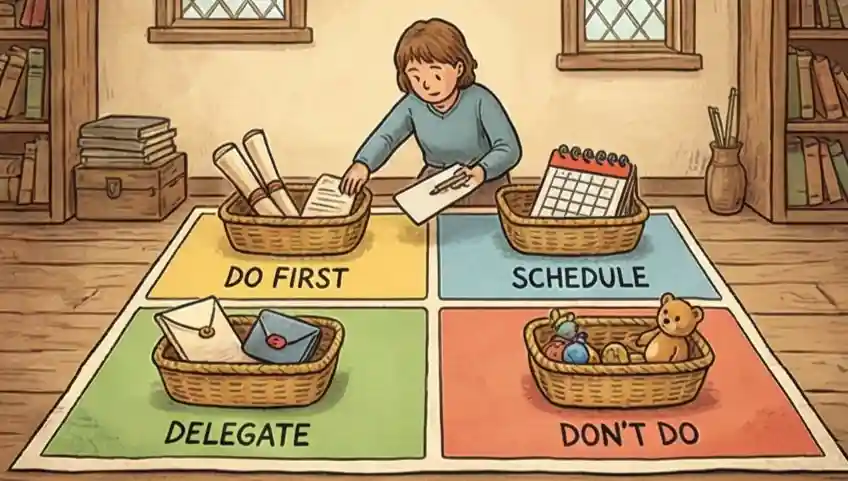
Many leaders get stuck under "administrative debt": a pile of small jobs that seem productive to track but actually stop them from doing important work. To see if your daily routine is helping or hurting you, try this 30-Second Strategy Check based on the "Flag & Forget Test." If you need a framework for deciding which tasks deserve your best hours first, the Eisenhower Matrix is a proven starting point.
Open your main place for messages (Email, Slack, or Teams).
Look at the last 5 things you marked to handle "later" (flagged, marked unread, or added to a list).
For each job, be honest: would the actual work (like saying "Yes" or sending a link) have taken less than two minutes?
Count how many of those tiny jobs you put off (the "Quick Wins").
What Your Score Means
0–1 Jobs Postponed: You are effective. You know it costs more time to manage a small job later than to just do it now.
2 or More Jobs Postponed: You are probably falling for the Common Mistake.
The Trap: The Common Mistake
Many people wrongly think it’s better to save up small jobs to do all at once in a special "admin time." They think this saves their focus time.
The Truth: If you have 3 or more small jobs waiting, you are creating Mental Clutter. It took you 30 seconds to read the request, 10 seconds to decide to wait, and 10 seconds to flag it. When you come back, you’ll spend another 30 seconds figuring out what it was about. By trying to "save time," you actually spent 80 seconds managing a 30-second job. If it takes less than two minutes, do it right away—or you will end up paying for it twice.
Cruit AI Tools: Making Small Jobs Finish in Two Minutes
For Your Image
LinkedIn Profile BuilderTurns your resume into a professional LinkedIn profile instantly, so you don't waste time writing.
For Reaching Out
Networking HelperWrites personalized connection messages right away, helping you say the right thing without delays.
For Remembering Success
Daily Log ToolRecord what you achieved in less than two minutes, so your best work is always ready when you need it.
Common Questions
Should I quit using the Two-Minute Rule completely?
You don't have to get rid of it, but you must change when you use it. The rule is fine for home chores, like hanging up your coat. But at work, don't use it during your best focus hours. Save those tiny jobs for the last 30 minutes of the day when your brain is already tired and ready for easy things.
How can I handle small jobs without losing my concentration?
The best way is called "Batching." Instead of stopping your deep work every time a small job pops up, write it down on a separate list. Then, set aside one or two times each day to quickly finish all those small jobs at once. This keeps your brain safe from the "mental switch cost" of jumping between different kinds of work.
Will my coworkers think I'm slow if I don't reply to every small message right away?
Usually, no. There's a big difference between being "responsive" and being "constantly available." Most people care more about getting good work than getting a reply in under three minutes. By setting rules for when you check messages, you show people that your time is valuable. You will be seen as someone focused on results, not just someone who is busy all day.
What is batching and how does it replace the Two-Minute Rule?
Batching means collecting all small tasks throughout your day and completing them together in one scheduled block, typically a 20-30 minute window at low-energy times like late afternoon. Instead of handling each two-minute task as it arrives, you write it down and return to it later. This preserves your deep work time while still clearing the small stuff. Pairing batching with a structured focus method like the Pomodoro Technique makes it even easier to protect your concentration blocks.
Does the Two-Minute Rule work better for some jobs than others?
Yes. Roles that are already interrupt-driven, like customer support or administrative coordination, may benefit from the rule since deep focus isn't the primary requirement. But for knowledge workers, engineers, writers, and analysts whose value comes from sustained concentration, applying the rule during peak hours is actively harmful. Know your role before applying blanket productivity advice.
How long does it take to regain focus after a small interruption?
Research from the University of California, Irvine found it takes an average of 23 minutes to fully return to a task after an interruption. This means a single "two-minute" task can cost you nearly half an hour of productive time when recovery is included. The cumulative impact across a workday is significant.
Pay attention to what truly matters.
Getting ahead in your career isn't about tricking your to-do list to look empty by lunchtime. It's about being indispensable: the ability to do the hard, focused work that actually helps your company move forward. While conventional productivity advice tells us that the Two-Minute Rule is a safe way to stay organized, the truth is it often turns good workers into people who only react to small things, stopping them from working on big projects. Don't let a clean inbox stop your career from growing.
Join Cruit Now