Introduction
Most advice on being productive is just "Sorting Games." You waste your first hour of the day moving tasks around a checklist, thinking that labeling something "Category Two" magically gives you the time to actually do it. It doesn't. All you've managed to do is put a nice color on your failures.
This forced sorting creates a "Guilt Problem" that steals your best work energy. The usual to-do list rules assume you have lots of helpers to "Pass Off" tasks and the total freedom to "Throw Away" unimportant stuff. But in reality, your boss or your customers own those tasks. Ignoring them doesn't make you look smart; it makes you look unreliable. You get stuck making too many small choices, acting like a "Chaos Tamer" instead of someone who moves big projects forward, while your main goals get crushed by unexpected emergencies you can't just ignore.
The scale of this problem is bigger than most people realize. According to DocuSign's Digital Maturity Report 2024, workers now waste nearly 12.6 hours per week on low or no-value tasks. That is more than a full working day gone every week, not to deadlines or hard projects, but to noise. The Eisenhower Matrix exists precisely to fix this.
To stop letting your inbox control you, you need to shift from managing time to Leverage Mapping. Stop looking at deadlines and start asking which task creates the biggest result. The goal isn't balancing a chart; it's finding the "First Key Move"—the main task that, when finished, makes five other things on your list unnecessary. Top performers don't organize boxes; they search for the unfair advantage that solves recurring issues forever. This guide shows you how to stop fighting fires and start building the systems that stop them from starting.
What Is the Eisenhower Matrix?
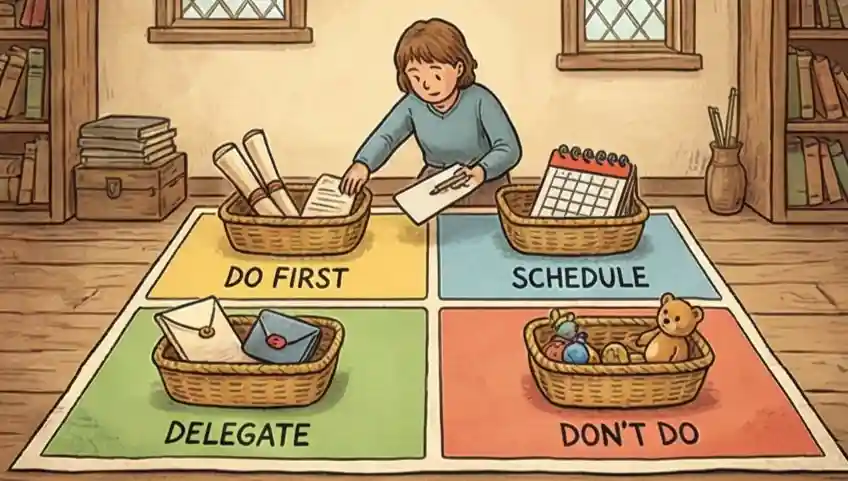
The Eisenhower Matrix is a four-quadrant prioritization framework that sorts every task by two criteria: how urgent it is and how important it is. Tasks that are both urgent and important get done immediately. Important but not urgent tasks get scheduled. Urgent but unimportant tasks get delegated. Everything else gets cut.
Named after President Dwight D. Eisenhower and later popularized by Stephen Covey in The 7 Habits of Highly Effective People, the matrix was built around a simple observation: most people confuse urgency with importance. They spend their days reacting to the loudest requests rather than the highest-value ones. The matrix gives you a structure to tell the difference.
The four quadrants are often labeled: Do (urgent + important), Schedule (important, not urgent), Delegate (urgent, not important), and Delete (neither). The real power of the system isn't the labels, though. It's the discipline of asking, for every task, whether urgency is driving you rather than actual importance.
Strategy Summary
-
01
Find the First Key Move Focus only on the one main task that makes several others pointless or easier to avoid the "Guilt Problem" caused by constantly sorting your list.
-
02
Handle Back-and-Forth Talk Group your replies and give clear "if-then" instructions ahead of time for small requests to stop the constant back-and-forth that pulls you away from big plans.
-
03
Use Leverage Mapping Put your energy into high-return tasks that build up over time, instead of simple "Important" tasks, so that every hour builds future shortcuts.
-
04
Use the Fire Extinguisher System Write down and automate what causes sudden "Urgent" problems so you shift from being a "Chaos Tamer" to a builder of things that run themselves.
-
05
Get Small, Quick Wins Deliver fast, meaningful results on your main goals to build the trust needed to safely ignore or change the low-value tasks that used to feel necessary.
Industry Check: Sorting Games vs. Leverage Power
As someone who analyzes work methods, I've compared the usual Eisenhower method with high-level success approaches. This section shows the difference in behavior between people stuck in "Sorting Games" and those using "Leverage Power."
How You Plan Your Morning
Spending the first hour neatly organizing your list into four boxes to feel "balanced."
Finding the single "First Key Move" task that makes several other tasks unneeded or easier.
What Makes Something "Important"
Treating every "Important" task the same, assuming labeling it means you'll find the time for it.
Checking tasks by "How Much They Multiply Results"—only focusing on work that builds lasting systems or gives an advantage.
Dealing with Small Demands
Trying to "pass off" or "delete" tasks you really can't ignore, which leads to stress from small choices piling up.
Letting "Urgent" noise burn in the background while you build a system to automatically stop or permanently remove the original reason for the interruption.
Your Role Identity
Acting as a "Chaos Tamer" who feels good because their fire-fighting is neatly sorted in boxes.
Acting as a "Leverage Builder" who ignores the boxes to focus on power moves that create long-term simplification.
How You React to "Urgency"
Reacting to every notification as a priority change, leading to a day spent only on immediate, small stuff.
Delaying immediate problems to get "Deep Focus" time for big projects that prevent future problems.
The Leverage Roadmap
Stop seeing your to-do list as just a list of things to finish. Most "Important" tasks are just maintenance—they keep things going but don't create big progress. You must find Main Tasks—things that, when done, make three other recurring tasks disappear or become automated. This is moving from doing things one by one to getting big exponential results.
- Put your current list through the "Unnecessary Check." For every item, ask: "If I spent 4 hours building a fix for this today, would it save me 40 hours later?"
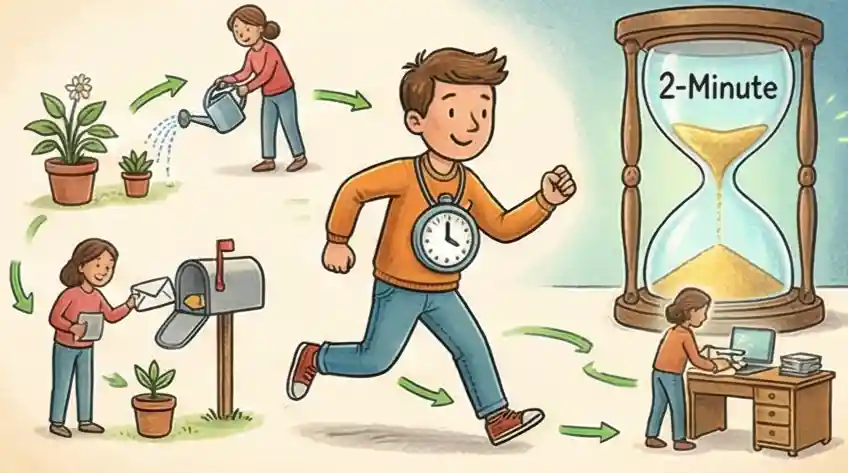
- Find the First Key Move: Circle the one task that makes many others easier or useless. (Example: Instead of answering 10 client emails, build a help page they can check first). For small tasks that take under two minutes, the Two-Minute Rule handles them instantly so they never clog your quadrants.
- Mark the "Required Noise": Tag tasks your boss demands (like reports) as "Just Enough Work." Do them with the minimum quality needed to protect your focus time for the Main Task.
"This plan moves you past "Sorting Games" (just organizing the mess) to Leverage Mapping (designing the mess out of existence)."
This is an immediate trigger, but the real test happens the first Monday when you set the pace for massive efficiency gains.
The "Guilt Problem" happens because you try to fix things while building new ones. The secret is: You have to let some fires burn. If you answer every urgent beep, people see you as someone who just processes things, not someone who builds things. You must create a "Strict Isolation" time where only the Main Task exists.
- Set aside time for Deep Focus Blocks.
- The Gentle Question: When something "Urgent" pops up during your main focus time, ask: "What happens if this waits 90 minutes?" Usually, nothing bad happens.
- The Shortest Possible Reply: Use saved templates like "I'm building something critical right now; I'll check back at 2 PM."
- Explain Your Work: Tell people your main task isn't "ignoring them," but "building the system that will serve everyone better later." Use phrases like: "I'm currently improving our [System Name] so we can stop these delays forever."
"I'm currently improving our [System Name] so we can stop these delays forever."
Your goal here is to make it clear that your focused time is sacred. The company will test this boundary every day.
Finishing the job isn't just building the system; it's Killing the Old Way. People often keep doing the manual work out of habit even after the fix is ready. You must aggressively stop doing the "Urgent" noise by using the systems you built.
- Hard Stop Switch: Once your "First Key Move" is done (like a working automated report), delete the calendar reminders for the old manual way.
- The Software Pass-Off: If you don't have staff, "pass off" the work to software or standard rule books.
- Smart Thinking: If a task can't be automated or deleted, Make People Use a Standard Format to Ask for It. If they won't use your required form or method, put that request lower on your list. You are teaching people to respect the system over your personal effort.
"If a task can't be automated or deleted, we must Make People Use a Standard Format to Ask for It."
True success isn't the system built, but the noise gone for good. If you keep doing the old thing, the system failed its first test.
Success creates its own clutter. As you get faster, people naturally try to fill your new free time with more "Urgent" noise. You must stop this Growing Complexity. This step is about staying focused on big picture stuff, not just reacting to your own good work.
- Do a System Check.
- Review your big wins from the last three months.
- The Self-Question: Ask, "Am I still doing things my systems should be handling?"
- Find the next "First Key Move." As you advance, these moves go from "Fixing Tech Stuff" (like spreadsheets) to "Fixing People Culture" (training others to decide without you).
"Am I still doing things my systems should be handling?"
The goal is to move from "Chaos Manager" to "System Designer," where your main value is the structure you leave behind, not the hours you put in. This check keeps you focused on building, not reacting.
The Recruiter's View: Why Smart Focus Adds a Pay Premium
When hiring, everyone claims to be a "hard worker." That's common. But hard work without smart prioritizing is just slow, damaging effort. Hiring managers don't look for the person who finished 100 small jobs yesterday; they look for the person who knew which 80 jobs to ignore. Here is what gets noticed behind the scenes.
"What gets us into trouble is not what we don't know. It's what we know for sure that just ain't so."
Research backs this up. A Journal of Consumer Research study found that people consistently gravitate toward time-sensitive tasks over more valuable ones, even when the less urgent option offers far greater rewards. The researchers called this the "mere-urgency effect." The Eisenhower Matrix is a direct countermeasure against it.
Saying you are "always buried" suggests you can't tell what matters and what doesn't, and you risk burning out. It shows you can’t filter out noise, so you lead teams down paths that don't lead anywhere important.
Candidates who master ignoring what's just urgent (Box 1) and focus their energy on what's Important but not Urgent (Box 2) are the ones who stay focused, deliver big results, and earn more money.
Entry-level workers focus on doing things; leaders focus on deciding. Leaders get paid more because they have the courage to stop or kill projects that waste time (Urgent but Not Important).
High earners talk about building systems to prevent problems, not just fixing them when they happen. When you talk this way, you look low-risk, making you the candidate who gets the extra 20% salary boost.
Leverage Mapping: System Building Tools
Roadmap Match: Steps 1 & 2
Career Guidance ToolAutomatically checks your tasks using an AI Advisor through a Socratic style to find what you are overlooking.
- Makes sure you focus on your Key Goals during focused work times.
- Reduces problems caused by unclear personal goals.
Roadmap Match: Steps 3 & 4
Note-Taking ToolWorks as a constant check to prevent forgetting recent wins and to measure the time saved by your new systems.
- AI pulls out and tags skills you showed in your "building times."
- Creates summaries you can use to tell managers why you need to stop old tasks.
Roadmap Match: Step 4
Future Job PlanningHelps you see where you are going once you clear the backlog of simple work.
- Deep look at your updated resume to show transferable skills.
- Shows you what higher-level jobs look like (moving from fixing tech issues to fixing people/policy issues).
FAQ: Dealing with Real-World Priorities
How do I prioritize tasks when I have no team to delegate to?
If you have no staff, your delegation must happen through systems rather than people. Look for a process, a template, or a piece of software to handle recurring low-value tasks. Doing them manually keeps you stuck; building a system to handle them frees you to focus on high-leverage work.
What if my boss treats every urgent request as the top priority?
Frame it as risk management. Show your manager how one high-leverage task will permanently eliminate five recurring urgent problems. You shift from an employee who takes orders to a planner who demonstrates value. Explain that 20% of your time spent building systems will save 80% of the team's wasted effort later.
Will ignoring some tasks to focus on leverage hurt my client relationships?
There is a short-term trade-off, but it is worth making. Trying to please everyone produces mediocre results everywhere. Concentrating on the highest-leverage tasks creates enough value over time that minor delays on non-essential responses are easily forgiven.
How is the Eisenhower Matrix different from a regular to-do list?
A regular to-do list treats all tasks as equal. The Eisenhower Matrix forces you to evaluate every task on two dimensions: urgency (does it need action now?) and importance (does it move your long-term goals forward?). This distinction prevents the common trap of staying busy on urgent but low-value work while neglecting the tasks that actually matter.
How many tasks should go in each quadrant?
Most productivity experts recommend no more than 8 to 10 tasks per quadrant. Quadrant 1 (urgent and important) should have the fewest items. If it is overflowing, that is a signal that too much of your work lives in reactive mode. The goal of the matrix is to move more of your energy into Quadrant 2, where planned, strategic work happens.
Focus on what matters.
Getting out of the trap of sorting tasks is the only way to protect your professional value from being slowly eaten away by busy work. The Eisenhower Matrix isn't a filing system. It's a decision filter. Commit to it, and you stop managing problems and start designing systems that solve them for good. The choice is simple: keep putting nice labels on your failures, or find the first key move that makes your to-do list shorter every week.
Stop fighting fires and start building the systems that stop them from starting.
Join Cruit todayFurther Reading
The Two-Minute Rule: A Simple Hack to Stop Putting Off Small Tasks

The 'Working Interview' Where You Perform On-the-Job Tasks