Important Things to Remember
Use a video resume to show your personality as an "extra piece," but never let it take the place of your normal, easy-to-scan resume.
Only bother making a video if the job requires strong talking skills, like jobs in sales, marketing, or management.
Keep your video under a minute and a half so you grab the hiring manager's attention but don't take up too much of their time.
Make sure your sound is clear and the lighting is good. Bad quality video can hurt your professional image more than a simple resume mistake.
What Is a Video Resume?
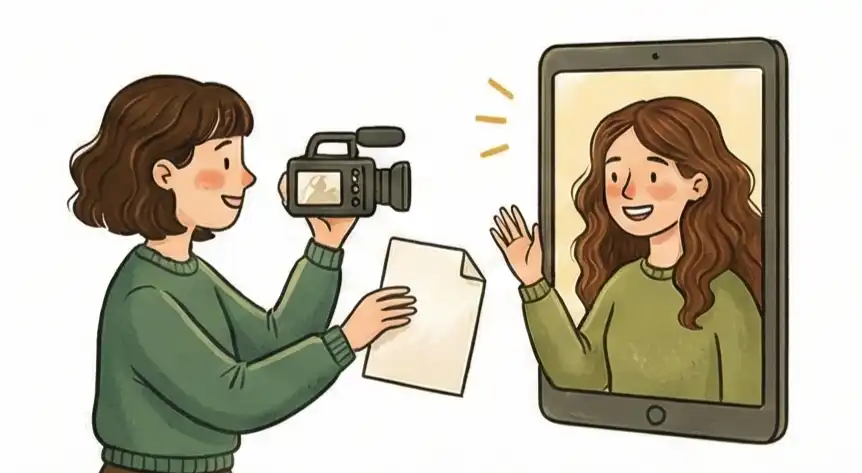
A video resume is a 60-90 second self-recorded clip where a job seeker introduces their background, skills, and value to a potential employer. It supplements a traditional resume rather than replacing it, and works best for roles where communication ability is a core job requirement.
Unlike a traditional resume, which gets about 6-8 seconds of a recruiter's attention (TheLadders, 2018), a well-made video can hold 60 full seconds of it. Used as a follow-up to a human contact rather than buried in an ATS submission, it acts as a soft screen: proving you can articulate ideas clearly before a director commits hours of their schedule to a formal interview.
Whether to make one depends on the role. Sales, marketing, public relations, management consulting, and client-facing positions all benefit from a short video. It's direct evidence you can do the work. For technical or compliance-heavy roles where ATS screening dominates, attach one only if the posting specifically requests it. For tips on building the full application package, read our guide on how your resume and cover letter should work together, or pair it with a tight one-page resume that's easy to scan.
Checking Your Video Approach
Don't turn your resume into a long video where you just read what's already written. Most people treat the camera like a stage to show their "talking CV," reading out bullet points in front of a messy background. This is a bad way to approach things. When you make a recruiter spend several minutes listening to something they could have read in six seconds, you are showing them you don't respect their time or understand how business works efficiently.
For high-level jobs, time is the most valuable thing a company has. According to SHRM, the average cost per hire in the U.S. is $4,700, with every wasted interview hour pushing that figure higher. A good video is not just about showing personality; it’s about proving you can handle things. It acts as a quick check to see if you can talk well or handle a client before a director commits a lot of their schedule to a formal meeting.
If you mess this up, you aren't just missing out on a job—you are showing that you aren't mature enough professionally to protect a company’s resources.
Strategy Shift
The best 1% of job seekers never send a "video resume." Instead, they use a 60-second pitch focused on solving problems.
- This plan means focusing on what you can do for them now, not just a long list of who you are.
- Focusing on one big result you achieved changes how people see you.
Using the video as a final closing tool, instead of something you send right at the start, helps you get past automatic screening systems and makes you look like a smart investment, not a risk.
Context helps here: according to a Robert Half survey, 78% of hiring managers prefer receiving traditional resumes, and only 3% are interested in video submissions through a standard application portal. That's not an argument against making a video. It's an argument for sending it through the right channel, at the right time, to someone who's already curious about you.
The Three Steps to Your Video Pitch
Don't make a "talking biography"; make a pitch that shows what value you bring. The goal is to prove you know what problems the company has and have a clear way to fix one of them. Talking about one major result instead of your whole work history shows you respect the recruiter's time and reduces their concern about hiring someone untested.
Write a short script with three parts that fits on one sticky note. Part 1: Name a common issue in the industry. Part 2: Explain the exact thing you did in a past job to solve it. Part 3: State the result using numbers. Practice saying it until you can do it smoothly in less than 60 seconds without talking too fast.
"In [Your Industry], many teams struggle with [Specific Problem]. In my last role, I fixed our [System or Process], which led to a [Number]% jump in how well we worked. I want to use that same skill for solving problems in your open role."
Recruiters are scared of hiring someone who looks good on paper but can't speak clearly. A short, clear video proves to us right away that you are prepared and can talk well. This saves us the risk of wasting $2,000 of a manager's time on a full interview.
To get past company firewalls, you must make sure your video is easy to watch without needing to download anything or log in. Use a simple tool like Loom or your own basic webpage (like Notion or Carrd). This keeps the IT department happy and ensures the hiring manager can see your pitch with just one click.
Record your video where the lighting is good and the background is simple—no messy shelves or distracting posters. Upload it to a site that lets people watch it easily and set the privacy so "Anyone with the link can see it." Send a test link to someone else to check that it opens right away on both computers and phones without asking for a password.
"I made a quick 60-second video about how I handled [Specific Task] for my old team. You can watch it here [Insert Link]—it’s a fast link that doesn't require a download, just to save you time."
If a candidate sends a large video file or a link that needs a password, we usually skip it. Our company systems block suspicious files. If your "important" content causes a technical problem, it's no longer important.
Don't use the video when you first apply, which might bring up bias concerns. Instead, use it as a "Closing Tool" after a person has already seen your resume. Send it to "warm up" the hiring manager right before the first phone call.
When a recruiter emails you to set up an initial call or shows interest, reply with your availability, but add the video link as a "bonus" to give them more information before you speak. This makes you look like a top candidate who is already offering value.
"Thanks for getting in touch! I'm free Tuesday afternoon for our chat. In the meantime, I thought this 60-second video about how I handled [Project] might give you some useful background for our talk. Talk soon!"
Sending a video after the first resume look is smart. It avoids HR's automatic filters about bias and goes straight to the person who can hire you, making it much easier for me to suggest you as the top choice to the hiring manager.
How Our Tool Helps Your Video Strategy
To Master Step 1 Practice
Interview Practice ToolGet good at your 60-second "Value Pitch" by getting coaching from AI to make sure your script is short and impactful.
To Get Proof with Numbers
Story Keeper ToolReview past work to find key skills and hard numbers, building a bank of facts for your "Proof of Concept" section.
For Smart Sending (Step 3)
Networking ToolCreate personalized emails to send your video as a helpful extra to recruiters.
Common Questions About Video Applications
Does a video resume make you look desperate?
In a stack of hundreds of identical applications, standing out is strategy, not desperation. The difference comes down to content. A five-minute autobiography reads as self-indulgent. A 60-second clip that directly addresses a problem the company faces reads as preparation. If a hiring manager views this as "too much effort," they’re probably not looking for someone who brings initiative to their role.
The goal is not to be an entertainer. The goal is to quickly prove you can explain a business solution better than anyone else. Employers who see a 60-second solution as excessive are looking to fill a seat. Move on to better opportunities.
What if HR rejects my video resume for bias reasons?
This is exactly why you should never submit a video as your main application. If you upload a video to an automated HR system, the system will likely discard it. Change your approach instead.
The Plan:
- Use your normal resume to get past the automated screening software.
- Once you have a person’s name or an email for follow-up, send the video as a "High-Value Preview."
- Link to a simple, clean webpage or a professional video host (like Loom), rather than a file attachment that looks suspicious.
If the company system blocks it, your paper resume is already in the running. You lose nothing. But if it does reach the hiring manager’s screen, you’ve jumped ahead of everyone else.
How do I make a video pitch without impressive numbers?
You don’t need million-dollar results to demonstrate value. Every job exists for one of two reasons: to help a company make money or to remove a headache for a manager. If you don’t have revenue figures, focus on the headache you eliminated.
Reframing Your Experience:
Instead of saying "I have five years of experience in project management," say:
"I noticed your team is growing quickly. At my last company, I created the tracking process that kept our weekly meetings from running over, saving leaders 10 hours every month. I can set up something similar for you."
Bosses care about their own time. Show in 60 seconds that you save it, and the conversation about hiring you becomes much easier.
How long should a video resume be?
Keep it under 90 seconds. The sweet spot for most roles is 60 seconds flat. That’s long enough to name an industry problem, describe your solution, and state the result, yet short enough that a recruiter can watch it in the same time they’d normally spend glancing at a paper application. If you can’t land your point in 90 seconds, your script needs tightening.
Should I send a video resume with every application?
No. Video resumes work best for roles where communication is central: sales, marketing, account management, teaching, training, and client-facing positions. For these roles, a clear and confident 60-second video is direct evidence you can do the job. For technical roles or positions screened primarily by ATS software, the video is unlikely to reach a human reviewer, so it’s not worth the time to produce one.
Stop Begging for Attention, Start Proposing a Partnership.
You are not just a job applicant asking for a role; you are a valuable expert who can solve a specific business issue.
Falling back into the BAD WAY (reading your resume out loud) makes you look like a risk who wastes important company time and seems unprofessional.
To succeed at high levels, you must switch to the SMART WAY by showing what you can do for them first, instead of just talking about yourself.
Great leaders want business partners who speak clearly and professionally, not just people who follow orders.
Make a Business Pitch They Can't Say No To