What You Need to Know Now
-
01
Your Value is ROI Instead of just listing tasks, show results. This proves you put in the extra work needed to help the company make or save money. This makes your financial worth clear right away to those hiring you.
-
02
Speed Comes from Knowing the Goal A resume focused on results shows you can start performing well quickly. This means you will get results fast in the new job from the very first day.
-
03
Tough Times Show Your Experience Showing how you fixed hard problems before proves you bring useful knowledge that helps avoid future mistakes. This signals you are tough and can stay productive even when the market gets difficult.
What Is a Resume as a Marketing Document?
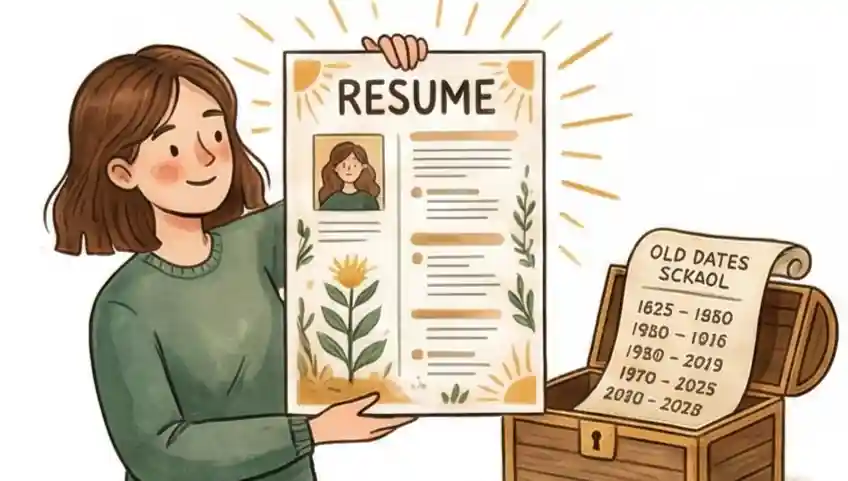
A resume as a marketing document is a targeted sales tool that uses your past results as proof of what you can deliver for a future employer — not a chronological list of everything you have ever done. Instead of reporting your career history, it argues a specific case: you are the right solution to this company's current problem, and here is the evidence.
Most professionals default to the historical approach, listing every role, responsibility, and task in reverse chronological order. A marketing document flips this logic: you lead with outcomes, cut anything that does not serve the job you are targeting, and structure the whole page as a sales pitch, not a deposition.
Changing Your Resume Strategy
Most resumes are designed wrong: they act like history books instead of tools for sales. The old idea that you must list every single task you’ve ever done is outdated and still causes problems today. By treating your work life like a record to be stored instead of a solution to be sold, you are creating problems for your career later. You are failing to clearly show your value, and that will catch up with you.
"Your resume is your 30-second commercial: your professional brand, value-added contributions, and competitive edge, all rolled into one document that either opens doors or closes them."
This problem is common. It makes hiring managers work too hard just to figure out what you are worth. When you present a timeline of your past jobs, you create a lot of distracting information that hides your real success. When people are busy, making them search for your importance is a sure way to get rejected. You are not being complete; you are becoming invisible.
The data makes this concrete. According to TheLadders (2018), recruiters spend an average of 7.4 seconds on initial resume screening before deciding whether to keep reading. With that window, a document that buries your value inside a wall of task descriptions gets discarded. Research from TeamStage (2025) found that only 2–3% of submitted resumes result in an interview. The difference between the resumes that advance and the ones that don't usually comes down to clarity of impact, not completeness of history.
The only real fix is to make a clear change. You must replace just reporting history with proposing what you can do. This means changing your resume from a diary of the past to a strong sales document. This change turns your work history from a list of old tasks into proof that you are the exact right person to fix a company's problems right now. To get the fundamentals of resume structure right before you apply this mindset, see our complete guide to writing a master resume.
Checking Your Resume: Removing Mental Effort for Others
Too Much History
You feel you must include every job from ten years ago or list every daily task. Your resume becomes many pages long, listing everything you’ve done since school, creating a confusing wall of text that you hope covers everything.
You are making the recruiter use up extra brain power. Handing them a complete list of history forces them to manually search for what matters. When someone has to work too hard to find the important parts in the messy information, they will often just throw the document away to save mental energy.
Focus on What Matters Now
Check your list against the job you are applying for. If an old job or task does not directly show that you can fix the company’s current issue, remove it or make it much shorter.
Talking About Duties Only
Your points start with weak phrases like "Was in charge of," "Helped with," or "My job included." You are describing what your old job required, not the good things you actually achieved while doing it, treating the resume like a chore list.
This is just "Reporting History," which tells a buyer what you were told to do, not what you can actually deliver. A list of duties doesn't prove you are a high-value solution, just another employee.
Focus on What You Achieved
Rewrite every point to focus on a specific success or result. Start with the result you got, using your past work only as proof that you can do it again for the new company.
Using the Same Resume for Everyone
You send the exact same resume to five different companies for slightly different jobs. You think your total experience is your main selling point, and you expect the hiring manager to figure out where you fit best.
By trying to appeal to everyone, you highlight nothing specific. In a world with too much information, a general resume doesn't stand out. If the document isn't clearly showing how you connect to their future goals, they won't see you as the right fit.
Customize Your Sales Pitch
Treat your resume like an advertisement made for one specific customer. Only select the successes that help bridge the gap to the job you want, getting rid of history that isn't needed so the most important message is clear right away.
Checking Your Resume: Before and After
Use this guide to see if your resume is stuck just listing history or if it has become a strong sales document. As an expert, I often see capable professionals struggling because they treat their resume like a legal report instead of a sales presentation.
The Life Story: A timeline listing every job and task you have done.
Believing you have to include everything, even if it doesn't fit the job.
The reader can’t quickly see what makes you valuable.
The Sales Pitch: A focused presentation designed to solve the buyer's current problems.
Success is measured by making sure nothing is left out, no matter if it matters.
Confusing a resume with a full, complete history of your professional life.
The reader wastes time looking through duties that aren't important.
Success is measured by how fast the reader sees you as the perfect match.
Bullet points describe daily tasks and what you were "supposed to do."
Focusing on what you put in (your effort) instead of what came out (your success).
Your work sounds normal and doesn't show real impact.
Bullet points highlight numbers and the value you created.
It only focuses on what you did in the past.
Not connecting your past results to what you can do in the future.
The reader sees you as qualified for your old job, not the next one.
It uses past wins to show what you are capable of doing next.
The hiring manager has to search through a lot of text to find your value.
Putting the hard job of figuring out your worth onto the busy reader.
The recruiter moves on to a resume that is easier to read.
The reader immediately sees your most impressive achievements.
Why This Shift Matters
When you use your resume as a History Book, you make the recruiter do the work. You are saying, "Here is everything I've done; you figure out if I'm any good."
When you use it as a Sales Document, you control the message. You remove the unimportant details of your daily work and highlight the strong proof of your excellence. In a tough job market, the winner is often not the most qualified person—it’s the person who shows their value the clearest.
Tricky Parts: The Hidden Dangers of Selling Yourself
Using your resume as a sales document has big rewards, but it also brings specific dangers that a normal history resume avoids. As someone who looks at risk, I always check where a plan might fail. Here are the tricky spots—the hidden dangers—of this approach.
The Check-Up Problem (Reality vs. Story)
If you use a creative job title to describe what you did, but the official company records have a different title, this causes a problem during the background check. You might win the interview with your sales pitch but fail the official check because your story doesn't match the official papers.
The Limited View (What You Left Out)
To make a short, focused sales document, you often remove older jobs or projects. This creates a problem: your resume only works for one specific kind of job. You might accidentally remove something that proved you were flexible or tough, making you look like you only know how to do one thing.
Tiring Yourself Out (Too Much Effort)
Selling yourself means constantly changing and updating your resume for every application. The difficulty is the huge amount of mental energy this takes, which can cause you to run out of steam for the actual talking and networking parts of the search.
To avoid these issues, try Switching: make sure your formal data matches your sales story for background checks. Keep a Master File of your full history so you can easily add details when your main pitch is too narrow. Lastly, use a 70/30 Rule: keep 70% of your resume as a solid history base, and apply the sales focus only to the top 30% (your summary and recent job) to save energy.
Tools to Help You Change
For The Basics
Basic Resume ToolFixes the "history list" issue: Changes basic duties into points that show the results you created.
For The Buyer
Resume Matching ToolAdjusts your professional story to match the job description, making sure you use the right words for the company.
For Planning
Job Check ToolA tool to find "Skill Gaps" and give you a plan to improve your profile based on what the job market needs.
Common Questions
If I leave out old jobs, will it look like I’m hiding employment gaps?
No, there is a big difference between being secretive and being focused.
You can add a "Quick Job History" section at the very bottom of your resume to list old job titles and dates without details. This shows you were employed while keeping the reader focused on the recent, important results that actually matter for the job you want now.
How do I choose which successes to keep and which to remove?
Think of the job description as a list of problems the company needs to solve. Look at every point on your resume and ask: "Does this prove I can fix one of these specific problems?"
If the answer is no, it’s just extra material. Even if you are proud of an old project, if it doesn't serve as proof for your next job, it belongs in your personal files, not on your sales pitch document.
Will a "focused" resume still get past the computer scanning systems (ATS)?
Yes, often better than a very long history. Hiring software is built to find a match between your skills and what the job needs. Around 75% of companies now use ATS to screen candidates before a human ever sees your file, according to TeamStage (2025).
When you remove irrelevant details, your important message becomes stronger. Focusing on the exact results and keywords the company cares about makes it easier for both the software and the human recruiter to see you as the right choice. For a full breakdown, see our guide to writing an ATS-optimized resume.
Should I have a different version of my resume for each job?
Yes, and the data backs it up. Research from TeamStage (2025) found that 63% of recruiters prefer resumes tailored to the specific position. Yet roughly 90% of candidates send the same generic version to every employer.
You don't need to rewrite from scratch each time. Keep a master file with all your achievements, then pull out the subset that best matches each specific role. Ten minutes of customization per application can be the difference between a callback and silence.
How long should a results-focused resume be?
For most professionals with under 10 years of experience, one page. For senior roles or those with extensive relevant history, two pages is acceptable. The rule isn't about page count — it's about density of value.
Every line should earn its place by directly proving you can solve the hiring company's problem. If a bullet point doesn't do that, cut it. A focused one-page resume almost always outperforms a padded two-page one.
Forget the Old History Book
The time for the "Career Life Story" resume is over. Continuing to treat your resume like a timeline of every single thing you’ve done only hides your real value under tons of useless facts.
Once you let go of this old idea, you stop making recruiters work hard to figure out why you matter. Instead, you give them a clear, strong Proposal of what you can do. Stop looking at where you have been and start building the path to where you want to go. Your past is not a list you must follow; it’s the proof you use to win your future.
Stop reporting your past; start selling what you can achieve.
Sell What You Can Achieve