How to Use Hand Gestures to Emphasize Your Points
Simple Ideas for Your Career Growth
-
01
Change Your Thinking Talk by Building, Not Just Telling. Don't let your words just flow out. Imagine your ideas as physical objects you are placing or weighing in the air. By doing this, you naturally organize your thoughts better before you even speak, giving your message a clear shape that others can easily follow.
-
02
Make it Easy to Understand Make Your Listener's Brain Do Less Work. Every new idea uses up your listener's mental energy. When you use your hands to group or order information, you give them a visual hint that saves them brainpower. When you organize things physically, they spend less time catching up and more time agreeing with you.
-
03
Long-Term Success Look Like a Leader by Controlling Your Space. Being seen as a leader comes from being consistent in how you act and move. By using purposeful gestures to show scale or order, you show you are calm and strategic. This signals that you can handle difficult situations, which helps you grow in your career over time.
What Are Hand Gestures in Professional Communication?
Hand gestures are deliberate movements you make with your hands and arms while speaking to emphasize points, clarify meaning, or guide your listener's attention. In interviews and professional settings, these movements act as visual punctuation that helps your audience process and remember what you say.
Research shows that speakers who use illustrative hand gestures are rated as more clear, competent, and persuasive by listeners. According to a 2022 study published in Frontiers in Communication, 1,600 participants consistently perceived speakers using hand gestures as more knowledgeable than those who kept their hands still. The key is using gestures that match your words and help organize information visually, not random movements that distract.
The Real Benefit of Good Presence
Most career advice treats hand movements like acting in a play. They tell you to "be yourself" or follow a list of rules to avoid looking nervous. This is unhelpful. When you only worry about how you look, you forget about how well you are understood. Your movements should help send information. Not be a show.
To truly own your presence, focus on Making Information Easy to Digest. According to research by Ping and Goldin-Meadow at the University of Chicago (2010), people who gesture while explaining concepts recall 71-76% of information compared to just 62-63% when they keep their hands still. Using your hands to show how ideas group together or follow steps gives the listener a visual guide. This means the listener uses less brainpower just to keep up, and more energy to understand why you are the right person for the job.
If you can't use your body language to simplify hard ideas, a hiring manager might think you can't influence others or lead teams. In fact, a 2024 survey by Career.io found that one in three hiring managers (32.4%) have rejected candidates based on body language alone. This guide moves you past trying to "look right" and gives you a clear plan to make your presence work for you. Combined with projecting confidence through your overall posture, these hand gesture techniques make your physical presence a real advantage.
Checking Your Presentation Style
Look at your posture against these common styles. Find your main issue, understand why it happens, and use the right goal to make people pay more attention to you.
The Still Presenter: Hands are hidden or stuck together in front of you.
You are afraid of moving too much and looking weird or defensive.
You look closed off. Open hands show you are honest and make the interviewer relax.
Show open palms to seem honest and make the person interviewing you feel more at ease.
Too Much Movement: Your hands move constantly, even if your words are okay.
You are nervous, and that restless energy shows up in your hands without you thinking about it.
It distracts from your message. Make your movements match the speed of your main point to keep attention.
Slow down your movements to match the rhythm of what you are saying. Don't let your hands distract.
The Idea Mapper: Your hands physically show size, steps, or separate ideas in space.
You are trying to use physical space to help people see the logic in your argument.
You make hard ideas easy to follow and remember by giving them clear visual "markers."
Use "markers" to make complex thoughts easy to scan and remember for the listener.
Using Body Language to Punctuate Your Talk
As a top manager, you need your message to stick, not just be heard. Research from 2025 shows that doubling your hand movements can increase audience engagement by 5.1%, with illustrative gestures correlating with over 33 million online "likes" in video studies. By using your hands to point things out visually, you help people remember your facts better.
When you compare two different plans or teams, physically put them in different spots in the air in front of you. This clears up Confusion Between Ideas by giving the listener a map that clearly separates your points.
Always move your hands from left to right when talking about a timeline (from the interviewer's view). This helps them see the Cost of Missed Chances by showing the difference between the past and the future, making your plan feel like the natural next step. Pair this technique with strategic pauses to let each phase of your timeline sink in.
Use your thumb and index finger to "hold" a tiny invisible thing when you mention a specific number or amount. This acts as a mental shortcut, telling the interviewer this small piece of data is the most important "atom" of the talk.
When talking about a compromise or something you both win on, keep your palms showing and slightly up. This signals openness without saying words, making your idea seem like a good deal for everyone involved.
Use your hands like a weighing scale to show how big a "problem" is compared to your "fix." This makes the current problem feel heavy, while your fix shows the power needed to solve it and get things back on track.
Use a steady up-and-down "chopping" move to separate steps in a complex plan. This breaks down long explanations into small, visual pieces, making sure the listener can follow your steps without getting tired.
Start with your hands close together and move them far apart when talking about a big success. This visually shows that you can think about the "whole picture" and grow things, proving you focus on big results, not just small tasks.
Tools to Practice Your Content
For Talking
Interview Practice ToolUse our AI helper to arrange your past job stories (like STAR method) so you can tell them smoothly.
For Numbers
Score Keeping ToolWrite down your wins right away. Our tool finds the exact numbers and skills you used to prove your success.
For Your Future
Career Coach ToolOur AI mentor asks smart questions to help you figure out your true impact and plan your career path.
Quick Answers
How should I use hand gestures in video interviews?
Keep your hand movements inside the "safe area" between your chest and the bottom of the screen. Moving your hands in and out of the camera view too quickly is distracting. Use smaller, controlled moves to point out lists or transitions. If your hands stay visible, they help the viewer focus instead of causing them to lose track.
Are hand gestures unprofessional in formal industries?
The point of using your hands isn't to be flashy. It's to be clear.
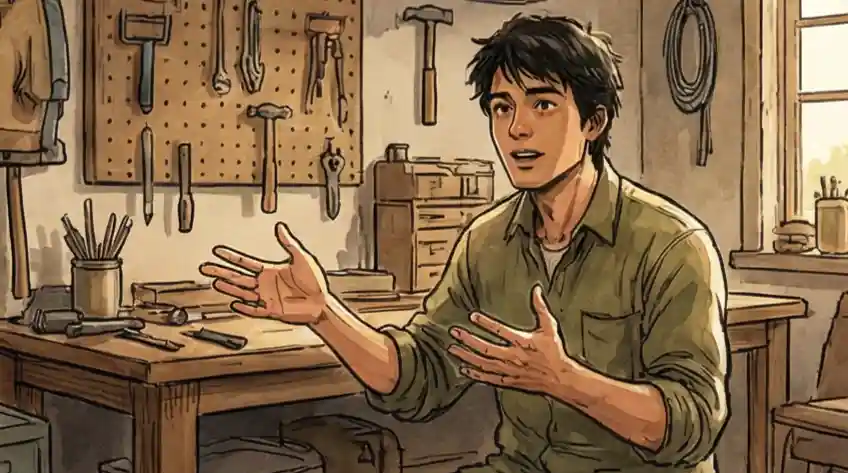
Even in strict jobs like finance or law, your hands should work like a physical whiteboard. If you have three steps, use your hands to "set down" those three steps in the air. This isn't acting. It's practical. When you use your body to make a hard idea simple, people see you as a leader who can explain tough topics to others, not as someone who is over-the-top.
Will gestures make me forget my talking points?
If you practice it right, gestures help you remember. When you link a specific hand movement (like holding up one finger) to a specific part of your talk (like "Point A"), your body creates a physical marker for your words. These physical cues help you follow your own plan because your body is tracking where you are in your argument. Instead of making you think harder, these moves act like a physical map that keeps you and the listener on the same page.
Should I use open or closed hand gestures?
Open palms (facing up or outward) signal honesty, openness, and collaboration. Use these when discussing solutions, compromises, or shared goals. Palms facing down suggest authority and firmness, which works when you need to emphasize a boundary or a final decision. Avoid pointing with a single finger, which can seem aggressive. Instead, use an open hand to indicate direction or reference something.
How can I practice hand gestures before an interview?
Record yourself answering common interview questions on video. Watch the playback and note where your hands naturally emphasize a point. Then, deliberately practice linking gestures to specific ideas (e.g., hold up three fingers when listing three achievements). Repeat this until the movements feel automatic. You can also practice in a mirror or ask a friend to give feedback on whether your gestures clarify or distract from your message.
Do hand gestures vary across cultures?
Yes. A thumbs-up is positive in the U.S. but can be offensive in some Asian and Middle Eastern countries. The "OK" hand sign (thumb and index finger forming a circle) is rude in parts of Europe and South America. Before an international interview, research the cultural norms of the company's region. When in doubt, stick to universal gestures like open palms, counting on fingers, or showing size/scale with your hands.
Focus on what really matters.
Stop thinking of your hands as something you must hide or put on a show with. When you see your hands as tools, you start using the space around you to guide people through your ideas. This turns a regular interview into a lesson in clear communication. By making it mentally easier for people to follow your logic, you stop being another person talking and start becoming the expert who controls the conversation. Prepare your talking points with our interview cheat sheet guide to align your hand gestures with your strongest stories.
See Our ToolsFurther Reading

How to Use Pauses Effectively to Seem More Thoughtful

How to Project Confidence with Your Body Language (Even When You're Nervous)