Key Ideas for Your Career Strategy
-
01
Change from Asking for a Job to Offering a Fix Think of the interview like a meeting where you are a consultant, not someone asking for a favor. Your job isn't just to show you are a good employee, but to prove you are the exact answer to the company's current problems. Clearly link what you've done successfully in the past with what they need fixed now — and the talk shifts from "why should we hire you?" to "how fast can you start?"
-
02
Use Real Numbers Instead of Just Sounding Good Get solid proof by using clear numbers instead of just saying you are great. In important situations, saying "trust me" is weak. Instead, use facts and numbers to show how good you are. Remove extra details and focus only on your biggest results. That way, the person interviewing you gets the most important information about your performance without getting sidetracked.
-
03
Show How Hiring You Lowers Future Risk To keep your job for a long time, people need to see you as someone who won't cause trouble. You do this by talking about your weak spots and showing the "cost of waiting"—the money or time the company loses every day the job isn't filled. When you show that hiring you stops a loss or protects future money, hiring you seems like the safest and best choice for the company.
What Is an Interview Cheat Sheet?
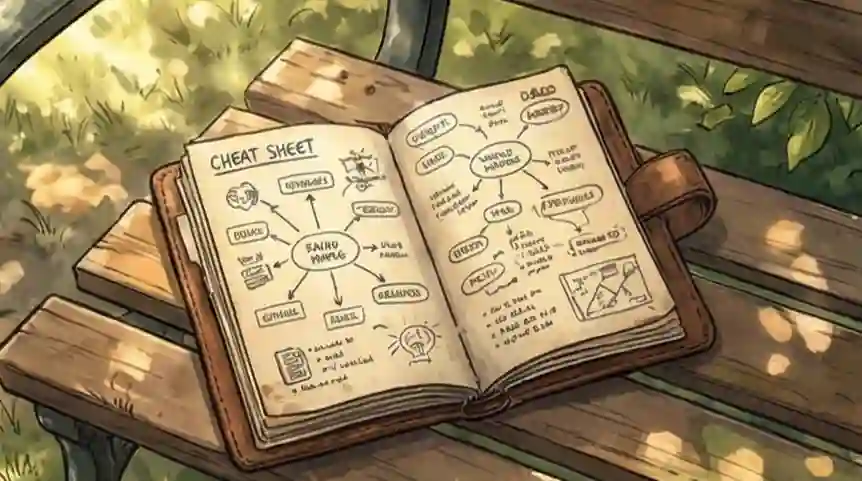
An interview cheat sheet is a one-page reference you bring into an interview — a distilled set of key talking points, specific results, and story cues that keep you focused without reading from a script. It is not a list of memorized answers. It is a set of prompts: a number here, a company name there, a bullet that triggers a full story in your memory.
Most people looking for jobs see an interview guide as just a safety net — a list of strong points and stories to keep them from freezing up when nervous. This is actually dangerous. When you are in a high-pressure business deal where your work is the item being sold, relying on a simple list of facts creates a gap in perceived value. You might be fully capable, but you fail to get the job because your prep work doesn't have a smart plan. According to LinkedIn, 47% of candidates fail interviews because they lack sufficient information about the company — not because of poor skills, but poor preparation.
To get the job offer, you need to go past simple reminders and use a method called Story Design. This changes your notes from just a list of past events to a planned structure of information. Your guide should help you with "Matching Patterns," making sure that every story you tell directly fits the exact business issues the company needs to fix.
You are no longer just recalling your past; you are carefully shaping what the employer thinks your future value will be. This guide moves you from just hoping for a good talk to having a plan for a successful hire. These steps turn your notes into a strong script that proves you are worth it and connects what you can do with what the company needs to succeed.
Checking Your Interview Performance
Use this chart to see common mistakes in how you tell your success stories. Find out which "Type" best describes how you talk about yourself to know what is going wrong and what smart changes you need to make to have a bigger impact.
You list dates, job titles, and simple job duties like reading your past work history out loud.
You are scared you will forget basic facts about your own work history.
The Memory Trigger
Change the focus from "what I did" to "how it created a good outcome."
You tell general success stories that don't match what the company specifically needs.
You focus too much on your own personal "wins" instead of the employer's current problems.
The List of Features
Switch from showing general ability to solving the interviewer's specific issues.
Every answer sounds like a planned fix for the company's future problems.
You are intentionally matching your past results to their future needs.
The Smart Story
Close the "Value Gap" by making hiring you look like a smart choice that brings a good return with low risk.
Seven Smart Tips for Your Interview Guide
As a top Career Coach, I suggest you treat your interview guide not as a memory helper, but as a smart tool for important talks. Use these seven ideas to make sure your planning directly leads to a job offer.
Use your guide to do Pattern Matching by making sure every point lines up with a problem mentioned in the job description. This makes your past successes look like the clear answer to their current needs, so your fit feels certain, not random.
Include real numbers and facts to use Signaling Theory, which uses solid proof to show your true skill. Instead of saying you are "good at saving money," list the exact percentage of time or cash you saved, giving the interviewer clear proof of your high level of work.
Limit your guide to just three main ideas to lower your own Mental Effort during the talk. Keep the paper easy to scan at a glance. That frees your mind to focus on reading the interviewer and keeping eye contact instead of hunting for notes.
Plan your success stories to focus on the final result, using the Peak-End Rule to control how the interviewer remembers you. Research on the Peak-End Rule, developed by Nobel Prize-winning psychologist Daniel Kahneman, shows that people judge an experience almost entirely by its most intense moment and its ending — not the average. Hiring managers form opinions within the first 7 minutes of an interview, so your strongest result should land early and your closing statement should land hard.
Prepare answers for your weak spots that deal with Loss Aversion by showing exactly how you handle and control your flaws. A clear plan for your weak points makes hiring you seem less risky and more like a safe choice for the company.
Put a section in your guide for the ZOPA (Zone of Possible Agreement) to track the overlap between what you want for salary and what the company has in mind for the budget. This lets you keep a clear view of the "win-win" situation, making sure you don't ask for too little or ignore the company's budget limits.
Note down the real Opportunity Cost the company pays for every month this job stays open or is handled poorly. Change the talk to the money lost or projects stopped because you aren't there — and the focus shifts from your "price" to the big value you protect.
Rules for Designing Your High-Value Talks
Situation: Setting the Story Structure in the First "Tell Me About Yourself" Moment
The interview starts with a general request for your history. Instead of listing your jobs by date, you need to use your guide to immediately show how your past serves as the answer to their future needs. If you didn't have time for a full research session, see how to prepare for an interview when you don't have much time.
"I've set up my background around three main ideas that directly match the problems your team is dealing with, like [mention a specific business issue]. While my experience covers many things, my career story has always been about [mention a specific pattern, e.g., turning confusing data into real money]. My guide shows how each part of my past work was actually training to solve the exact 'Type II' issues you are facing right now. Should we start with how my work at [Previous Company] fits your goal for [Current Project]?"
This immediately moves the focus from your past to their future, using your story to show you are the already-chosen fix, not just another candidate.
Situation: "Matching Patterns" Your Success Stories to Solve a Current Business Crisis
The interviewer explains a specific, stressful problem they are dealing with right now. You need to use your guide to cover the "value gap" by showing that what you did before is a clear plan for their future results. The sharper your pre-interview company analysis, the more specific this moment becomes — see how to do a competitive analysis before your interview to build this context in advance.
"That exact challenge is what I was hoping we could discuss. Based on my notes, I've dealt with a similar situation before. At my last job, we had [brief story], but the real value wasn't just fixing the issue—it was building a system to stop it from returning. I have a plan for how I would use that same thinking here to make sure your team doesn't lose speed. Would you like me to quickly explain the three parts of that plan?"
This immediately shows that you take ownership of the solution process, not just the final result. It signals that you know how to find the root cause and create plans that can be used again, which is key for high-value roles.
Situation: Closing the "Value Gap" to Stop Them From Choosing Someone Else
The interview is ending, and you want to make sure your salary request seems fair compared to the value you bring. You use your guide to confirm you've clearly explained your worth so they can confidently decide to hire you. The dynamics shift further when you know who's on the other side of the table — see how to prepare for an interview with your future boss for the specific framing that works with hiring managers vs. HR.
"Before we finish, I want to make sure I’ve given you a clear map of how my skills will create value for your team. We talked about [Point A] and [Point B], but I want to be sure I cleared up any confusion about [Specific Goal]. Based on what we discussed, I see a clear match between my 'Pattern' of [Specific Skill] and your need for [Specific Result]. My goal is to make sure you have all the necessary facts to see me as a top performer who can start bringing value right away."
This final check makes sure there are no doubts left by clearly connecting past success patterns to future, required results, making the salary discussion feel like a simple business exchange.
Make Your High-Stakes Interview Guide Automatic
Automates "Pattern Matching" Job Analysis Tool
Compares your resume with the job details to find "Matching Skills" and "Missing Skills." Get a fact-based list of the company's problems and plan your own "Corrective Actions."
Executes "Peak-End Rule" Interview Prep Tool
Uses the STAR method for powerful stories. Turns your talking points into digital cards so you can reduce "Visual Distractions" and keep eye contact.
Defines "Value Exchange" Career Guidance Tool
Acts as a coach to help you explain the "Cost of Waiting." Justify your salary by proving the big amount of money the company loses by not hiring you.
Common Questions
What if my experience doesn’t match the job description?
When your history doesn’t look exactly like the job, your guide should focus on "Pattern Matching." Instead of listing old job titles, list the specific business issues you solved that happen everywhere, like saving time, cutting costs, or making teams work better.
Link what you successfully fixed in the past to what the company needs fixed now, and you close the "value gap." You aren’t just a candidate with an unrelated past; you are a proven fixer whose skills fit their specific needs.
Won’t using a guide make my answers sound practiced?
The goal of Story Design is not to memorize words, but to create "key points." Your guide should only have simple reminders — one or two words that bring back a specific result or number.
Since you aren’t reading a script, you can stay relaxed and sound natural. This lets you listen better to the interviewer while being sure that your most important points are ready to be used at the right time.
How do I handle skill gaps in my cheat sheet?
Use your guide to turn a skill gap into a chance to show how fast you learn. Instead of stressing over what you lack, prepare a point that shows how quickly you learned a new system or tool in the past.
Your guide should remind you to switch the talk from "Do you know X?" to "Here is how fast I can start getting results when I have to learn something new." This shifts the focus from not knowing something to your strong ability to learn and bring value quickly.
How long should an interview cheat sheet be?
Keep it to one page — or one screen if you’re in a remote interview. The best cheat sheets have three main sections: your top three talking points with one metric each, two or three company-specific problems you’re prepared to address, and a salary range if that topic comes up.
Anything longer slows you down when you need to find information fast. The goal is a quick glance, not a read-through.
Is it okay to look at notes during an interview?
Yes, especially in phone or video interviews. Tell the interviewer upfront: "I prepared some notes so I can give you precise numbers." This signals thoroughness, not weakness.
In person, place the sheet on the table, glance briefly, and return eye contact. The interviewer cares about your answers, not whether you referenced a page.
How do I add numbers without exact figures?
Use ranges and comparisons when exact numbers aren’t available. "We cut the process from roughly two weeks to under three days" is specific enough to be credible. Avoid vague phrases like "significant improvement."
Even an estimate like "saved the team about 30% of their review time" is far stronger than a claim with no numbers at all. Specificity signals that you measured your impact — even approximate figures show that instinct.
Focus on what matters.
Moving from a simple list of memories to a smart story changes you from a candidate who "hopes" to a professional who "proves." Close the value gap. Treat the interview as a serious business meeting, not a memory test. Everything you say will help build your path to your next big job.
See Cruit Tools