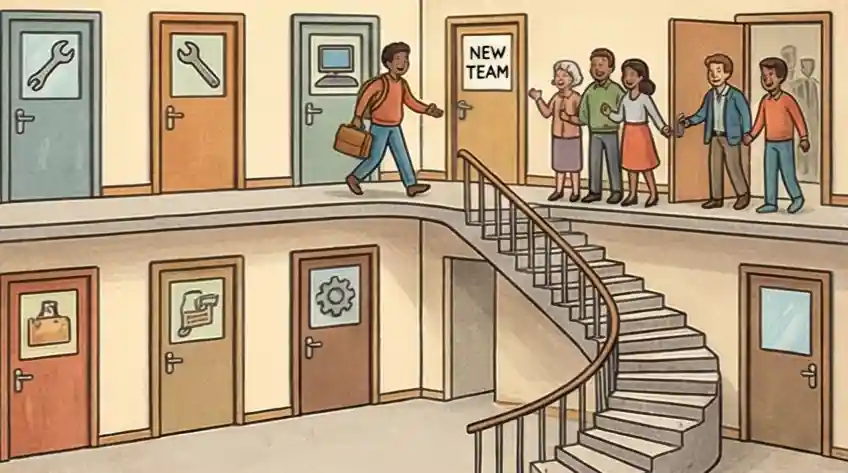
Simple Steps for Moving from Old-School Work to Tech
Don't start at the very bottom of the tech career ladder. Keep your current job type (like HR, Money Management, or Selling) but move it into a tech company. This lets you keep your current pay and rank while getting direct experience in the tech world.
The best thing you have is knowing exactly how people in your current field think and what problems they face every day. By showing you understand the user's real struggles, you become the crucial link between the people writing the software and the people who buy it.
To succeed long-term in tech, you must solve problems. Start by giving specific feedback on how a company's software could serve your industry better. Giving this "free insight" to a team leader makes you look like a smart strategist, making you a top pick who can skip the normal HR interviews.
A Quick Look: Using What You Already Know
Switching to tech doesn't mean starting over. The fastest path in is finding a software company that serves your current industry, then walking in as the person who already understands the customer — not as a beginner trying to learn everything from scratch.
It's a big mistake to think you must start from scratch to get into tech. The idea that you need to go back to school or take a coding course to be useful is old advice that treats your real work experience like something useless.
Falling for this trap creates a painful "Gap in Identity." When you try to restart your career, you end up fighting for entry-level jobs and taking big pay cuts. You get stuck: recruiters ignore you because you are too experienced for the starting jobs, but you don't have enough specific tech skills for the expert jobs. According to LinkedIn, 45% of career changers succeed specifically by leveraging transferable skills from their previous field — not by acquiring new technical degrees.
Your best advantage right now isn't learning to code; it's building a "Connection Path." Instead of changing what you do, change where you do it. The fastest way to tech is finding a company that makes software for your current job area. If you work in shipping, join a company that makes shipping software. You aren't a "rookie" confused by code; you are the "insider expert" who knows the customer's problems better than any programmer. This is your strongest proof of ability.
The numbers back this up. Over half the jobs at tech companies — 54%, according to LinkedIn research — are non-technical roles. There are far more seats at the table than most people realize. The real trick is knowing which door to knock on.
What Does "Switching to Tech" Actually Mean?
Switching to tech means moving into a role at a software or technology company — not necessarily becoming a programmer. Most people misread this as a full career restart requiring coding skills. It isn't. A non-tech-to-tech career transition is the process of taking your current professional skills (finance, healthcare, sales, logistics, HR) and applying them at a company that builds digital products for your industry. The "tech" part is the company, not the job function.
How to Choose Your Path from Your Current Job to Tech
How you move into tech depends on how much time and energy you have right now, and what you want later. As someone who helps hire for tech product jobs, I look at how risky it seems to hire someone new. Here is a chart to help you pick the right level of effort for where you are now.
Level 1: The Basic Start
If you are:
Tools: LinkedIn, basic ways to fix up your resume, normal job websites.
What to do: Change your resume to use tech words and apply to many "starting level" jobs.
Your Quick Goal
This is the bare minimum you must do. It helps job search systems find you. It takes the least work but relies a lot on luck.
Level 2: The Smart Move
If you are:
Tools: Industry certificates (like Scrum Master), online chat groups (Slack).
What to do: Change how you talk about your past non-tech work into tech words (like calling "team organizing" "Project Management"). Talk to people at the companies you like.
Your Quick Goal
Tech managers worry if you "get" how tech works. By using their words and having some certificates, you show you've done your research and can talk the talk right away.
Level 3: Becoming an Expert
If you are:
Tools: A website showing your work, building small apps without code, reading deep industry reports.
What to do: Build a "Proof of Work" portfolio. Solve a real problem for a tech company before you are hired. Talk directly to team leaders with a clear idea of what you can offer.
Your Quick Goal
This skips the normal HR process. By showing a finished project or a deep study of their product, you offer real proof of skill. This changes you from a "job applicant" to a "consultant," often leading to better pay.
Quick Summary
Which path is right for you?
- Pick Level 1 if you have a job now and just want to "check things out" without spending much time.
- Pick Level 2 if you have a certain job in mind (like Sales or Marketing at a software company) and need to prove you understand the tech world.
- Pick Level 3 if you need to switch jobs fast or want to join a top tech company where a normal resume isn't enough to stand out.
The Plan: A 3-Step System for Switching to Tech
To successfully move from your traditional job to tech, you need more than just a new resume; you need a new way to manage your career. Here is The Pivot Plan, a 3-part system to help you connect where you are now with where you want to be.
The Translator Step
Rewording Your Past
Goal: To change your current skills into the words and values used in the tech world.
Action: Rewrite your work story by matching what you did before to outcomes that tech cares about, like "ability to grow" or "making choices based on facts."
The Basics Step
Learning Key Knowledge
Goal: To learn enough about how tech products are made and managed.
Action: Learn the main tools and ways of working—like common project management styles—that tech teams use every day to work together.
The Bridge Step
Finding Overlap Jobs
Goal: To find "mixed" jobs that need your current skills but are inside a tech company.
Action: Aim for starting roles in Customer Support, Sales, or Operations where knowing your old industry is a big plus. Then, work your way closer to the product from the inside.
"The people who make the fastest transitions into tech are rarely the ones who learned to code. They're the ones who found a company solving a problem they've lived with for years — and showed up already knowing the answer."
— Career coach perspective, widely reported in tech hiring communities
Build these three parts in order: first, show your value in tech terms (Translator); second, understand the tech world (Basics); and finally, use your industry knowledge to get an inside start (Bridge). If you're already at a company with a tech arm, read our guide on making an internal career move — it covers a faster path that most people overlook.
The Quick Plan: Turning Roadblocks into Smooth Sailing
This quick plan focuses on fixing common career problems (Roadblocks) with simple, powerful solutions (Smooth Sailing).
The Invisible Resume: You apply for "Beginner Tech" jobs and get turned down for being too experienced or not having a tech degree.
The Vertical Move: Stop applying everywhere. Look for tech companies that build software for your current job field (like if you're in farming, look for "Agri-Tech"). Your industry knowledge becomes your tech experience.
The Restart Waste: You spend months on coding courses or certificates, trying to pretend you are starting over from zero.
The Skill Keep: Keep your current job title but change the company type. Move from being HR at a bank to HR at a software company. You keep 100% of your salary power while joining the tech scene.
The Silent Expert: You feel you can't join in on technical talks because you don't know the programmer's language.
The Customer Expert Edge: Present yourself as the person who truly understands the user. Programmers build the tools, but they don't know the customer's daily pain. Use your "insider" knowledge to help decide what features to build and connect code to reality.
The Empty Message: You send "Can I get a referral?" messages to recruiters and they are ignored.
The Product Tip Hook: Message a Product Manager at a company you like. Instead of asking for a job, give one specific idea on how their software could help your old industry better. This proves your value instantly without needing a resume.
The 48-Hour Switch: Your Start-Now Plan for Tech
This quick plan covers five important things you can do right away to start positioning your current skills for a switch to tech in the next two days.
Check your current work history for "skills you can move." List everything you do that involves managing people, looking at numbers, or making processes better, as these are valuable in tech.
Change your resume into "tech language." Swap out words specific to your old job for general terms—for example, change "planned a meeting" to "handled talks with people involved" and highlight any digital tools you use.
Pick five tech companies that build things for an industry you already know well. If you know about schools, look at "EdTech" firms. This keeps your industry knowledge as your big advantage.
Find three people on LinkedIn who have the job you want. Send a short, friendly message asking for 15 minutes to hear what skills they use most, instead of asking for a job right away.
Start a small learning project to prove your interest. Sign up for a free basic class in data, coding, or digital marketing, and immediately add "Learning In Progress" to your profile to show employers you are trying to learn.
Get Better with Cruit
Exploring Your Job Path
The Fix: Forgetting Your Past SkillsChecks your resume for "hidden" strong points and gives you a clear plan for switching roles while keeping your high value.
Networking
The Fix: Getting Ignored When You Reach OutHelps write friendly messages using the "Product Idea Hook," letting you prove you are an expert without asking for a job first.
Job Reading Tool
The Fix: Resume Going NowhereCompares your resume to the job listing, points out your "Expert Edge," and gives you a step-by-step guide to fix any missing skills.
Common Questions
Should I accept a lower salary to switch from a senior role in another field to tech?
No. If you take a big pay cut, it means you are trying for beginner jobs that don't value your background.
To keep your salary high, use the "Industry Link." Apply to tech companies that serve your current field. You aren't a beginner hire; you are an expert in that field. A company making finance software will pay more for a former banker who knows how money works, while a general software company will just see you as someone without tech experience.
What do I say when recruiters tell me I "don't have tech experience" in an interview?
Change the topic from "tools" to "problems." When a recruiter points out your lack of tech skill, they worry you won't understand their product.
Answer by showing your "insider knowledge" of their customers. Explain that even if you haven't coded, you have personally experienced the issues their software is meant to fix. Present yourself as the "Voice of the Customer" who can guide the engineers to build things that truly help, saving the company time and money on bad ideas.
Should I still do a coding course just to prove I am "serious" about tech?
Only if you truly want to become a programmer. If your goal is a role in business, sales, or operations, a course often confirms the "Start Over" idea, making you look like a beginner instead of an experienced professional.
Instead of learning to code, learn the "business basics" of tech — how different systems connect, how a product roadmap is created, how agile teams work. This lets you speak the language without giving up the valuable experience you already have.
How long does it take to switch from a non-tech role to a tech company?
With a focused approach, most people land their first tech-company role within three to six months. The timeline shortens dramatically when you target companies in your own industry rather than applying broadly.
Employees with a clear transition plan are twice as likely to succeed, according to career research. The 48-hour action plan in this article is your starting point — five concrete steps you can take this week without quitting your current job.
Is it better to apply to a startup or a large tech company first?
Startups are usually the better first move for non-tech professionals. They hire for versatility and domain knowledge over credentials. A 10-person EdTech startup needs someone who actually understands schools — a large tech company might filter you out before a human ever reads your application.
Once you have 12 to 18 months of tech-company experience on your resume, the larger companies become much more accessible.
What non-technical roles exist at tech companies?
More than half of all jobs at tech companies are non-technical. Common entry points include Customer Success, Sales, Account Management, Operations, HR, Marketing, and Product Support.
For people with deep industry knowledge, roles like "Solutions Consultant," "Industry Specialist," or "Customer Onboarding Manager" are particularly well-suited — these jobs exist specifically because the company needs someone who can translate between the software and the people using it in the real world. You can also explore making an internal move within your current company into a more tech-adjacent team as a lower-risk first step.
Focus on what brings value.
The shift that matters isn't learning a new skill. It's changing how you see the value you already have. You don't need to forget your past to get into tech — you need to find the tech companies that need it. Target software companies in your own field. Walk in as the person who understands the customer better than any programmer on their team. You're not a beginner starting from nothing. You are a seasoned professional with inside knowledge the software company is paying to acquire. Find those companies today, and reach out as the expert advisor you already are.
Start Linking Up