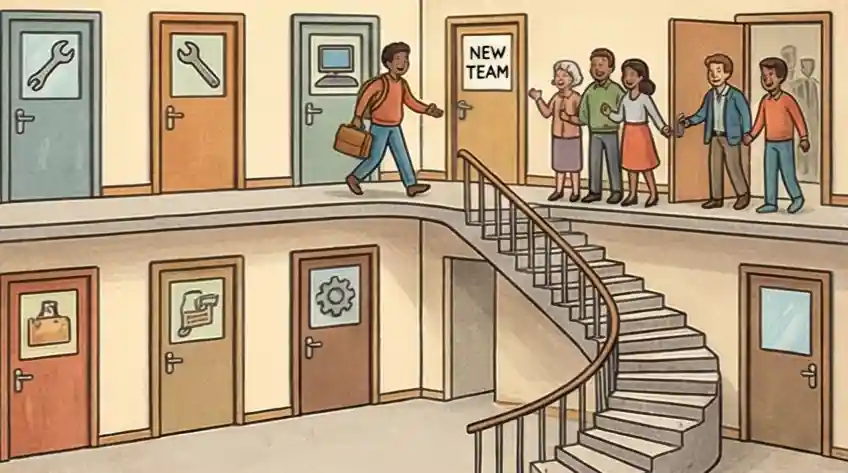
What You Need to Remember
The Change: Instead of asking for a new job (which is just doing tasks), find a big business problem and suggest how you can fix it (which is being strategic). Don't wait for a job opening; show them how creating this new role will actually make the company more money.
The Change: Forget who has the hiring power. Instead, track how important work moves between your department and the one you want to join. Understand these connections so you can become the essential link between them, not just another person trying to switch teams.
The Change: Less experienced people just do what they are told; experts solve problems before they are even assigned. Start solving small problems for the team you want to join, even while you are still in your current role, to prove the value of your move beforehand.
The Change: Instead of just finding one person to recommend you, build a group of internal advocates across different teams. Your goal isn't just to prove you have skills—it's to make sure leaders in various departments see your move as something the company needs to grow.
The Change: A big reason internal moves fail is that you are too important where you are right now. Stop keeping all the knowledge to yourself; automate and teach others your current duties. A true expert knows they can only move up once they have successfully trained someone else to do their old job.
Moving Jobs Inside the Company
An internal career move is when an employee switches to a different role, team, or department at their current employer — without leaving the company. It can be a lateral shift to build new skills, a promotion within a different function, or a full pivot to a new department. Unlike an external job search, internal moves rely on existing relationships, company knowledge, and strategic positioning rather than a traditional application process.
Moving to a new role inside your company is not like looking for a job outside. It's a strategic business move where you try to gain an advantage within the organization. Many employees act like they are applying externally, sending resumes through the HR system and waiting for permission to switch desks. This is a bad strategy. It makes your current boss think you are planning to leave, and it makes your new boss worry you will be a slow learner. You are asking for a favor instead of offering a solution.
The data backs this up. According to LinkedIn's 2024 Workplace Learning Report, only 19% of employees are encouraged by their organizations to explore internal role changes — yet 43% say they want to move into a new role in a different department. That gap means most people who want to move internally are on their own. The ones who succeed don't wait for the system to help them.
To succeed, you need to use a three-level plan instead of the usual way of applying.
- Skill Transfer Proof: Show that moving you won't cause any drop in work quality.
- Connecting Value: Become the human bridge between different teams to solve problems that current people can't see.
- Using Influence Wisely: Find the projects that have the most attention from top leaders and move into them before everyone else realizes those projects are important.
This is about getting the best position for yourself, not just finding a new chair.
To do better than the standard approach, you need to change from someone who just finishes tasks to someone who checks the whole system and finds weak spots. If you are also preparing for the interview that comes with your move, see our guide on preparing for an internal interview at your current company.
Checklist: The Internal Advantage Guide
This check helps you see if your move is viewed as a problem to be managed (like a normal transfer) or a smart play to take advantage of opportunities (Strategic Advantage). See if your approach looks like a risk or an asset.
| Area | Warning Sign (Stage 1) | Good Sign (Stage 3 Mastery) |
|---|---|---|
|
How You Show Success
|
Warning Sign
You point to your high marks ("Exceeds Expectations") in your current job. You think doing well for your current boss means you deserve to move to a new team. Doing great in your current small area, assuming that's enough.
|
Good Sign
You show exactly how much trouble (cost/time) your move will stop for the whole company. You prove that by being in the new spot, you make both Team A and Team B work better overall.
|
|
Who You Talk To
|
Warning Sign
You wait for an official job ad or ask HR about your "career plan." You try to get your current manager to agree to the move by appealing to their good nature. Waiting for HR or hoping your current boss says yes.
|
Good Sign
You have already unofficially helped the new team as a "helper" or "consultant." The leader of the new team sees your move as making something official that is already working in the background.
|
|
What You Say
|
Warning Sign
Your pitch focuses on "how excited you are," "new chances," or "wanting to grow." This tells leaders the company has to train you while losing an expert in your old job. Talking only about your personal desire for a new role.
|
Good Sign
You present the move as "Stopping a Problem." You use your inside knowledge to solve a big issue that an outsider would take six months just to understand. You are being "sent" to protect a key goal, not just "moving."
|
|
Future Plans
|
Warning Sign
You move to teams that are big or seem important now ("Cash Cows"). These teams might not be getting much new attention or budget from the top leaders anymore. Chasing big, safe departments that might be past their peak.
|
Good Sign
You follow where the CEO's "unplanned time" is going and where the company is putting new money. You move to where the real change and new value are being built, not where the old value is just being protected.
|
Scoring Your Strategy
- Result 1 Mostly Red Flags: You look like a Risk of Leaving. Your move might get stopped, or you'll have to do favors for people to make it work later.
- Result 2 Mixed Results: You are a Standard Mover. You can move, but everyone will expect you to start from scratch in terms of trust and respect in the new area.
- Result 3 Mostly Green Flags: You are an Internal Advantage Player. The company sees your move as necessary, and you might even get a raise or better stock options disguised as a simple role change.
Stage 1: Meeting the Basic Rules
In this first step, your move depends entirely on Rules and Paperwork. You are not negotiating; you are just meeting the Strict Requirements. If you fail even one of these basic checks, the system will stop your application before any person even looks at it. Success here is simple: either you pass or you are out. Research by SHRM shows the average cost per hire is $4,700 (SHRM, 2023) — which is exactly why most companies protect the internal transfer process with hard eligibility gates. They need to know the investment is worth it before they start the paperwork.
Performance Review Check
What you need: You must have a rating of "Doing what is expected" or better in your last two reviews. Why it matters: Moving people internally is usually only for proven employees. If you have a bad record, they see you as a headache waiting to happen, and the new team will reject you to protect their own output.
Time in Role Rule
What you need: Check the rules and make sure you have been in your current job for the required time—usually 12 months—before asking to move. Why it matters: The company needs to see they got their money's worth from training you in the first place. Trying to leave early looks like you don't stick with things and HR will block the move to stop people from jumping around.
Telling Your Boss
What you need: Tell your direct boss about your plan to move before you send any official internal application. Why it matters: Companies follow the chain of command. If your boss finds out about your application only after it’s sent, they see it as a sign of not being honest. Your boss can stop the move by saying you are needed where you are or that it’s too risky for the team.
The Pro Move (Mid-Level to Senior)
At this level, people assume you know your job. To move, you have to stop trying to get the job and start acting like you are the fix for a big problem. You aren't "applying" for a new role; you are finding a process breakdown that costs the company time or money, and you are saying you can solve it by moving.
Business Effect: How Much Trouble Are You Stopping?
Don't focus on what you want to learn; focus on the money or time the business is losing now. Find a specific goal that is stuck and show with numbers how moving you to that team will speed up their results directly.
They say:
"We need someone more experienced."It means:
They need someone who can handle the job without constant checking. They are scared you will waste time learning. Prove you can start delivering results on Day 1 by fixing an old issue they have ignored.Work Maturity: Making Things Reliable
Internal moves often happen because a department is growing too fast (which means it's disorganized). Offer your move as a way to improve how things are done. Show how you can create the standard steps, notes, and procedures needed to make their current fast growth steady.
They say:
"We need someone who fits the culture."It means:
They need someone who won't mess up the fragile systems they currently have. They want someone who can bring order to a team that has a lot of energy but often delivers uneven results.Team Context: Be the Translator
The best internal people are the ones who can speak both sides of the conversation. If you move from, say, Sales to Operations, use what you know about Sales pressures to help Operations meet their needs better. You become a bridge, not just a new person, ending the arguments between teams.
They say:
"These teams aren't working well together."It means:
There is a breakdown in how people talk, causing problems. They need a "Bilingual Leader" who understands both sides to stop the blame game.Mastery (Top Level Moves)
When you are at the top, the idea of a "job description" disappears. Moves at this level are not about filling open spots; they are about giving you a mission. You aren't selling your ability to do work; you are selling your ability to manage company money, stop big company risks, and create real financial returns. At this stage, your move is seen as a necessary change in how the company's leadership structure works. LinkedIn data shows internal mobility is up 30% since 2021 — but managers and senior staff are twice as likely to make internal moves as individual contributors (LinkedIn Talent Solutions, 2024). At the top level, you aren't competing with your peers. You're negotiating with the org chart itself.
Using Your Trust and Influence
A move at this level rarely comes from a job application; it comes from agreement among the top leaders and board members. To switch, you need to use the trust you’ve built inside the company to connect different groups that aren't working together. Your move should solve a major structural problem that only you, because of your history and trust, can handle. You aren't asking for a title; you are offering to fix a huge issue by moving your influence to the right spot.
Playing Offense or Defense
Look at what the company is focused on right now. If the company is in "Defense Mode" (cutting costs, changing structure, dealing with legal issues), your move must be framed as reducing risk—making unstable departments steady or making internal processes more efficient. If the company is in "Growth Mode" (buying other companies, entering new markets), frame your move as the main way to bring in more money. Being a Master means knowing which goal the CEO cares about most and showing how your new role will drive that specific goal.
Making a Plan for Who Takes Your Old Job
The biggest roadblock for a top leader moving is the fear that the company can't run without them. Mastery means planning ahead for your succession. You must show that you have developed a strong leadership team under you that can keep—or even beat—your current results. By providing a clear plan for replacing yourself, you remove the risk of your leaving and earn your freedom to move into a high-value, strategic area.
Get Better at Internal Pivots: Use Cruit
These tools work for any kind of internal pivot. If you are also thinking about a bigger shift — like moving from a non-technical background into a tech-focused role — see our guide on how to move from a non-tech role into a tech company.
To See Clearly
Career PlanningFinds your hidden skills that you can use in other roles, showing you the best internal paths by looking at everything you have done.
To Build Connections
NetworkingHelps you come up with smart things to say and write respectful messages to get those important internal chats with people in other teams.
For Interview Prep
Job Check ToolCompares your current experience against the new role and gives you a clear list of things you need to fix or show proof of before you even talk to anyone.
Quick Answers About Moving Inside
Will my current manager think I'm disloyal if I try to move?
The "traitor" feeling only comes if you act like you are running away from your current boss instead of moving for the good of the company. If you use the Internal Advantage Guide, you can show how your new job will actually help your old team—maybe by making sure handoffs between teams are smoother or by having a friend in a key spot in another department.
How do I cover the fact that I lack experience in the new job area?
The risk people see in you is that you will take time to become productive. You fix this by focusing on Step 1: Proving you can do the job right away. Don't ask for time to learn; show proof you are ready on Day One. Find out what results the new job needs and create a small test project using your current access to company data. When you can show the hiring manager you have already done 20% of the job before you even have the title, the lack of experience doesn't matter.
Should I wait until there is an official job posting before I talk to people?
Waiting for a job ad is a reactive move that puts you in a race against every other employee. Real internal advantage comes when you find important projects and talk to the right people before a job is even officially open. This lets you help shape what the job description will look like. By the time it is posted, you won't just be an applicant; you will be the clear choice.
How long do I need to stay in a role before requesting an internal move?
Most companies require at least 12 months in your current role before you can apply internally, though some require up to 18 months. Check your employee handbook first. The rule exists because the company needs to see a return on the time it spent training you. If you are under the minimum, focus on Stage 1 work — building visible results and identifying the team you want to join — so you are ready to move the day the window opens.
Is it better to move laterally or aim for a promotion when switching internally?
It depends on your goal. A lateral move into a high-growth team often leads to faster advancement than staying put and waiting for a promotion in a mature department. If the team you want to join is expanding fast and gets leadership attention, a same-level move there can leapfrog you ahead of people who have been chasing the title in a slower area. Look at where the budget and the CEO's focus are going. That matters more than the level on the org chart right now.
What if my manager refuses to approve my internal transfer?
A manager who blocks your move is usually worried about their own team's output, not yours. Address this directly: have a plan ready for who can cover your work and how you will hand off your responsibilities before you even raise the conversation. If your manager still refuses after that, you can escalate to HR and ask about the formal transfer process. Document your eligibility, your performance record, and the steps you have already taken. Most companies have a process that lets employees move even when a manager objects, as long as the employee meets the hard eligibility requirements.
Does switching roles internally affect my salary?
Lateral internal moves often come with little or no salary change unless you negotiate. The best time to negotiate is when you can show the new team a clear business case — not just that you want the role, but that hiring you internally avoids the cost of an external search. The average cost to replace an employee externally is $4,700 in direct costs alone (SHRM, 2023), and that does not include the ramp-up time. When you make that math visible to the hiring manager, your leverage increases. Framing the conversation around value saved — rather than a personal request for more money — tends to land better.
Focus on what helps you advance.
Cruit helps you think like a strategist, giving you the data and the roadmap you need to successfully move inside your company and get the best value for your career.
Start Smart Moving Now