What You Should Remember
-
01
Move Faster By Focusing If you stop doing things that don't matter, you will get to your main goals much faster. This simple rule makes sure your daily work helps you grow your career quickly and see results right away.
-
02
Be Stronger By Auditing Checking how you spend your time creates a solid base that helps you stay calm and get work done even when things get stressful. This built-in steadiness protects your time and lets you bounce back fast when things change unexpectedly.
-
03
Get More Value From Extra Effort When you take back time you were wasting, you can put your extra energy into the projects that matter most. This means the time you thought was lost now creates big wins that leaders will notice.
-
04
Improve By Remembering What Happened Keeping track of your time builds a personal history of what works and what doesn't. This stops you from making the same mistakes over and over, making sure you always move forward instead of wasting effort on problems you already solved.
What Is a Time Audit?
A time audit is a structured review of how you actually spend your work hours over a set period, typically one to two weeks. You record what you do, when you do it, and how long it takes, then compare that reality against where you intended to spend your time.
Most people are surprised by what they find. The point isn't to optimize every minute but to spot the patterns draining your focus — the recurring meetings that could be emails, the admin work eating into your peak hours, the context-switching that adds up to hours of lost productivity each week.
The Calendar Lie
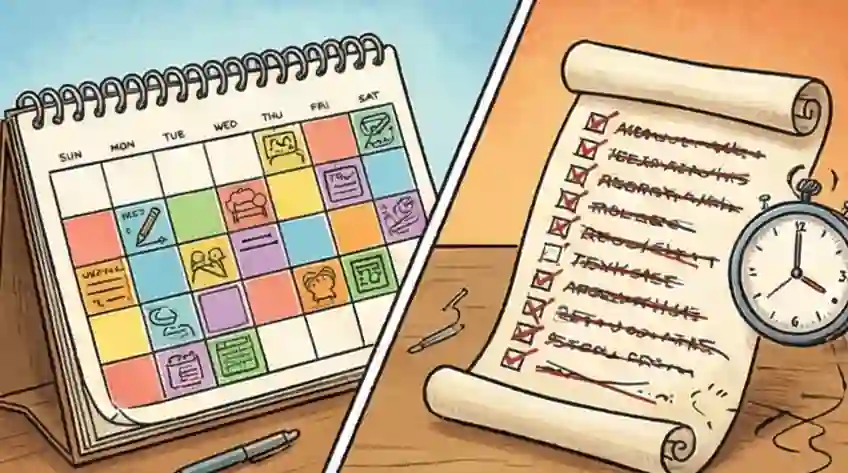
Most people use their schedules just to hold things, trying to pack them full and squeeze every moment. This is the wrong way to think about how people actually get things done. We have automatically started believing an old myth that treats the human mind like a factory machine, assuming that any empty space in our day is just lost supplies that need to be filled up.
This way of thinking causes a big problem. When you try to record every single minute, you pay a high price with your focus. According to the Hubstaff 2026 Global Benchmarks Report, which tracked 140,000+ workers across 17,000 organizations, the average employee gets just 2-3 hours of genuine focus time per day. Your day turns into many small, broken periods that aren't long enough for real, important work. You are building up "Career Debt" — where you spend more mental energy keeping track of tasks and switching between them than you do actually working.
If you keep treating your time as only 15-minute slots, you are holding back your chances for big success later on.
The Change You Must Make
To stop getting burned out, you need to change how you check up on your daily life.
- You need to track the importance of your tasks, not just how long they take.
- To get your best work back, you must focus on "saving your energy" instead of "finding time."
- Success isn't about having a full schedule; it's about the time you save for working without interruptions on things that truly matter.
Once you've identified where your time actually goes, the next question is how to structure what remains. Time blocking and task lists work very differently — understanding which fits your workflow is the practical next step after a time audit.
How to Run a Time Audit in 5 Steps
Run your audit for five consecutive workdays. That's long enough to surface patterns without becoming a burden. Here's the process.
Set up a simple log
Open a spreadsheet or use a free tool like Toggl or Clockify. Create four columns: Time, Task, Category, and Energy Level (high/low). Don't overthink the setup — a plain text file works too. The goal is a frictionless log you'll actually maintain for five days.
Track in 30-minute blocks
Set a recurring alarm every 30 minutes. When it goes off, spend 20 seconds writing down what you just worked on. Don't log what you planned to do — log what actually happened. If you spent 25 minutes on email and 5 minutes in a Slack thread, write that down. Accuracy matters more than tidiness.
Categorize every entry
At the end of each day, tag each entry with one of three labels: High-Value (work that directly moves your main goals), Maintenance (necessary but not growth-producing, like admin or routine emails), or Low-Value (meetings you didn't need to attend, reactive tasks, time spent context-switching). Be honest. Most people discover that Low-Value fills 25–40% of their week.
Analyze the results on day 6
Total the hours in each category. Then look for two patterns: where does your highest-energy time go? (if most of your morning goes to email, that's the core leak) and which Low-Value blocks repeat daily? (recurring 20-minute gaps between meetings, daily status reports, check-ins that could be async). These repeating patterns are your highest-leverage targets.
Make one structural change
Don't try to fix everything. Pick the single biggest leak and redesign that part of your day. If scattered meetings are breaking your focus, consolidate them to two days. If email is eating your mornings, set two fixed windows for it and close the app otherwise. One structural change, consistently applied, outperforms ten small tweaks you abandon by Friday.
Work Check-Ins: Signs of Trouble and How to Fix Them
The Trap of Tracking Every Detail
You spend your whole day carefully writing down every 15-minute block in a spreadsheet or tool, but you feel like you are falling further behind. At the end of the week, you have a perfect log of your time but zero progress on your most important projects.
By treating your mind like a machine on an assembly line, you are paying a high "Focus Cost." The mental effort needed to constantly stop working, record what you did, and then start again uses up the very focus you need to finish the work.
Track How Hard Tasks Are, Not How Long They Take
Stop tracking minutes and start tracking how complex tasks are. Figure out your "Best Thinking Time"—the two to four hours when you have the most energy—and move all your tough problem-solving into those blocks, ignoring the clock for everything else.
Work Broken Into Small Pieces
Your schedule is filled with tiny gaps of 20 or 30 minutes between meetings. You try to use these "free minutes" to get work done, but you usually end up just checking emails or staring because the gaps are too short to start anything important.
These tiny, broken periods aren't long enough to overcome the "cost" of switching your brain from a meeting to a focus task, leaving you looking "busy" but not getting much done. Research by Gloria Mark at the University of California, Irvine (2008) found it takes an average of 23 minutes and 15 seconds to fully regain focus after an interruption — making those "quick gaps" between meetings almost worthless for deep work.
Create Safe Zones and Low-Energy Zones
Group your meetings together to create bigger, uninterrupted "Safe Zones" for deep work. Treat any gap shorter than 60 minutes as a "Low-Energy Zone" only for simple tasks like filing receipts or deleting junk emails.
The Mistake of Treating All Time the Same
You clear your schedule for three hours late in the afternoon to "get things done," but you feel too mentally tired to do anything useful except simple data entry. You get annoyed that you have the time but no mental power left to use it.
You are treating every hour as equal. In truth, your "mental fuel" runs out during the day; an hour at 4:00 PM is not as valuable as an hour at 9:00 AM. The Hubstaff 2026 report found that managers and team leaders average just 27% of their hours in genuine focus time — the people most responsible for high-stakes decisions are the ones with the least protected deep work.
Rate Tasks by Importance, Not Time
Check your tasks based on how "heavy" they are, not how long they take. Put your hardest, most mentally draining work into your best energy times, and save "light" work, like routine emails, for the times of day when your focus naturally drops.
The Time Check-Up Scorecard
When I work with managers, I see that the difference between someone who is highly effective and someone who is just stressed isn't the amount of work they have, but how they keep track of their time. Most people can't see where their value is actually being made. They are "time-blind." A time check-up is the tool to help you move from constantly reacting to having a high-impact plan. Use the chart below to see where you are now and where you need to move.
Sorting Tasks
Everything feels urgent; you spend your day reacting to the loudest demands.
You know which important tasks need protection, and you push away or remove low-value work.
High-priority projects move forward; reactive busywork drops off your plate.
Planning
You rely on a to-do list that never ends, making you feel like you are always behind.
You use a schedule where every big task has its own dedicated, realistic time slot.
You end the week with concrete deliverables finished, not just tasks checked off.
Protecting Time
Quick questions and pop-ups control the flow of your day, making you switch tasks constantly.
You group your emails and quick questions into set times; "Deep Work" sessions have no interruptions.
Deeper, higher-quality output on the work that gets you promoted.
Energy Check
You try to do hard, creative work late in the day when your focus is already low.
Your hardest tasks are scheduled during your best focus times; easy tasks fill the gaps when your brain is tired.
You produce stronger work with less effort, and leave the day with more energy.
How You Measure Success
Success is based on how busy you felt or how many emails you cleared.
Success is based on real progress on 1-3 main goals that truly move the company forward.
Managers notice what you actually ship, not how many hours you looked occupied.
The Tricky Parts of Checking Your Time
Since I focus on managing risk, I always look past the easy promises of productivity tricks. While checking your time is a great way to see clearly, it's not a perfect process. It brings its own dangers that can actually make your output worse if you aren't careful. Here are the main problems where a time check-up usually fails.
"Our data proves that teams aren't failing at productivity — they're working in systems that constantly disrupt focus."
— Jared Brown, CEO of Hubstaff
The Tracking Cost (Too Much Paperwork)
To record what you are doing, you have to stop doing it. This creates a hidden cost called "overhead." If your tracking system is too detailed, the work of recording your time actually steals time from the hours you are trying to save. This method fails if tracking your time takes more than 5% of your day.
The Focus Vacuum (Work Fills Up Space)
The biggest danger when you "find" extra hours is thinking you will automatically use them for important work. In many offices, if you find two free hours, that space will just get filled with more useless meetings or small tasks. You must check the value of the task, not just the time it takes.
When Creativity Needs Room (The "Too Rigid" Trap)
Time checks assume every hour is the same for production, but big growth often comes from unplanned moments—like sudden ideas, useful talks, or thinking time that doesn't fit a category. Focusing too much on "wasting time" might cut out the necessary "blank space" needed for new ideas.
To fix these problems: For the tracking cost, only track deeply when you think there's a problem, aiming for "good enough" data. For the focus vacuum, set specific Deep Work goals for the time you save before other things fill it up. For rigidity, allow for some "Useful Downtime," knowing that a schedule that is 100% perfect is 100% breakable. A time check-up is a tool for finding problems, not a way to live your life; use it to fix leaks, then stop checking constantly. If your audit reveals that your focus keeps breaking down in short bursts, structured work intervals can help rebuild the habit.
Main Tools for Checking and Fixing Work
Fix for the "Endless Loop" Sign
Resume ToolStop guessing about what to write and let AI turn your general job duties into clear, powerful statements about what you achieved.
Fix for "Can't Start Reaching Out"
Networking GuideUse the guide to help you brainstorm what to say and draft personal messages, turning networking from something you dread into a managed strategy.
Fix for "Too Much Paperwork"
Job Tracker DashboardUse the visual dashboard to instantly see where your job search time is actually going, instead of just guessing.
Common Questions
What is a time audit and how does it work?
A time audit means tracking how you actually spend your work hours over one to two weeks, then comparing that to where you intended to spend your time. You log your tasks as you do them — noting what the work was, how long it took, and whether it moved your main goals forward.
The goal isn't to account for every minute. It's to find the patterns: recurring interruptions, tasks that take longer than expected, and blocks of time that look busy but produce nothing.
Is tracking my energy just another kind of time tracking?
Not really. Tracking time usually means logging every 15 minutes, which often creates more stress than it solves.
Energy mapping is simpler. You figure out which tasks feel "hard" (need deep thought) and which feel "easy" (emails, filing). Instead of watching the clock, you align your hardest work with the hours when your brain is sharpest.
How do I protect focus time when I have back-to-back meetings?
You don't have to clear your whole morning. Start by protecting just 90 minutes during your best energy time. Block it on your calendar as "Deep Work" or "Focus Time" and treat it like a meeting you can't move.
When you show your team that you produce better work during these protected periods, it gets easier to ask for more. The goal is to shift from "always available" to "reliably effective."
What should I do with the small urgent tasks that keep showing up?
The point isn't to ignore small jobs but to stop them from interrupting your important work. Group "low-energy" tasks, like answering quick messages or organizing files, into a one-hour block in the afternoon when your focus naturally drops. This prevents what productivity researchers call "focus drain": the steady depletion of your cognitive reserves by tasks that don't require them.
How much time do people waste on email each week?
More than most people expect. The McKinsey Global Institute found that knowledge workers spend an average of 28% of their workweek managing email — roughly 11 to 12 hours for a standard 40-hour week. A time audit almost always reveals that email is eating into time that should belong to high-value work. Once you see the actual number, it becomes much easier to set boundaries around when you check it.
Taking Back Your Focus
The "Busy Myth"—the old idea that you can be perfectly optimized by shoving work into every 15-minute gap—is finally over.
You don't have to feel like a "robot worker," constantly filling time slots while your real energy disappears. Work with your brain's natural rhythm instead of against it, and you'll stop fighting the clock.
The first step is easy: Tomorrow morning, find your best two hours of clear thinking and protect them. Everything else can wait for the "Low-Energy Time." Stop managing by demanding; start leading by design.