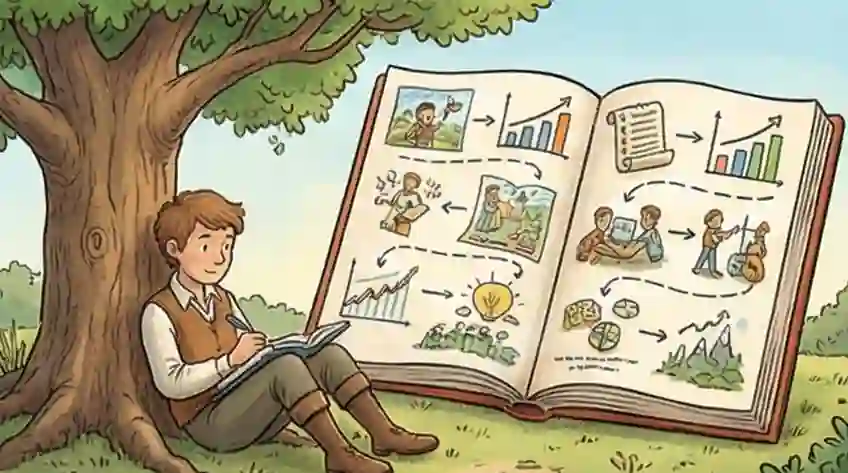
How to Manage Your Career Intelligence
Don't wait until you need a job to remember what you achieved. If you only check your history every three years, you forget most of what made you valuable. Write down one success or one tough problem you solved every Friday. This keeps your career history fresh and useful.
Computers can track what you did; only you know why you did it that way. Don't just say you finished a project. Explain the messy office issues you handled, the small details, or the hard choices you made. This turns simple work into your own unique methods that machines can't copy.
Take ten minutes once a month to read over what you wrote. Look for things you keep struggling with or hidden strengths you always use. By looking at your work from the outside, you switch from just reacting to analyzing, which helps you learn twice as fast.
Think of your journal like a savings account for your knowledge. Every entry is a deposit into your personal system of how things really get done. When you change jobs, you start with a proven set of plans, which makes you more valuable right away.
As someone who helps executives perform better, my goal is to help you stop just "working hard" and start building something valuable. Your career is not just a list of places you worked; it's a collection of your best insights.
Managing Your Career Asset
The biggest mistake professionals make today is letting their best work vanish the moment they finish it. A career journal fixes this. Most workers follow an old approach where their achievements get thrown away. They only look back at what they’ve done when something bad happens, like losing a job or starting a new search, then scramble to pull together a resume that shows only the surface of their skills. Waiting until you’re forced to reflect is a trap. When you don’t review your growth often, you lose nearly all the small successes and problem-solving moments that show your real worth.
We are moving to a time where you aren't just paid for what you create. Since machines can now handle basic tasks, the job market pays more for how you think. Your real value comes from your unique thinking—the special way you handle tricky situations and lead when things are uncertain. To succeed now, you must stop seeing your daily tasks as simple work that gets thrown away and start seeing them as an asset that grows over time.
The new currency in the job world is Information with a Story. A career journal turns your work life into a constant learning system. You go from doing your job when asked to actively owning your knowledge. This habit builds a record of proof that shows your value in a way a normal resume never can.
What Is a Career Journal?
A career journal is a written record of your professional experiences: the problems you solved, decisions you made, lessons you learned, and wins you earned. Updated regularly, it turns your daily work into documented proof of your skills and judgment.
Unlike a diary, a career journal is not about feelings. It captures the how and why of your work: how you handled a difficult client, why you chose one approach over another, what you would do differently next time. This is the data that builds a career, and the kind no AI system can generate for you. According to research by Harvard Business School professors Giada Di Stefano and Francesca Gino, workers who took structured time to reflect on their work improved their performance by 22.8% compared to those who kept working without pausing to reflect.
How Your Career Changes: From Tracking Tasks to Building Knowledge
The main idea changes from seeing your career as a fixed list of things you finished to actively building a growing asset of your personal knowledge and special ways of solving problems.
Main Goal: Saving Tasks: Treating your career like a list of jobs done, only updating it when you must.
When You Look Back: Only During Events: You only think about your work when something forces you to, like losing a job or looking for work.
What You Focus On: What You Made: Looking at basic jobs and titles, which computers can now do.
Long-Term Result: Forgetting Stuff: You forget 90% of your small successes and skills, so your growth stops.
Main Goal: Growing Knowledge: Building a bank of personal insights that capture how you lead and think.
When You Look Back: All the Time: Daily notes turn simple work into permanent knowledge you own.
What You Focus On: Your Unique Methods: Focusing on the "how" (the special ways you solve hard problems).
Long-Term Result: Learning About Your Own Thinking: A permanent system that builds high-level skill faster than just having more time on the job.
The Personal Intelligence System
This plan is made to change your career journal from just a diary into a high-value asset. It moves you from just writing down events to actively building up knowledge by treating your daily work as data for a bigger system.
Step 1
The daily habit of writing down small successes and problems you faced at work. This stops you from forgetting things by capturing small details as factual starting points.
Step 2
A weekly review to look at the "why" behind your choices and spot repeating ways you solve problems. This turns on your self-awareness, making you strategic instead of just reactive by finding patterns in how you work.
Step 3
The act of turning your recorded experiences into usable guides and personal systems that show what you are worth professionally. This changes simple work into lasting knowledge.
These three steps, writing down events, checking your logic, then turning findings into your unique guide, shift your market value from "what you did" to "the unique way you think." That shift is what makes your skills hard to replace. Pair this system with proven motivation strategies to stay consistent long-term.
The Tools for Your Personal Intelligence System
Part of the System The Story Log
Journaling Tool: Where you enter daily notes to record wins and problems, stopping the "Memory Loss."
Part of the System The Logic Check
Career Guide Tool: Uses an AI Mentor to ask smart questions based on what you write, helping you think about your goals and choices.
Part of the System Your Special Asset
Interview Tool: Takes the history you saved and shapes it into clear stories (like the STAR method) to use as strong talking points.
Common Questions About Career Journaling
How can I start a career journal when I'm too busy?
You don't need hours; you need five minutes. Short notes, just one success and one challenge at the end of the day, stop memory loss before it starts. Harvard Business School research found that workers who reflected on their work improved performance by 22.8% compared to those who kept working without pausing (Di Stefano, Gino et al., HBS Working Paper).
Consistency matters more than length. Capturing small moments daily saves you many hours later when you need to recall achievements for a raise or a new application.
Is it worth journaling if my job feels boring or routine?
Yes, because your value comes from how you handle the "boring" parts too. Even in routine work, there is "unique thinking"—the specific way you manage difficult people, fix small errors, or stay efficient.
Writing these things down turns simple labor into proof of your skill. When you move to a more important job later, these notes will show you have the focus and smarts to handle complex systems.
What should I write to keep my journal focused on career growth?
Focus on facts about your work, not your feelings. Ask yourself: ”What challenge did I solve today, and why did I pick that specific solution?” This moves you from reacting to thinking deeply about your actions.
Instead of writing “I had a tough meeting,” write “I handled a disagreement by doing X, which led to Y result.” This builds a record that proves your thinking process to future employers, not just what you did.
How often should I write in a career journal?
Daily entries work best, but even a few minutes once or twice a week delivers results. The key is regularity, not length.
Start with one short entry at the end of each workday: one win and one challenge. Over time, this builds a detailed record of your professional growth that no resume can replicate.
What is the best format for a career journal?
The best format is the one you will actually use. Digital documents, note apps, and paper notebooks all work. What matters is structure.
For each entry, record the situation, your decision, and the outcome. This outcome-focused format turns vague memories into concrete proof of your skills and judgment.
The Main Idea: Going From Applicant to Creator
You are done being a passive applicant waiting for a resume to tell your story; you are now in charge of building your own valuable knowledge. In this new age of personal intelligence, your worth isn't in a list of past chores, but in the unique thinking patterns you have recorded and improved.
Your daily successes, saved, become a growing asset no machine can copy. Stop working just for your current job and make your work build your future.
Focus on what truly matters.
Handling today's job market requires smart planning. Cruit gives you the tools powered by AI to simplify these steps, letting you focus on building a career you enjoy.
Start Creating