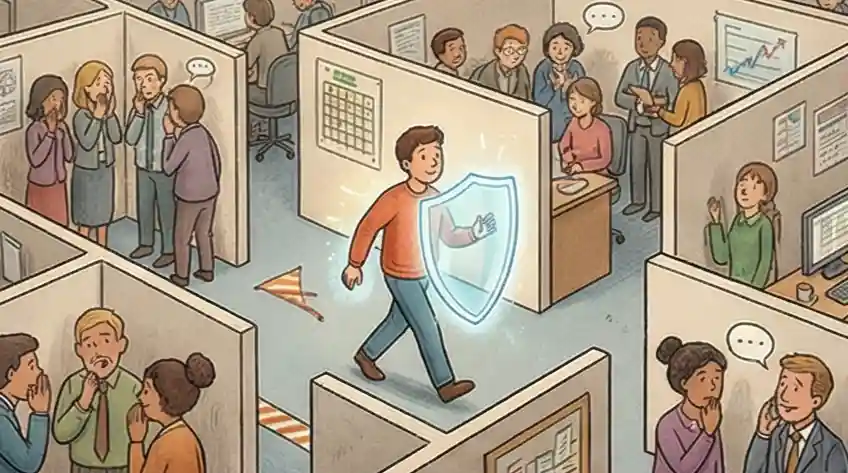
Simple Ways to Handle Office Politics with Honesty
-
01
The Who Wants What Map Before a big talk, write down what each person will gain or lose depending on the result. This helps you address what they really care about without getting caught up in their personal groups.
-
02
Sharing Facts Only Share facts, project updates, and how-to guides freely. But strictly refuse to share personal thoughts or gossip. This makes you a useful source who stays neutral.
-
03
The Fixed Statement When explaining your position to different people, always use the exact same factual sentence. This stops others from twisting your words or making up different stories about what you said.
-
04
Your Personal Rules Decide on three things you will never do, like taking credit for someone else's work. Treat these as unbreakable rules, even if it means missing a quick win or a small promotion.
The Hidden Game at Work
You are in the glass meeting room, but you haven't heard the update for ten minutes. Instead, you are watching a small head nod from the VP to the finance person, trying to guess if it means your project is approved or if your team size is about to be cut. Your stomach is tight, not because of the work, but because of the silent messages. Every phrase like "let's discuss later" feels like a hidden trap.
Good advisors often tell you to "stay out of it" and just let your work prove itself. This isn't true. Office politics isn't just about rumors; it is the secret way that money, power, and resources actually move in a company. If you ignore how these things work, you won't look pure; you’ll just be the last person to know when things change.
To succeed at work, you need to change how you think: stop seeing these social games as something bad you have to do, and start seeing them as a map you need to read to keep your goals and your honest approach safe. If you are also thinking about bigger career questions, our guide on navigating a career change after 40 covers how to make strategic moves without losing your footing.
What Are Office Politics?
Office politics is the informal system of influence, relationships, and power dynamics that shapes how decisions get made at work. It determines who gets promoted, which projects receive funding, and whose ideas are heard by leadership.
Every workplace has politics because every workplace has people with different goals, competing priorities, and limited resources. The question is not whether your company has office politics, but whether you understand them well enough to protect your work and your values. As Carla Harris, Vice Chairman at Morgan Stanley, puts it: "You can't let your work speak for you; work doesn't speak." People speak. Relationships speak. Your job is to make sure the right people hear about the good work you do.
What Experts Say
You’ve likely been told to "just stay out of the drama." That sounds honorable, right? It’s the idea that if you ignore all the social conflict, you will stay honest and successful.
That advice is wrong.
"Ignoring the drama" is just a nice way to say "becoming invisible." If you ignore office politics, you aren't being more professional; you are just letting others make decisions about your job. According to a Robert Half survey, 53% of workers believe that playing workplace politics could help them get promoted. Politics is how a company decides who gets the money, who gets the next step up, and which projects get done. If you don't play, you aren't "above it." You just have no say in your own career.
Taking Smart Action means you know the rules so you can protect your team and stay true to yourself. Ignoring the social side means you let people who are less capable or less ethical make choices for you.
There is a big difference between learning how things work and being stuck in a workplace that is toxic. If you have to use a "mental reset" every morning just to show up, the issue isn't your skill level. The issue is a company culture that encourages fear. You cannot manage a workplace that rewards backstabbing or runs on secrets by just being a better person.
Stop trying to "fix" a bad culture with better personal habits. If you find yourself spending most of your energy avoiding office traps instead of doing the work you enjoy, you need to stop managing the problem and start planning your exit.
The Exit Rule: If you spend more than half your thinking time on social problems and less than half on the work you actually like, it’s time to leave.
When "Handling It" Becomes "Just Surviving"
If you are a Rule Follower or a New Manager, you might think that if you just get better at "reading" people or "mapping" who has power, the stress will disappear. But if you are constantly on high alert, spending more time trying to decode emails than writing them, you aren't handling politics anymore. You are dealing with constant stress.
Learning office dynamics should be a tool to get your work done. When learning the politics becomes your main job, you need to leave before you forget the skills you had before you started "playing the game."
Cruit: Your Helper for Honest Work Life
For Planning
Strategy GuideGet help from a Virtual Mentor for tough talks. Figure out tricky office situations and plan your calm, factual answers.
For Proof
Record KeepingWrite down your good work as it happens so you can protect your story and have real data to show your worth.
For Links
Connection ToolCreate real connections by writing messages focused on mutual respect and shared goals, not just asking for favors.
Common Questions Answered
Isn’t "playing the game" just a nice way to say being tricky?
No. Being tricky is about fooling people to benefit yourself. Smart strategy is about building the needed relationships so your important work can actually get done.
If you have a project that will genuinely help the company, it is your job to make sure the right people see how good it is, so it doesn't just sit on a shelf.
Can't I just work hard and let my achievements speak for themselves?
No. Achievements don't talk; people do.
If you don't tell your own story and have support from people inside, your hard work can be missed, misunderstood, or even taken by someone else. Learning how things work socially makes sure the people who decide things notice what you do.
How do I handle a boss who plays favorites?
Focus on what you can control. Document your results, build relationships with other leaders in the company, and make your work visible through written updates and project summaries.
If the favoritism becomes extreme or crosses into discrimination, keep records and consider speaking with HR or a trusted mentor about your options.
What is the difference between office politics and a toxic workplace?
Office politics is normal. Every company has informal influence and competing priorities. A toxic workplace is different: it rewards backstabbing, punishes honesty, and runs on fear.
If you spend more than half your energy managing social threats instead of doing real work, the problem is the culture, not your skill. That's when you should start planning your next move. If you are weighing your options, our guide on handling ethical dilemmas at work can help you think it through.
Should I avoid office politics as a new employee?
No. Your first 90 days are the best time to observe how decisions get made and who influences whom. Listen more than you talk. Ask questions about how things work. Build one or two genuine connections early.
You don't need to take sides. You need to understand the map before you start walking.
How do I make my work visible without bragging?
Share results, not opinions about yourself. Send short project updates to your manager. Mention team wins in meetings. Offer to present your work to other departments.
The goal is to make your contributions easy to find, not to convince people you are great. Facts do the convincing when you put them in front of the right people.
The Plan for Success
Learning how office dynamics work isn't about becoming dishonest; it's about getting the power to protect your work and your honesty. Don't just ride along when you could be helping guide the direction of important results.
Understanding the hidden rules of work is the only way to turn your honesty into real professional strength.
Focus on what matters most.
Handling your career today needs smart planning. Cruit gives you AI tools to handle these small tasks easily, letting you focus on building a career you enjoy.
Start Today