Three Main Rules for Keeping Team Conflicts Under Control for the Long Haul
When you focus on "what needs to be done" instead of "who is right," you show everyone you care about practical results. Doing this keeps you from getting emotionally tired and helps your team stay focused on business goals instead of arguing.
By making sure only one person is in charge of each job, you stop people from fighting over territory or doing the same work twice, which causes most team problems. This makes things clearer so you can focus on bigger plans instead of constantly solving small fights.
Setting clear rules for how fast people should reply and communicate removes confusion about how everyone should act. These rules create a fair and predictable workplace that brings in good employees and builds trust over time, without you needing to check on every small conversation.
What Is Conflict Resolution for Managers?
Conflict resolution for managers is the process of identifying, addressing, and resolving disagreements between team members in a way that restores collaboration and removes obstacles to work. Unlike general mediation, managerial conflict resolution focuses on fixing the broken processes and unclear ownership structures that create friction — not just smoothing over feelings.
According to the CPP Global Human Capital Report, U.S. employees spend an average of 2.8 hours per week dealing with workplace conflict — costing organizations $359 billion in lost productivity annually. Managers who learn to resolve disputes by addressing root causes rather than emotions can cut that cost dramatically and reclaim their own time in the process.
Sorting Out Work Issues vs. Dealing with Feelings
Old advice tells managers to act like a company therapist, bringing people together to share their feelings and find a compromise. It sounds reasonable. But it doesn't work. The "Therapist Way" doesn't solve conflicts — it creates a temporary, weak agreement that falls apart the moment pressure hits.
When you focus more on people's feelings than on getting work done, you get stuck in the "Therapist Trap." Research from the Workplace Peace Institute (2024) found that 49% of managers feel unprepared to address workplace disputes, and on average, managers spend 20-40% of their time managing conflict. You become a permanent stop sign, processing drama instead of driving results. Your best workers — the ones who care most about output — leave because they are tired of the chaos.
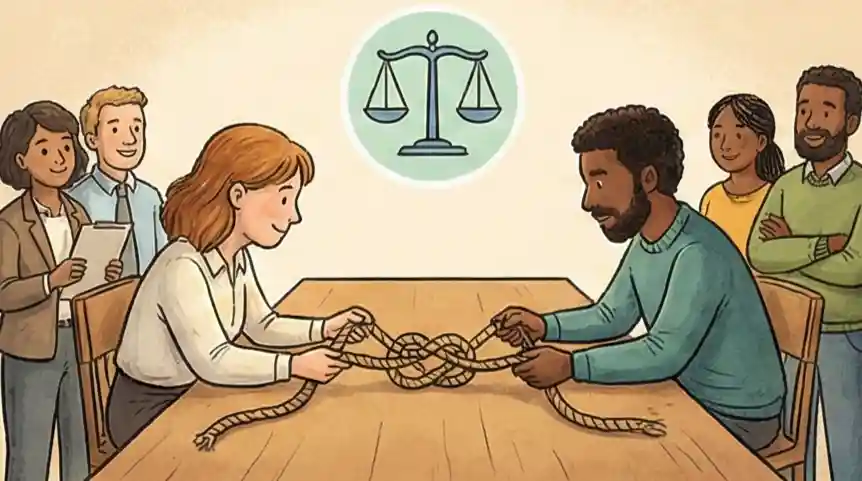
To start winning again, switch to Fixing the Operations. Stop trying to manage feelings and start managing the actual way work gets done. For individual contributors dealing with friction at peer level, the same principles apply — see our guide on how to handle conflict with a coworker professionally. Change the focus from "how you feel" to "what part of the work is stuck." Fixing process problems — like unclear ownership or missing tools — removes personal feelings from the situation. You are not telling your team they need to be best friends; you are changing the system so they can succeed. This practical shift turns every argument into a chance to improve the system, moving your team from stuck in drama back to working fast in a single meeting.
"A good manager doesn't try to eliminate conflict; he tries to keep it from wasting the energies of his people."
— Robert Townsend, author of Up the Organization and former CEO of Avis
How to Decide on Conflict Resolution
As someone who manages technical products, I see fixing people conflicts as something that needs to be built into the team's structure, just like fixing technical problems. Unresolved fights are like "old code" for people; the longer they sit, the slower the work gets and the worse the quality becomes. The chart below shows three levels of handling conflict—from basic survival to being a top-level leader—to help you see where your management skills are now and where you need to improve.
Level 1: The Basics (Reacting)
If This Describes You:
What You Do:
- • Talk to each person alone first.
- • Find out the facts: what happened and when.
- • Tell people clearly how they must act from now on.
What This Achieves
It stops immediate chaos: This approach puts out small fires so the team can keep working on their short-term goals.
Level 2: Professional (Being Ready)
If This Describes You:
What You Do:
- • Hold a formal meeting where both sides speak using a set process.
- • Figure out the real reason the fight started (was it a person, a bad process, or lack of tools?).
- • Create written promises for behavior changes.
What This Achieves
It cuts down on work problems: By fixing the process that caused the fight (not just the fight itself), you create a fairer culture and keep people from quitting.
Level 3: Mastery (Systemic)
If This Describes You:
What You Do:
- • Create a safe place where people feel okay to argue early on.
- • Teach the team how to solve their own small problems without you needing to step in.
- • Design meetings where different ideas are used to find better technical solutions.
What This Achieves
It speeds up new ideas: Great teams don't avoid conflict; they use it to test ideas. This mastery saves you time and creates a team that can fix itself and work very fast. Teams that reach this level tend to also build strong psychological safety cultures.
Which Level Should You Be At?
If You Are:
Choose Basics: if you are a new manager or managing a short-term project where stopping immediate problems is the main goal.
Choose Professional: if you lead a permanent team and notice the same fights keep happening. This is the standard for good leadership today.
Choose Mastery: if you manage important projects (like main product releases) where the team must safely challenge ideas quickly to get the best result.
The Three Steps to Connect People
To help managers turn fights into growth opportunities, this set of steps gets rid of the drama and focuses the team on working together toward shared goals.
The Safe Spot
Calming Things Down
Goal: To lower how emotional everyone is and make sure everyone feels heard without being judged.
Action: Talk to each person privately first to understand what they are feeling before bringing them into the same room.
The Shared Point
Agreeing on the Problem
Goal: To shift attention away from personality clashes and toward the actual work problem.
Action: Have a joint meeting where the team agrees on the exact business goal or process issue that needs fixing.
The Way Forward
Making a Promise
Goal: To create a clear, written agreement about how the team will act from now on.
Action: Create a simple "team rule" together that lists three specific steps or actions the people involved will take to stop the same fight from happening again.
These three parts follow one another: First, make sure people feel safe (Safe Spot). Second, get everyone focused on the same goal (Shared Point). Finally, write down the rules for future behavior (Way Forward) to make sure the teamwork lasts.
Quick Fix: From Stuck to Smooth Work
When things get tough at work, fights can quickly stop projects from finishing. The quick fix is to immediately stop talking about feelings and start talking about how the work process is broken. Here is how to remove the roadblocks and get things moving again.
The "Therapist Way": Team members complain about each other’s moods or personalities, pulling you into emotional arguments.
The Blocker Switch: Stop listening to stories. Ask: "What exact work is stopped right now?" Focus only on the task that is waiting and fix the process, not their relationship.
Fighting Over Territory: Two people argue about a task because no one knows who makes the final call, causing delays.
One Owner Rule: Immediately name one person who is "Responsible." One person makes the final choice; the other gives input. Sharing responsibility causes fights, so one person must own it.
Ignoring Messages: One person takes too long to reply, making the other feel disrespected and stopping their work.
Set Reply Rules: Stop making it about "respect." Set a strict rule (like "reply within 4 hours") for important messages. If a deadline is missed, it’s a process failure, not a personal insult.
Arguing Methods: Team members fight over the "best" way to complete a task, which brings all work to a stop.
The Fast Way Wins: Stop the discussion. Pick the method that gets the work finished the quickest. Tell the team: "We are using Method A for now. We will talk about the 'best' way next week."
Your Quick Plan: Fix Conflict in 48 Hours
Here is a quick, step-by-step plan to calm down and solve team conflicts fast, so work can keep moving smoothly.
Don't wait for things to get better on their own. Tell the people involved right away that you see tension and that you are paying attention to it.
Set up short, private meetings (15 min) with each person. Focus on getting the facts and understanding what is frustrating them, without taking sides or saying what you think.
Get both people together in a quiet place. You must lead the discussion, making sure each person speaks without being cut off, and guide the talk toward solutions for the work, not personal attacks.
Write down what was agreed upon—the exact fix and the specific behavior changes expected from both people. Email this plan to both of them so everyone is held responsible.
Check back with both people one week later to see if the solution is working. Make sure the tension is lower and offer small fixes if the original plan needs a little change.
Get Better Tools with Cruit
The Tool
Career Guidance ToolWorks like a coach who asks smart questions to help you handle tough situations at work, see what you might be missing, and focus on your career goals.
The Tool
Journal ToolHelps you keep track of your daily work by turning your tasks into clear summaries of skills and results you achieved.
The Tool
Interview Prep ToolTeaches teams how to tell their success story clearly using a step-by-step format (like STAR), focusing on the proof of their work (Actions and Results).
Common Questions
What do you do when conflict feels purely personal?
Even when it feels personal, there is almost always a work cause underneath. If someone says another person is "hard to work with," check whether slow replies are blocking deadlines, or whether ownership of a key decision is unclear. Ignore the "personality" label and look for the broken work habit. That is where you solve the issue — without getting caught in endless blame.
Will I seem uncaring if I cut the venting short?
Being efficient is the most caring thing you can do. Letting a team vent for hours often leaves everyone more exhausted and stuck in a weak agreement. Your job is to reduce daily stress by fixing the broken systems that generate the frustration. When you name the roadblock and assign clear ownership, you give your best employees the professional relief they are looking for.
How do I choose between two valid approaches to a task?
Avoid the weak compromise that satisfies no one. Treat this as a decision-ownership problem rather than a methods debate. Look at the business goal and pick the path that gets there fastest. Name one person as the final decision-maker for that task. Clear "areas of control" remove ego from the conversation and let the team get back to work.
How long should conflict resolution take?
Most active conflicts can be addressed within 48 hours using the steps in this guide. Acknowledge the tension right away, hold individual 15-minute conversations within 12 hours, then bring both parties together within 24 hours. Document the agreed fix and send it by hour 36. Waiting longer lets frustration harden into resentment, which takes far more time to undo.
When should a manager escalate instead of mediating?
Escalate immediately if the situation involves harassment, discrimination, threats, or any behavior that violates company policy. In those cases, mediation is the wrong tool — HR and formal procedures need to take over. Process-level and task-level conflicts are where managerial mediation works best. When in doubt, document what you observed and loop in HR before attempting any resolution yourself.
What causes most team conflicts at work?
The most common triggers are unclear ownership (two people think they own the same decision), communication delays that create assumptions, and resource scarcity (two teams competing for the same budget or headcount). Personality clashes almost always trace back to one of these three structural problems. Fix the structure and the personality conflict usually dissolves on its own.
Stop counseling and start leading.
Sticking to the old "Therapist Way" will only make your office a revolving door of drama and unfinished projects. To keep your best people from quitting, shift your focus to Fixing the Operations. Managing how work flows — not moods — ends the cycle of "temporary peace" and builds a team that moves fast. Don't let arguments control your time. Every team fight is a chance to improve the system, fix the process problems, and get back to top speed.
Start Leading Now