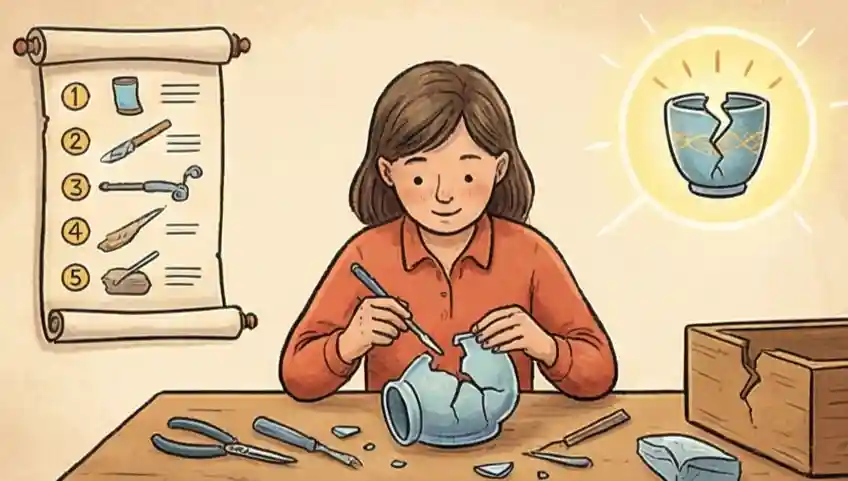
Important Lessons for Bouncing Back
-
01
Think About Risk, Not Feelings Instead of trying to make your manager feel better, focus on making the mistake less likely to happen again. Your boss needs proof that the mistake's cause has been permanently fixed.
-
02
Fix the Process, Not Just the Effort Working harder using the same bad methods won't solve the issue. Real recovery comes from creating a clear, repeatable system that makes it impossible for the error to happen again, instead of just trying harder.
-
03
Show Proof of Your Fixes Use clear facts and records to show that your new system is working well. By sharing updates on your progress, you stop needing constant checking and rebuild your reputation for being accurate.
-
04
Become Valuable Again Aim to become a top performer again instead of someone who always needs help. You earn back trust by consistently delivering good results that show you can succeed without needing a backup plan.
Checking Your Actions: Getting Back on Track After Mistakes
Stop begging for forgiveness. When you mess up a big project or miss an important date, your natural reaction is to act like a victim. You say sorry over and over, stay at work extremely late, and hope your boss sees how dedicated you are. You’ve been taught that if you feel truly sorry and work much harder, people will eventually trust you again.
But the plain truth is: Nobody is concerned with your guilt. In a demanding job, trust isn't about feelings; it's about judging risk. Your manager doesn't want to see you feel bad; they just want to know that the problem in how you work has been completely fixed. When you focus on feeling guilty, you aren't solving the real issue—you're just running the broken way of working faster.
This strategy of "sorry first" can ruin your career. By starting with an apology, you keep the memory of the mistake fresh and make yourself look like someone who can't be relied on. You turn yourself from a great employee into someone who needs constant checking and a safety net forever. To get past a major error, you must stop asking for forgiveness and start showing you have upgraded your work system. If you don't fix the system, you aren't recovering; you are just waiting for the next failure.
The stakes are real. A 2023 study in Frontiers in Psychology tracking 141 professionals found that 67.8% of workers felt nervousness, worry, or fear after making a significant error—and that emotional response, if left unaddressed, actively prevented them from learning from the mistake. The employees who recovered fastest were those who shifted from emotional reaction to systematic problem-solving within the first 24 hours.
How Professional Systems Actually View Recovery
In the world of work performance tracking, we create systems not to measure "how bad someone feels." We create them to track your Dependability Score.
Spotting the Problem
System AlertWhen you make a big mistake, the "system" (whether it’s a real tracking tool or what your boss mentally records) signals an Alert. To the system, a mistake is just data showing that your current way of working has a high Mistake Rate.
Feelings vs. Speed
Why Apologies FailThe common approach—Saying Sorry and Working Harder—fails because it tries to use Feelings to fix a technical failure. Apologies are just random words. If you apologize and then only work harder, you are increasing the Speed of a broken system, which actually raises the total Risk Level.
The Fix and The Proof
Need Structured AnswersTo fix things, you must provide Structured Proof in the form of a "Fix." Your boss ignores your guilt and instead looks for Process Improvement. They want to see that you found the exact Details—like the missing check, the late handoff, or the communication gap—that let the error happen.
If you don't put a new "safety net" or a Key Question in place, the "system" will keep seeing you as risky. You won't be "let off the hook"; you will be overlooked for important jobs because your Dependability Score hasn't been updated with a solution. You don't need a fresh start; you need a version update.
Common Career Beliefs That Are Wrong
If I stay late every night and take on extra jobs, my boss will eventually stop thinking about the error.
Effort does not replace fixing the problem; managers value a "system fix" more than a "tired employee." You need to show you looked closely at why the mistake happened and changed the way you work so it is statistically less likely to happen again. Research published in Frontiers in Psychology (2023) found that simply working harder after an error—without changing the underlying process—actually increases the total risk of recurrence, because speed amplifies flawed systems rather than correcting them.
Use the Career Guidance Tool to practice talking with an AI mentor, helping you create a clear, realistic plan to deal with the real reason for the error and earn back trust with logic, not just long hours.
You should delete any mention of the project where you failed and hope no one brings it up during an interview.
Employers look for Resilience—the ability to recover and learn from problems. Owning the mistake with a structured story shows more leadership potential than a perfect resume that looks fake or lacks real-world experience.
The Interview Prep Tool helps you turn that failure into a strong story using the STAR method, making sure you describe the situation and outcome in a way that proves you grow when things get tough. For a deeper look at handling a mistake during an interview itself, see what to do if you realize you made a mistake in your interview.
A huge error proves that I don't have the natural talent for this job and I should look for something easier.
Career improvement happens when you adjust based on feedback, not based on whether you are naturally "good" or "bad" at something. Most failures just show a specific skill gap that can be found, tracked, and closed with the right information.
Use the Journaling Tool to record your daily successes and the specific skills you used to fix problems; the AI will help you see the bigger picture by highlighting your strengths and proving your professional worth is still strong.
The 30-Second Check for Recovery
Before you send another email saying "I'm so sorry," quickly check if your plan to recover is actually fixing things—or if it’s just making you look unprofessional.
Check your "Sent" folder (Email, Slack, or Teams) from the last day.
How many times did you write "sorry," "apologize," or "my mistake"?
How many times did you send a specific, numbered list of things you are doing to make sure this never happens again?
What Your Numbers Mean
If you have more "Sorries" than "Fixes": You are currently only focused on the damage. You are making the mistake more visible than the solution.
If you have 0 "Fixes": You aren't recovering, you are just feeling bad. Your boss is probably still worried that the mistake will happen again.
If you have 3+ "Fixes" and only 1 "Sorry": You are acting like an expert consultant. You admitted the error and immediately shifted the focus to what you are doing to solve the problem.
The Common Mistake: "Saying Sorry Constantly"
Most people fall for the Common Mistake: The more I show people how upset I am about the mistake, the more they will forgive me.
But this is the opposite of what works in a business setting. When you keep apologizing, you remind your boss of the problem every time you talk. Managers don't need you to be upset; they need the risk to go away.
The Reality: Great employees don't earn back trust with their feelings; they earn it back with a system of operation. If your recovery plan is 90% guilt and 10% action, you aren't fixing your reputation—you're damaging it further.
Cruit's AI Assistant: Helping You Handle Work Errors
For Planning
Career Planning ToolActs like a mentor available anytime, using guided questions to help you plan your next steps and get ready for tough talks.
For Looking Back
Journal ToolHelps you sort out what went wrong and automatically finds the skills you used to solve the problem.
For Fixing Things
Networking ToolRemoves worry by helping you write professional, sincere messages to repair trust with coworkers or clients who were affected.
Changing Mistakes into Career Gains
Recovering from a major mistake at work means shifting your focus from guilt to evidence. Acknowledge the error once, identify the exact process failure that caused it, and present your manager with a concrete fix—a checklist, a new reminder system, or a changed workflow—that makes the same mistake structurally impossible to repeat.
When you make a big mistake at work, it feels terrible. Most of us react by following the Common Mistake: the "Apology and Hard Work" plan. We say "I'm so sorry" many times, stay late every night, and hope our boss sees how bad we feel so they will eventually forgive us.
But in a job, your boss isn't looking for an apology—they are looking for Ways to Reduce Risk. They don't care how bad you feel; they care that the mistake won't happen again. If you just work harder without changing how you do things, you're just "running bad instructions" faster.
"A conversation about a mistake should focus on the cause, offer a way to avoid it in the future, and remind the employee that recovery is part of a learning journey—not a verdict on their value."
— Career development guidance, American Psychological Association (APA), 2024 Work in America Survey
The pressure you feel after a mistake is real. According to a 2025 MyPerfectResume survey of 1,115 U.S. workers, 81% are worried about losing their jobs—and that anxiety makes people more likely to over-apologize rather than take the strategic action that actually rebuilds trust. The employees who recover successfully do the opposite: they treat the mistake as diagnostic data about a process gap, not as evidence of personal failure.
To truly recover, you must treat your mistake like a "software error." You don't ask for forgiveness; you provide a "fix." Here is a simple 5-step guide to turn a failure into a professional improvement.
1. Focus on Facts, Not Feelings
When the mistake comes up, admit it right away. But keep your words short and focused on details. Instead of saying, "I feel awful that I messed up the report," say, "The numbers in the report were wrong because I skipped one part of the checking process." By removing emotion, you stop looking like a "person who messes up" and start looking like a "professional fixing a problem."
2. Find the "Weak Spot" in Your Work
Mistakes hardly ever happen because someone is naturally "bad at their job." They happen because there is a weak point in the process. Ask yourself: Was it bad communication? Did I skip a necessary check? Did I not have the right tool? Find the exact moment the process failed.
3. Build a "Safety Guard" Rule
This is the most important step. You must create a new rule or tool that makes it almost impossible for that exact mistake to happen again. This could be a new checklist, a reminder on your calendar, or asking a coworker to check it. You are building a "safety net" so your boss doesn't feel like they have to watch everything you do.
4. Present Your "Upgrade"
Go to your manager. Quickly mention the error, then spend most of the time explaining the new plan you have put in place. Show them the checklist or the new way you will handle the work. You are proving that you have "fixed" the error. This builds trust because it shows you are now more reliable than you were before the mistake.
5. Confirm the Fix and Move Forward
Once the new system is running, stop bringing up the apology. If you keep mentioning it, you keep the memory of the mistake alive. Going back to high-quality work and following your new system shifts attention back to your good results. If you are navigating a layoff situation on top of a recent error, the same logic applies—read how to navigate a layoff with strategy for a parallel approach to rebuilding professional standing.
Common Questions
How do I tell my boss about a mistake without seeming like I’m making excuses?
Stick only to the facts of what happened and what you are doing to correct it. Do not use words like "but" or blame others. Instead of saying, "I missed the deadline because John didn't send me the data," say, "I missed the deadline; going forward, I will set a reminder to ask for pending files 24 hours early."
Should I apologize more than once to show I am truly sorry?
No. Saying sorry too many times actually makes you look less professional. It reminds your boss of the problem instead of the solution. One clear, professional apology followed by a clear plan to fix the process is all you need.
Will one big mistake ruin my career reputation forever?
Only if you focus on "feeling bad" instead of "fixing the system." If you don't change how you work, your boss will feel they need to watch you closely, which limits your chances for promotion. But if you use the mistake to build a better process, you often end up with a stronger reputation as someone who handles high-pressure situations well.
How long does it take to rebuild trust after a big mistake?
Trust typically rebuilds in 30 to 90 days if you put a concrete fix in place and consistently deliver quality work. The timeline shortens when you give your manager visibility into the new system you created—weekly progress check-ins or a brief written update showing your process is working signals competence faster than just hoping time fixes things.
What if my boss won't let the mistake go?
Keep sending documented proof that your fix is working. If you've implemented a new checklist or process, share a written update every week for a month. Eventually, the pattern of evidence outweighs the memory of the mistake. If the dynamic doesn't shift after 60 to 90 days of solid execution, it may be worth having a direct conversation about what specific outcome would signal full trust restored.
Should I tell my team or just my manager?
Tell whoever was directly affected. If a coworker's work was impacted, a brief, fact-based message to them—"The error in my report affected your numbers; here's what I've changed"—prevents rumor and shows ownership. Avoid broadcasting to people who weren't involved; that extends the mistake's footprint unnecessarily.
Focus on what counts.
Don't fall for the Common Mistake that working long hours and feeling bad will save your job. Those actions don't fix the "bug" in your workflow—they just wear you out. By finding the gap and building a safety guard, you prove that you are a valuable part of the company, not a problem.
Start Building Fixes