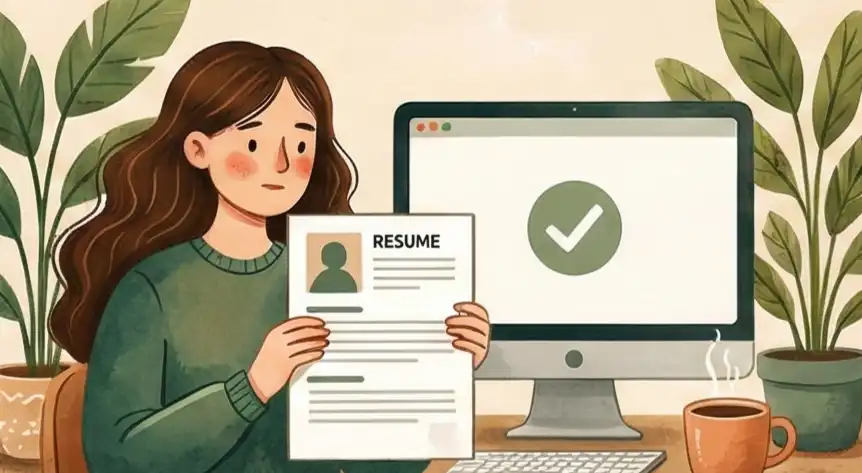
What Is the 6-Second Resume Test?
The 6-second resume test is based on a 2018 eye-tracking study by TheLadders: recruiters spend an average of 7.4 seconds on initial resume screening, with 80% of that time on five elements — your name, current title, previous titles, employment dates, and education. If those elements don't signal fit immediately, the resume goes in the no pile.
Recruiters scan in an F-pattern — reading across the top of the page, then moving down the left side. Position, formatting, and white space determine whether your most important information lands in that path. Passing this test isn't about writing less. It's about putting the right things where the eye goes first.
Simple Guide to Making Your Resume Better
-
01
Put Key Info Where Eyes Go First Put your best achievement or job title in the top-left area of your current job section. People naturally look there first and look there the longest.
-
02
Keep Bullet Points Short Limit every point to only two lines of text. This stops you from creating a huge block of text that makes recruiters stop reading your achievements.
-
03
Use Numbers, Not Just Words Swap weak words like "skilled" or "hard-working" with real numbers and percentages. This gives quick, clear proof of what you actually did.
-
04
Add Empty Space to Breathe Put clear empty spaces between sections. These act like visual breaks, helping the recruiter focus as they move from your skills to your work history.
How to Prepare Your Resume
You hesitate before hitting delete, worried about removing a project from 2014 that you feel defined your career. This is the feeling of not having enough space—the rushed need to include everything because you think leaving something out means hiding part of who you are professionally. You add one more bullet point, sure that having more information means you look better, while the recruiter's eyes are already looking away.
Many people try to hide this panic by using a clean, simple resume design. But a nice design is like painting a nice coat on a house with no front door; it looks okay from the road, but it doesn't help visitors get in. If a recruiter can’t find out why you matter in just a moment, the prettiest font won't help you.
The stakes are steep. Research compiled by Qureos (2024) found that only 3% of submitted resumes result in an interview call. Those 7.4 seconds are often the only shot a resume gets.
To pass the six-second look-over, you must stop using your resume like a history book and start using it like a fast guide designed to make things easy for a new reader.
Real Action vs. Just Looking Good
When you feel that pressure to fit everything in—the "Too Much Information" panic—your first idea is usually to distract the reader's eye. You think, “If I can’t clearly explain my 15 years of work or my career change, maybe a colorful design or a fancy two-column layout will cover it up.” This is the trap of relying on a nice template. It's a common mistake because it tries to fix a content problem with decoration.
Relying on fancy design elements when your main content is unfocused. A beautiful template is just fancy paint on a house with no clear entrance. If a recruiter can’t see your value in six seconds, they move on. Design should help your story, not hide the fact that you don't have a clear one.
Doing the hard work of cutting information. For someone with a long history, this means deciding which five years of experience matter most to this specific job. For someone changing fields, it means changing how you describe old skills to match the language of the new industry so they don't have to guess.
If you've spent months trying every template, and it's still not working, the problem might not be your resume itself—it might be the type of job you're applying for. For people skilled in many areas, constant feedback that you are "too much" might mean you are trying to join a company culture that only values one specific type of person.
If you have to hide everything that makes you good just to get a recruiter to look at you, you are applying in the wrong places. If passing the 6-second test requires you to pretend to be someone you aren't, stop editing your past and start planning an exit to a place that values who you actually are.
Does Your Resume Pass the 6-Second Test? Tools to Get Attention Fast
For Clarity
Simple Formatting ToolChange vague duties into achievements backed by numbers. Our tool uses smart questions to help you find data, and it automatically makes sure your resume fits nicely on one page.
For Targeting
Job Matching ToolScans job descriptions to find the exact keywords and skills needed by managers and the scanning software. Helps you remember and add important experience you forgot.
For Focus
Job Comparison ToolCompares your resume to a job posting instantly, showing you exactly where you match and where you have gaps. Stop guessing and focus only on the strengths that will catch the reader's eye quickly.
Quick Questions Answered
Won’t removing older details make me look less experienced?
No. Recruiters aren't looking for a list of everything you’ve ever done; they want proof you can solve their problems right now. By removing the unnecessary stuff, you stop hiding your best work under boring details, making your real skills impossible to miss.
Do I need to include everything so the computer scanners (ATS) don't reject me?
No. While keywords matter, stuffing your resume with them makes it look messy, and a human recruiter will skip it fast. Focus on the few key skills needed for the job, making sure that once you pass the computer scan, you give the recruiter a clear, easy-to-read guide straight to the "Hire" decision. For a deeper look at this topic, read our guide on ATS resume myths.
How do recruiters actually scan a resume in 6 seconds?
Recruiters follow an F-pattern: they scan across the top of the page, then move down the left side. The most-read zones are the top third of the first page and the left column. This means your name, current title, and most relevant achievement need to appear at the top left. Information buried in multi-column layouts or the lower half of a resume often goes unread on the first pass.
What should be in the top third of my resume?
Your name, current job title, a two-line summary targeting this specific role, and your single strongest quantified achievement. Think of the top third as a billboard — it should answer "Who are you?" and "Why should I call you?" without scrolling. This is the only section a recruiter is guaranteed to read on a first pass.
Does the 6-second resume rule apply to every industry?
The scanning behavior is consistent, but what recruiters prioritize in those seconds differs. Tech recruiters scan for recognizable company names and specific tools. Finance recruiters focus on credentials and numbers. Creative fields place more weight on portfolio links and formatting. The principle stays the same: your most relevant credential for that industry should appear in the F-pattern zones at the top and left of your resume.
How many resumes does a recruiter review per day?
Most corporate recruiters review 20 to 50 resumes per open position, often managing multiple roles at once. Research from Qureos (2024) found that only 11% of applicants are considered suitable for any given role. That ratio explains why the initial scan is so quick — it's a filtering decision, not a full evaluation. Getting past that first cut requires your resume to signal fit within seconds.
Think of your resume as a clear map.
Your resume is not a trophy case for your past, but a clear plan designed to lead a recruiter to one single conclusion: you are the solution they need. Getting good at the 6-second scan is the first step to taking control of your career and making sure your true value is never overlooked again.
Start Now