Expert Facts: Where You Apply Shapes How You Apply
-
01
The U.S. Tech Way (Fast Talk) Value is shown through Quick Wins: important results that show recent success, cutting out the boring details to make the reader's job easy.
-
02
The Strict Way (UK, Germany, School Jobs) Trust is built with Full Proof: a step-by-step, detailed history where everything lines up. If there are gaps, people get suspicious.
-
03
How Computers Read Applications (ATS) Resume systems like the Quick Scan* (checking for keywords/numbers); CV systems like the *Structure Check, penalizing you if you miss required details or history.
What to Use: Resume or CV
Deciding between a resume and a CV isn't just about how long it is; it’s about using the right kind of data. At a high level, your application is a special data file meant to meet specific proof requirements. The common mistake is thinking a resume is just a short CV or a CV is just a long resume. They serve completely different goals.
One is a quick advertisement focused on selling your best points; the other is a detailed history that proves who you are professionally.
If you just guess based on page count, you risk looking too brief where depth is needed, or drowning your value in unnecessary details where speed is key.
Solving the Puzzle of What to Show
To figure this out, you need to know the Rule for Hiring in that Country/Industry.
Using the wrong document means your important points get missed. Success depends on making your document fit what the local boss expects to see as proof of trust.
This guide uses a Decision Guide to make sure your professional power is presented the right way for where you are applying.
What Is the Difference Between a Resume and a CV?
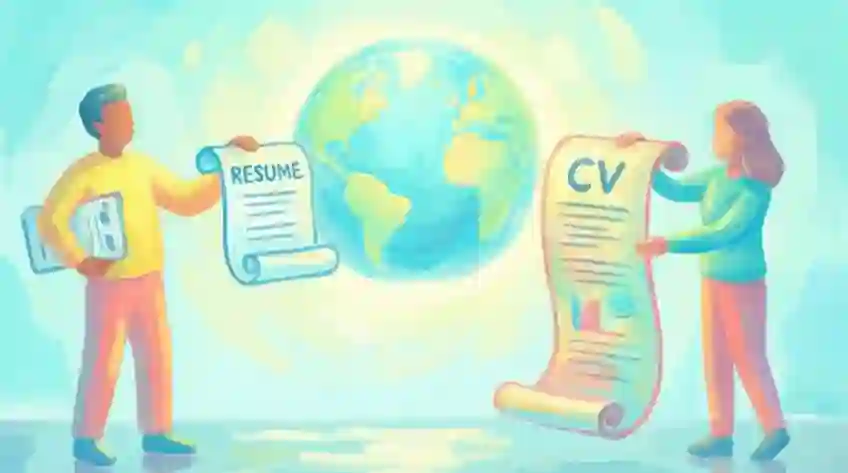
A resume is a concise 1-2 page document focused on your most relevant experience and results for a specific job. A CV (Curriculum Vitae) is a comprehensive record of your full academic and professional history, with no page limit, used in academic, medical, and most international hiring contexts.
The word "curriculum vitae" is Latin for "course of life," which signals the intent: a CV tracks everything. A resume tracks only what matters right now. The choice between them is not a formatting preference. It is driven by where you are applying and what that market expects as proof of credibility.
According to LinkedIn's 2025 Hiring Trends data, recruiters spend an average of 7 seconds on their initial resume scan. That number alone explains why the resume exists: in high-volume US hiring, brevity is a feature, not a flaw. In academic and European hiring, the opposite standard applies.
Resume vs. CV Showdown
| What Matters | Resume (The Quick Sell) | CV (The Full Story) |
|---|---|---|
| The First Impression | Immediate results proof | Deep background proof |
| Recruiter Experience | Fast check for merit | Checking the history step-by-step |
| Where It Works Best | US; Focus on what's new | EU/UK; Indexing the whole life |
| Biggest Danger | Looking like you don't have much experience | Too much detail that causes boredom |
| Bottom Line | Use in the US, Canada, and for private-sector roles globally. Keep it to 1-2 pages. | Use everywhere outside North America, plus academic, medical, and research roles worldwide. No page limit. |
The Main Reason Resumes and CVs Are Different: Local Rules for Trust
To know why a Resume and a CV are different, you have to look at the Rules for Hiring in Different Places. It’s not about paper length; it’s about how a culture decides if you are Trustworthy. The main thing happening is that different places weigh your data using two different ways of thinking: The Need for a Quick Sell versus The Need for Complete Records.
1. The Resume: Designed for Quick Selling
US Private Companies & Tech AreasHow It Works
Follows the idea of Less Work for the Reader. Uses "Quick Wins"—big achievements separated from daily tasks—so the reader doesn't have to think too hard.
The Reaction
Being short shows you are a leader. It cares most about What You Did Recently and How Big It Was. Giving them a long CV looks like you can't focus.
2. The CV: The Full, Step-by-Step History
UK, Germany, & School/University JobsHow It Works
Needs "Anchored Data"—every success must be tied to a clear timeline. Missing parts make people nervous because it breaks the expected chain of evidence.
The Reaction
The CV acts like a Neutral Record Keeper looking for complete history. A short document seems like you are hiding something because the required proof trail isn't there.
3. Computers Reading Your Application: Matching the Local Boss
ATS Program TuningHow It Works
For Resume rules, systems check for How Many Keywords you have and if the ratio of good info to junk info is high (focusing on the "What" and "How Much"). According to Jobscan (2024), 75% of resumes are filtered out by ATS before a human ever reads them.
The Reaction
For CV rules, the system checks for Completeness. If expected details (like full lists of school papers or job dates) are missing, it scores you as "Low Trust" because the required pieces of evidence aren't there.
The Key to Choosing
Picking a Resume is betting that being brief and focused on results is enough; you are hoping your big selling points are enough to get you interviewed. Picking a CV is betting that proving your total authority through a full record is necessary; you are hoping they need to see every step you took. Success is not about the number of pages, but about correctly figuring out the Local Hiring Rule and giving them the specific kind of "Proof" they are used to trusting.
Digging Deeper: Pick Your Tool
The Resume: High-Risk Sales Talk
The Plan: This is a short, punchy selling document meant to show your best money-making results in just a few seconds. It focuses on recent wins and key skills to show you can fix their current problems fast.
The Danger: If you focus too much on selling without showing the proof, you look like a smooth-talker with no substance. Cutting your history too much creates empty spots that make recruiters think you were fired or aren't good at staying in one place.
Best For: When you are aiming for a management job in a US or Canadian company that gets hundreds of applications and has no time to read long stories.
The CV: The Full Investigation Report
The Plan: This is a full record of your school and work life that proves your authority by showing an unbroken line of evidence and credentials. It values being detailed and giving full context over being short.
The Danger: Most CVs are too long and boring. If you don't organize what's important within this long format, you will bore the reader to sleep before they even see the one thing that makes you right for the job.
Best For: When applying for a university job, a medical role, or a senior job in Europe/UK that requires a complete, step-by-step look at your entire career history. If you need to build a strong academic CV from scratch, see our guide on how to write an academic CV.
Career Guide: What to Do Based on Your Situation
The Steady Climber (Moving Up)
Staying in the Same CountryWho You Are: A Senior Manager in Chicago wanting a VP job in the same field, using ten years of specialized knowledge.
The Big Change (New Field/Country)
Moving Globally/Changing IndustryWho You Are: Someone working in logistics in the UK who wants to become a Supply Chain Consultant for a global company in Singapore or Dubai.
The Important Start (New Graduate/Returning)
School/Research JobsWho You Are: Someone just finished Medical School or getting a PhD, applying for a special training program or a research job that might become permanent.
Using Cruit to Get It Exactly Right
The biggest mistake is sending the wrong document format to the wrong place, which gets you instantly rejected by hiring people or their computer systems (ATS). Cruit gives you the rules and tools to make sure your application paper matches exactly what the local industry expects.
To Match The Format Resume Tweaking Tool
Reads job ads to find the right code words and skills, helping you beat the screening software.
To Make It Shorter & Punchier Simple Resume Tool
Turns long CV duties into short, powerful results needed for corporate resumes.
To Base Strategy on Facts Job Fact Checker
Shows you exactly which skills you are missing and suggests how to fix the weak spots.
Common Questions
Does shortening a CV to a resume hide my seniority?
No. In private-sector companies, seniority is proven by the size of your results, not the length of your duties list. Converting a CV to a resume means shifting your "signal" from listing responsibilities to highlighting strategic outcomes — so your authority comes through more clearly, not less.
A US tech job ad says "CV." Should I send a resume or a full CV?
Send a resume. In the US, recruiters frequently use "CV" to mean any application document. If you send a 10-page academic CV to a tech recruiter, it reads as a cultural misread. The rule: unless the role is research, medicine, or academia, deliver a focused 1-2 page resume regardless of what the job posting calls it.
Will a shorter resume make me look less qualified than a long CV?
In markets where the resume is standard, the opposite is true. A long CV sent to a fast-moving company signals an inability to prioritize — which is a red flag for leadership roles. Choosing the right format for the market shows you understand the audience, which is itself a signal of executive-level thinking.
Is a CV the same as a resume in the UK?
Not exactly. In the UK, the word "CV" is used for all job applications — the term "resume" is rarely used. But a UK CV for a corporate role is typically 2 pages and results-focused, which makes it closer to a US resume in practice. An academic CV in the UK, on the other hand, follows the same comprehensive format used globally for research and teaching positions.
How long should a CV be?
A CV has no hard page limit — it grows as your career does. Entry-level academic CVs start at 2-3 pages. Senior researchers or professors with decades of publications, grants, and teaching experience can have CVs of 10 pages or more. The standard is completeness, not brevity. Every entry must be accurate and verifiable; padding with irrelevant content hurts credibility.
Focus on what truly counts.
Your choice of resume or CV is your first "work sample"—it shows you have the good sense to change how you present complex information for a specific audience. By ignoring the simple page count rule and solving the issue of what information to show, you signal to global employers that you are smart enough to handle their specific local rules. Don't let the wrong format hide your professional value.
Start Using Cruit Now