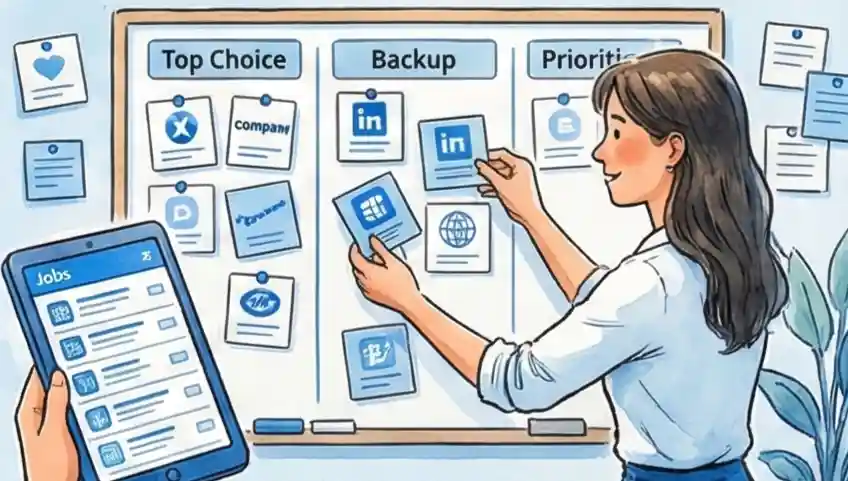
Changing How You Look for Jobs
-
01
More Focus, Fewer Applications Learning to prioritize job applications isn't about doing less work: it's about directing effort where it counts. What matters is how many fitting recruiters see you, not how many easy apply buttons you click.
-
02
Apply Quickly When You Fit If you are a very good fit for a job, try to apply early in the process. Being fast and relevant means you beat the automated filters that often hide applications that arrive late or look too general.
-
03
Make Your Skills Clear Make sure your application clearly shows what you are good at, instead of being a general overview. Giving a clear, strong message stops hiring software from marking you as unimportant or spam.
-
04
Be Careful About Your Image Protect your value by only applying to jobs that really fit your special skills. Don't apply for every job at one company just because you need a job. Doing this can make systems automatically hide your profile.
The Fake Idea of Job Hunting
Stop thinking that sending out fifty resumes a day is showing you are working hard. It's just creating junk data. Many job hunters treat job searching like a big lottery, believing if they send enough applications everywhere, it will eventually work out. They click every easy apply button, treating every open job as the same.
The tough reality is: you aren't playing a numbers game; you are trying to be seen. Recruiters are buried under tons of low-quality applications, and they and their software are very good at filtering things out. According to a report by The Times, the average corporate job posting attracts 250 applicants. In that crowd, only two things really count: how new your application is and how well it matches. If you are not in the first group of people who apply or you are not a very close match, you basically don't exist.
Even worse, if you apply for every job opening at one company, they see you as desperate instead of specialized, which causes their systems to hide your profile right away.
This cycle of feeling busy but not actually getting anywhere feels like progress, but it just leads to your application disappearing. Chasing volume leaves you nowhere important. Until you stop chasing how many applications you send and focus on the specific jobs where you are the best fit, you will stay hidden at the bottom of a digital stack, wondering why no one calls.
What is an Applicant Tracking System (ATS)?
An Applicant Tracking System (ATS) is software companies use to collect, sort, and rank job applications before a human recruiter ever reviews them. As of 2024, 98.4% of Fortune 500 companies use a detectable ATS (Jobscan, 2024), making it the first filter every resume must pass.
When a recruiter posts a job, the ATS scans every incoming resume for matching skills, keywords, and experience. Resumes that match closely move up. Resumes that don't get buried. Most job seekers never learn this, which is exactly why their applications disappear without a response. Understanding how ATS scoring works is the first step to learning how to prioritize job applications that actually land interviews. For a deeper look at how AI reads job descriptions, see how Cruit reads job description concepts.
Understanding the System Reality
Inside the hiring system, the Applicant Tracking System (ATS) is not just a file organizer; it's a way to rank things built to throw away junk. When you send applications everywhere, you aren't just fighting other people; you are fighting a computer program designed to focus on the Signal vs. Noise ratio.
First Checks & Language Understanding
Yes/No FilteringIt starts with Knockout Questions. These are simple yes/no checks (like, "Do you have 5 years of Python experience?") that instantly toss out your resume before a person sees it. If you pass those, the system uses NLP (Natural Language Processing) to check your resume using Semantic Search.
Grouping Ideas
Matching the Core NeedNewer systems don't just look for exact words; they use Semantic Clustering to see if your skills match what the job actually needs. If the job requires "Growing the Product" and your resume talks mostly about "Customer Support," the computer marks you as a low match, even if you could do the job well.
The Problem of Scattered Data
Keeping Your Profile TogetherThe biggest mistake is the Data Fragmentation Trap. When you apply for ten different kinds of jobs at one company—say, in Marketing, Sales, and Product—the system flags your profile. Instead of looking flexible, it looks like you lack focus, which lowers your internal "match score."
Recruiters use specific search terms to sort by How Recent It Is, giving priority to the first group of highly-scored candidates. If you aren't in that first group, you become old data—basically invisible to anyone who actually hires. Select Software Reviews found that 88% of employers believe they lose qualified candidates because those candidates don't submit ATS-friendly resumes.
Common Job Search Ideas That Are Wrong
If I send my normal resume to 100 job openings, I will surely get some interviews just based on the high number of tries.
Most company systems (ATS) score resumes based on how well they match the job's specific needs. If your resume isn't clearly connected to what the job asks for, it will likely end up at the bottom of a digital stack where no human recruiter will ever see it, no matter how many applications you send. Research from GetSmartResume (2024) found that keyword-optimized resumes are 70% more likely to pass ATS filters—a gap that no amount of mass applying can close. Before you apply to any role, use Cruit's job fit analysis to see how well you actually match the job.
Use the Job Analysis Tool to see exactly how you compare to a specific job before you apply. This lets you only focus your effort on the jobs you have a good chance of getting.
I should only apply for jobs that have the exact same title as my previous job, or they will reject me for not having the right background.
Hiring managers actually look for skills that can be used in different roles—like managing projects or solving technical problems—but they often don't have time to figure this out for you. If you don't explain how your past achievements fit the new job's needs using the right words, you will be missed even if you are capable of the work.
Cruit's Career Path Planning tool finds your hidden strengths and shows you which new career paths they fit, telling you exactly how your skills from being a "teacher" or "manager" can move into good corporate jobs.
I can trick the robot by putting the job description in white text or just listing a bunch of buzzwords at the bottom of my resume.
Modern screening software is built to spot hidden text or keyword stuffing, which usually causes an automatic rejection. To truly pass the filters, your skills must be naturally included in your work achievements so that the system—and eventually the recruiter—can see real proof of what you’ve done.
The Resume Tailoring Tool uses an AI helper to guide you in finding real stories from your past that prove you have the needed skills, making sure your resume is both good for the ATS and completely honest.
The 30-Second Check: Volume vs. Value
Before you send another resume, check if what you're doing is helping or hurting you. Open your list of job applications and follow these quick steps to see where you really stand.
Choose your last 5 applications from where you keep track of them or your "Sent" folder.
For each job, try to name one specific business issue that company currently has (like "They want to start selling in a new country" or "They have a known software bug").
Guess how much time you spent learning about the company compared to just clicking "Apply."
Now, check your results against the meanings below.
What Your Results Mean
If you couldn't name a specific problem for at least 3 of them, you are stuck in the Mainstream Trap (thinking that applying everywhere is better than applying smart). You are competing where the value is low.
If you knew what the company was trying to achieve and changed your pitch to match that, you are acting like a Strategist. You focus on solving real problems instead of just sending out many applications.
If you spent less than 5 minutes on each application, you are just doing the "Spray and Pray" method. This creates activity but rarely leads to interviews because you are presenting yourself as just another option.
Your AI Helper for Winning Jobs Strategically
For Planning Job Analysis Tool
Tells you how your skills match a job description, showing you "Skill Gaps" and "Matching Skills" so you can focus on the jobs you compete well for.
For Seeing Progress Application Tracker
Shows you your whole job search in one place to spot problems (like sending many applications but getting few interviews) so you can change your approach.
For Making an Impact Resume Tailoring Tool
Helps your resume match the keywords hiring managers look for, highlighting past work that might otherwise be missed through conversation.
Getting Through the Modern Job Search
Should I apply for more than one job at the same company?
It is best to stick to one or two jobs that truly fit your skills.
If you apply for five or six very different jobs at one company, it sends a message to recruiters that you don't know what your main strength is. This often makes you look desperate rather than like a specialized candidate, which can lead to an automatic rejection.
How do I make sure a human actually reads my resume?
To get noticed, you need to focus on when you apply and the right words to use.
Most recruiters only look at the first group of applications that meet at least 90% of the job needs. Use tools like Cruit to find jobs the moment they are posted and adjust your resume to use the exact words from the job posting.
Will applying to dozens of jobs every day help me get hired quicker?
Not really. How focused your applications are matters much more than the total number.
Sending five applications that are highly targeted to jobs where you are a perfect fit is much better than sending 50 general resumes to random postings. Focusing on jobs where you match well makes sure you stay at the top of the recruiter's list instead of getting lost in the clutter.
How many jobs should I apply to per week?
Career experts suggest 5 to 10 carefully researched applications per week rather than dozens of generic ones.
The goal is to spend 15 to 20 minutes per application reviewing the company and tailoring your resume to the role. Targeted applications consistently outperform mass-applying. Quality is the variable that gets you calls, not volume.
How do I know if my resume is ATS-friendly?
A resume is ATS-friendly when it uses the exact keywords from the job posting and avoids complex formatting that confuses parsers.
Text boxes, columns, tables, and graphics often break ATS parsing. Stick to clean, single-column layouts with clearly labeled sections. Cruit's Job Analysis tool shows you exactly how your resume scores against any job description before you apply, so you can fix gaps before they cost you the interview.
Stop guessing and start winning.
Doing well in the job market today means changing from "Trying to trick the system" to "Showing you are the right fit." By focusing on the jobs where your skills stand out and by being one of the first to apply, you move from the bottom of the stack to the top of the list.
Use Cruit Now