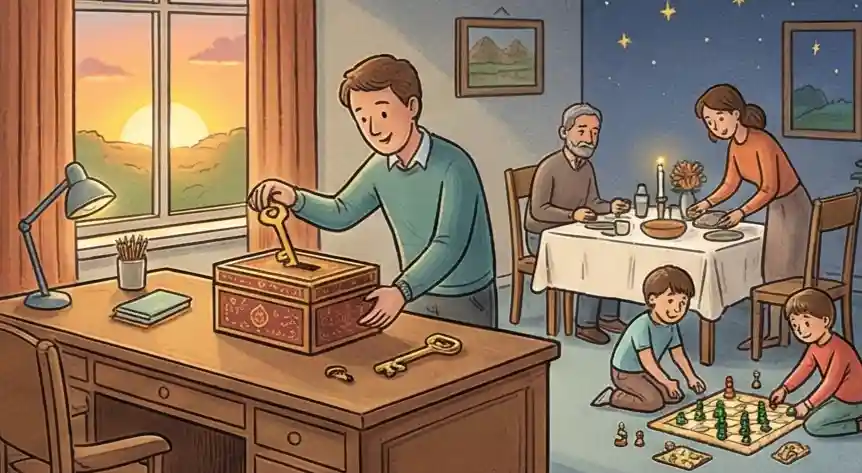
What Is a Workday Shutdown Ritual?
A workday shutdown ritual is a short, repeatable sequence of actions you do at the end of every workday to mentally close out work and prevent it from leaking into your personal time. It typically takes 10 to 20 minutes and involves writing down unfinished tasks, reviewing tomorrow's priorities, closing all work tools, and performing a physical signal that marks the end of the workday.
The concept was popularized by Georgetown professor Cal Newport, who argues that without a deliberate shutdown, your brain keeps incomplete tasks active in the background, which drains energy and degrades recovery. A consistent shutdown ritual tells your mind that work is truly done for the day.
A 2021 study published in the Journal of Occupational Health Psychology found that employees who did a brief end-of-day planning routine reported less work-related rumination in the evening and stronger engagement the following morning.
What You Need to Remember: How to Get Better
Less Experienced Way: Keep working until your list is done or you are completely worn out. Expert Way: Set a time you absolutely will not work past. Know that work tends to take up all the time you give it; a firm boundary forces you to choose only the most important tasks.
Less Experienced Way: Worrying about what you need to do next even when you are trying to relax. Expert Way: Write down every open thought or task. Spend the last 10 minutes listing the top 3 things that will make the biggest difference tomorrow. This clears your mind so your brain can work on problems while you rest.
Less Experienced Way: Leaving many computer tabs open and your desk messy so you remember where you were. Expert Way: Close everything digital and tidy your physical space. Start tomorrow with a clean slate. You shouldn't use your best morning energy to clean up yesterday's clutter.
Less Experienced Way: Slowly switching gears, like looking at your phone while still feeling like you are at work. Expert Way: Use a physical trigger—like a specific exercise, a short walk, or changing your clothes—to clearly tell your brain it is moving from "Work Mode" to "Personal Mode." Create a sensory wall between your roles.
Less Experienced Way: Thinking that resting early means you aren't trying hard enough. Expert Way: Seeing the end of the day as the first step in preparing for tomorrow. You cannot do your best work if you are not fully rested; if you never switch off, you can never be fully focused when it's time to start.
The Air-Gap System
Slowing down at the end of the day is a work mistake. Most people let the workday slowly drain away, leaving the office but staying mentally attached to unfinished tasks. This keeps you running inefficiently, where work harms your rest and rest never feels deep enough. To stay ahead, you must use the Air-Gap System.
This method is not just about feeling good; it's a strict, three-part plan for managing your energy. It starts with simple rules to stop work stress from leaking into your personal time. According to a RescueTime survey, 92% of knowledge workers regularly work into the evening and on weekends, and most report that their off-hours feel unrestored because they never mentally leave the office. A workday shutdown ritual breaks this cycle at the source.
It then moves to making sure you switch contexts smoothly, removing the morning drag that stops you from getting important work done quickly.
Done well, the system completely separates you from the day's noise, ensuring your best thinking ability isn't ruined by the build-up of small emergencies. Mastering this skill protects what you value most: your ability to think clearly when things get tough.
To go beyond just doing tasks, you need to start checking your work like a high-level manager. If you find the lines between work and personal time are already blurring, read our guide on work-life integration vs. balance to rethink the underlying structure of your day.
The Air-Gap System: A Check to See if You Are Truly Disconnecting
| Factor | Bad Sign (Normal Routine / Fading Out) | Good Sign (Level 3 Mastery / Air-Gap Used) |
|---|---|---|
|
How You Measure Success
|
Using Up Energy
You think you succeeded if you finished your to-do list. The day only stops when you are mentally drained, meaning you start the next morning slowly because your brain needs time to figure out all the broken pieces again.
|
Quick Start Tomorrow
You think you succeeded by perfectly saving your context. You set up the exact mental state needed for the first important work block tomorrow, so you can jump right into the flow state without warming up.
|
|
Your Attention & People
|
Distracted Presence
You are physically present but mentally "loading." You seem available to your coworkers and family, but you keep checking your phone, which shows you aren't really there and hurts trust in relationships.
|
Being Truly Present is Valuable
The ritual acts as an "Emotional Cleanup." By officially ending the day's story, you can give 100% of your focus, making your presence a high-value gift rather than something diluted and spread thin.
|
|
How You Communicate
|
Always Ready to Reply
You send out messages late in the evening that aren't urgent. This trains your team to think your boundaries are weak, causing them to send non-urgent things during your rest time too.
|
Sending Clear "Finished" Signals
Your shutdown ritual ends with "Clean Handoffs." This clearly tells your team that the "Boss Brain" is offline and encourages them to solve problems on their own.
|
|
Long-Term Goals
|
Thinking About Small Problems
You spend the evening replaying small issues and tactical fires. This keeps your active thinking part busy with low-level cleanup, stopping your brain from seeing bigger patterns.
|
Letting Your Unconscious Mind Work
The Air-Gap purposely clears out the small details so your subconscious mind can begin "Background Processing" on hard, complex strategy problems while you sleep. Learn how recognizing when your energy is depleted before it hits zero connects to this — our post on recognizing burnout signs early covers the warning patterns to watch for.
|
Summary from the Expert
- What Beginners Think A beginner sees the "Shutdown Routine" as a way to stop working.
- What Experts See A Level 3 Master sees it as a Non-Negotiable System Rule.
- The Price of Not Doing It Without the Air-Gap, you suffer from Mental Clutter—the effect where old tasks keep your current decisions from being clear. True skill isn't about working longer; it's about protecting your Core Thinking Ability so that when you are working, your choices aren't clouded by the unresolved "noise" from the last 12 hours.
The Base Level (New to Expert)
At this stage, success is about following instructions. You aren't aiming for "creativity" or "flow" yet; you are making sure your work system is stable. If you skip these rules, you leak mental energy, which harms how you perform the next day. You must either follow the plan or give up your rest time. There is no in-between.
"A ritual, anything that's going to pull our attention to, 'OK, now it's done,' it's going to be helpful in setting down that aspect to open us up to the next thing."
Rule: Keep a Central List
Every task, thought, or "to-do" that isn't finished must be moved out of your immediate thinking space and into one clear, saved list (digital or paper).
Why this matters: Your brain can only hold so much information. If you don't "save the file" (the list), your brain keeps running the task in the background.
Rule: Clear Your Work Area
Close all your computer tabs, chat apps, and work programs. Leave only one screen open—the main thing you will work on first thing tomorrow.
Why this matters: Every open tab is a background task fighting for your attention. A messy space makes you waste focus time restarting your focus tomorrow.
Rule: Set a Hard Stop Time
Pick a set time to announce you are done for the day on team channels and physically step away from your desk. Do not look at messages after this time.
Why this matters: If you don't have a fixed end, the workday will stretch to fill all your time. This rule clearly tells the work system that you are "Off the Clock."
The Professional (Mid-Level to Senior)
At this level, stopping work isn't about resting—it's about stopping the work system from drifting and managing the cost of switching mental gears. Your goal is to create a "hard stop" that protects your best ability to make good decisions.
Business Result: Measuring the Price of Being Always On
Professionals at this level know that tired work leads to more mistakes that take twice as long to fix tomorrow. By having a ritual that includes a "Start Plan" for the next day, they guarantee the first 90 minutes of tomorrow are spent on the most important work, not recovering from yesterday.
Professional Skill: Setting Up the "Handover Message"
A smart shutdown includes sending a quick message (5 minutes) that updates the team on what's happening. This stops people from constantly checking in on "hidden projects" and sending late-night messages. You create a system where the work communicates itself so you don't have to.
Team Context: Cutting Down on Noise Between Departments
Your end-of-day ritual must consider how it affects others. If a senior person sends "quick thoughts" at 8:00 PM, it causes anxiety and unnecessary work for other teams. By planning your outgoing messages for the next morning, you stop being the source of stress for your coworkers during their downtime.
Mastery (Lead to Executive Level)
The focus here shifts from personal tasks to Overall Value and Company Relationships. For top leaders, the shutdown ritual becomes a way to Manage Big Risks. Formally ending the work day protects the leader's most valuable thing: clear thinking. Setting this boundary makes sure personal stress doesn't affect important, long-term decisions.
Influence: Checking Your Political Balance
Use the last ten minutes to review who you interacted with and how it went against your "political capital" reserves. Send one brief, important message to a key person you might have challenged or ignored, fixing that relationship before you leave.
Goals vs. Tasks: Re-Aligning on Main Objectives
Look at tomorrow's schedule and label meetings as either "Effort to Grow" or "Effort to Defend." If you are spending too much energy on defense (putting out fires), pass one small "fire" to a subordinate to save your brainpower for the most important growth projects.
Future Planning: The Handover Test
Treat this routine as a daily test. Ask yourself: "If I suddenly couldn't work, is the plan for tomorrow's key decisions clear enough for my second-in-command?" Write down one crucial decision-making rule in a shared place to build the company's knowledge base.
Boost Your Day Ending: Why Setting Firm 'Shutdown Routines' is Key, and How Cruit Helps
To Find Closure
Journaling ToolQuickly write down what you did that day, note your accomplishments, and automatically tag the skills you used. This helps you feel finished and keeps a clear record of your progress.
For Future Planning
Career Advice ToolThis acts as your 24/7 advisor, using helpful questions to change your focus from today's worries to your long-term goals.
For Clear Tracking
Job Application TrackerSee your job search as a clear, organized list of steps. This lets you see where you stand and gives you permission to stop working for the day.
Common Questions About the Air-Gap System
Will a shutdown ritual make me seem less dedicated at work?
Your commitment is judged by the quality of your results, not how quickly you respond. Constantly being "half-available" just shows you can't manage your priorities. By using the Air-Gap System, you show that your focus is a valuable thing that must be protected. If a real crisis happens, you can still be reached through emergency channels; you just aren't waiting around for minor issues. Being strategically quiet is a sign of a great leader.
Is it better to finish all tasks before shutting down for the day?
The urge to "clear everything" is often a mental trap (the Zeigarnik Effect): your brain remembers unfinished things better than finished ones. Research by Weigelt and Syrek tracked employees over 12 weeks and found that unfinished tasks at the end of the week significantly impaired sleep quality by keeping cortisol elevated into the evening. Trying to finish everything just means low-quality work late at night. The Air-Gap System fixes this in Step 2 (Switching Contexts) by making you write down your exact progress and plan the very first step for tomorrow. This closes the mental loop without needing to finish the task, letting your brain truly rest.
How long should an end-of-day shutdown ritual take?
The system isn't extra work; it's an investment in your thinking power. The 10–15 minutes spent closing out the day stops hours of mental worry during dinner or sleep. If you are too tired to do a short routine, you are already performing poorly. The ritual is the cure that stops you from starting the next day already behind.
What should a workday shutdown ritual include?
A good shutdown ritual has three core parts. First, capture every open task into one trusted list so nothing stays loose in your head. Second, write down the top three things you want to accomplish tomorrow, which gives your brain a clear starting point rather than a blank slate. Third, close all work tools, tabs, and notifications and do a physical action like changing clothes or a short walk to signal the transition. Start with 10 minutes and add steps as the habit forms.
Does a shutdown ritual actually improve sleep?
Yes, and the research backs it up. A 12-week study by Weigelt and Syrek found that employees with unfinished tasks at day's end had measurably worse sleep quality due to elevated cortisol and work-related rumination. Writing down a specific plan for those tasks before shutting down closes the mental loop your brain keeps open, which reduces that nighttime thinking and lets you fall into deeper rest. The shutdown ritual is, in a real sense, part of your sleep routine.
Focus on what truly matters.
Work demands more attention than ever. Cruit gives you AI tools to manage your daily career tasks so you can focus on building the career you actually want.
Join Now