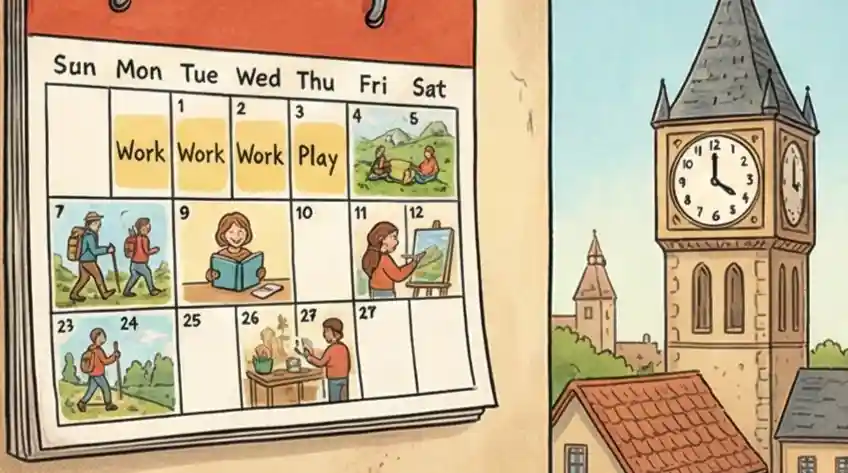
Simple Rules for Your Career Portfolio
Don't just use your official title when introducing yourself; it limits how people see your worth. Instead, describe three different kinds of problems you solve for three different types of customers. This way, if one job goes away, you still have other ways you are valuable.
Think of your main job salary as just one main backer, not your only way to survive. Spend five hours a week on something else—like a small project, selling a digital guide, or a paid newsletter. Real safety is having three different income streams, not just one big salary.
In a regular job, you trade time for money, and the company keeps what you create. In a portfolio career, you trade time for knowledge you can use again. Every project you finish should become a public example or a guide that you own, not your boss. This builds value that keeps growing for you.
Every six months, try to sell your skills to a new kind of industry you haven't worked in before. If you can advise a health company or a small charity, you are adaptable. If you can only sell your skills to people in your current office, you are at risk of everything failing if that one area changes.
What Is a Portfolio Career?
A portfolio career is a deliberate approach to work where you hold multiple income streams at once — combining a main role with freelance projects, consulting work, creative ventures, or other paid activities — rather than depending on a single employer for all your income and professional identity.
Unlike a side hustle (which is usually supplementary and informal), a portfolio career is a strategic structure. Each "project" in your portfolio reinforces the others. Skills you develop in one stream make you more valuable in another. And if any single stream disappears, the rest hold you steady.
Your Career Value and Real Security
The most costly mistake you can make today is putting all your career eggs in one basket. For a long time, people were told that working your way up one company ladder was the only way to be safe. This old way of thinking is a trap. It forces you to tie your whole identity and all your money to one company, making your life's work something that can be thrown away when the company changes or struggles. When that single company has a problem, your whole life can fall apart.
The numbers back this up. As of 2024, more than 76 million Americans freelanced alongside or instead of traditional employment — up from 73.3 million just one year earlier, according to Upwork's Future Workforce Report (2025). That's not a fringe trend. That's nearly a third of the U.S. workforce building careers that don't depend on a single employer. Real security doesn't come from a big salary or a special job title; it comes from spreading your value across many different roles and projects.
When you build a career from different parts, you stop being a fixed object and start becoming a flexible force. You're no longer judged only by what one company thinks of you; you're judged by the real value you create in many different fields. That spread is the best protection available. If one part of your work hits trouble, your whole world stays standing.
How Career Thinking Has Changed
Today's career world requires a big change: instead of looking for safety in one single structure (Staying in one place for a long time), we must build the ability to handle changes in many directions (Being able to adapt everywhere).
Main Goal: Staying put (Trying to climb up one ladder at one company forever for safety).
Who You Are: Simple Identity (Defining yourself only by one job title at one company).
Money Plan: Relying on One Source (Selling all your work time to one boss for one payment).
How to Survive: Fragile Single Structure (If the company fails or the business area changes, everything you have falls apart).
Main Goal: Being Flexible (Building a strong set of skills that are useful in many different fields).
Who You Are: Complex Identity (Defining yourself through many roles, like consultant, creator, and owner).
Money Plan: A Collection of Value (Spreading your expertise across different projects and income sources).
How to Survive: Strong Resilience (If one project ends, your other sources of income and confidence keep you steady).
The 3 Levels of Career Safety
To move away from having one critical failure point and toward a modern career that can adapt, you should use The 3-Level Safety Framework. This plan helps you stop depending on one employer and start building your own financial strength in many ways.
Level 1
What it is: The main role or project that gives you your basic money safety and proves your professional skill.
Why it matters: This is your financial safety net. It gives you the steady money needed to pay for your other activities. By having this main source, you feel safe enough to try new things without worrying that one failed project will ruin you financially.
Level 2
What it is: Actively working on side projects to get good at skills that are different from your main job.
Why it matters: This makes you a professional who can change direction as the market changes. It guarantees that if your main job field goes bad, you have already built the knowledge and proof needed to easily jump into a totally new area.
Level 3
What it is: Building a personal brand and a sense of self that doesn't depend on any single company or title.
Why it matters: This level uses the idea of Identity Complexity to protect you from feeling lost or tired. When your sense of self is spread across being a consultant, a creator, and a specialist, losing one role is only a small problem, not a complete breakdown of your life.
The main point of using these three levels is to create a strong, spread-out personal economy that keeps you adaptable and protects who you are against changes in the job market. This matters more now than it ever has: broader shifts like the rise of alternative work structures are reshaping what "a stable career" even means.
Tools for a Strong Portfolio Career
Safety Level: The Main Job/Project
Resume Tailoring ToolMake your main income source better. Uses smart technology to check job posts and find proof of your past success to get past automatic filters.
Safety Level: The Skill Building Plan
Career ExploringA smart check-up tool to see yourself as a set of skills. It finds your useful strengths to plan out other career paths you could switch to.
Safety Level: The Self-Image Shield
Public Profile CreatorAutomatically creates a public brand that shows you as an expert, protecting your identity by focusing on results, not just past employers.
Common Questions Answered
How can I manage a portfolio career without working way too many hours?
You don't need more hours; you need to use your time smarter. Most people start by building on what they already do. If you take what you do at your main job and offer it as a valuable consulting service for just three hours a week, you create a second income stream without losing your weekends. It’s about doing the work once and getting paid for it more than once.
Will I look like I can't commit to one thing to future employers?
The job market has changed to value proof of results over how long you stayed somewhere. Modern companies want people who can adapt across different areas. When you show your work as a list of problems you solved, not just job titles, you aren't seen as scattered; you are seen as a flexible expert who is too valuable to let go of.
Is switching between different kinds of work mentally tiring?
Actually, it protects you from burnout. Research on identity complexity shows that people who define themselves through multiple distinct roles are less prone to depression and stress than those with a single-domain identity. If one project hits trouble, you don't feel like a failure because you have other successes happening elsewhere. Spreading out your work creates a mental safety net that keeps your energy and motivation up.
How many income streams should a portfolio career have?
Most career advisors recommend three as the minimum for real financial resilience: one predictable stream (a main job or retainer), one growth stream (a skills-building project or course), and one high-upside bet (consulting, creative work, or a small business). Start with two and add a third once the first two are stable. Don't try to run five streams from day one — that's how you spread yourself too thin.
Can I build a portfolio career while still working full-time?
Yes — and that's the recommended approach. Start by dedicating five hours a week to a second income stream alongside your main job. This lets you test ideas, build proof of your work, and grow a client base before you ever need to depend on it financially. As of 2024, 76 million Americans were freelancing alongside or instead of traditional employment (Upwork, 2025). Most of them started exactly this way.
The Portfolio Career Promise
The time when you waited for permission to work is over. You are now the manager of your own skills. Stop depending on big companies and start building flexibility across many areas — that's how your career becomes a safe place. You don't just survive the market. You control your part of it. Stop building someone else's success and start spreading out your own value.
Take Control NowFurther Reading

How to Build a Simple Portfolio Website to Showcase Your Work

How to Build a Portfolio of 'Micro-Experiences' to Learn New Skills