Rethinking the Case Interview
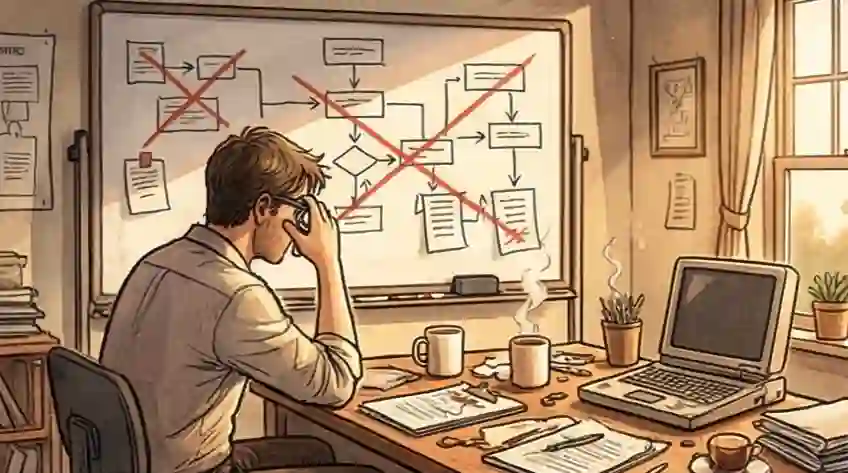
Stop treating your case study interview like a final exam. Too many people get stuck on the "Framework Obsession," desperately memorizing things like MECE or Porter’s Five Forces as if business puzzles were simple math problems. They think that by following every step (asking for clarification, drawing a tree, and summarizing) they will win. In reality, they are just going through the motions.
This box-checking approach creates a "Robot-Consultant" wall that ruins your chances. When you hide behind buzzwords and deliver a stiff, rehearsed routine, you look like a student taking a test, not a colleague giving advice. You end up solving for the structure instead of the actual business issue, creating conclusions that are technically "right" but boring, making you instantly forgettable. This mechanical way of working destroys your credibility before the meeting even starts. Research from Harvard Business Review confirms that structured, data-based evaluation methods outperform gut instinct by at least 25% in predicting job performance. If the interviewer can't see your actual thinking, you're just noise in their scoring sheet.
To get the job, you must switch to "Working Together to Lower Risk." Instead of a solo show, treat the interview like a working session focused on the "Biggest Limiting Factor." Skip the generic lists and state your main, risky guess (Hypothesis) in the first three minutes. Pinpoint the one thing that could make the whole project fail and you instantly change from "job applicant" to "trusted advisor." This shows you provide real value right away and makes the interviewer engage with you as a teammate, making the framework unimportant and your knowledge obvious.
What Is a Case Study Interview?
A case study interview is a job interview format where a candidate analyzes a real or simulated business problem, presents a structured solution, and defends their reasoning to the interviewer. It tests analytical thinking, business judgment, and communication under pressure, and is the primary screening method at consulting firms like McKinsey, BCG, and Bain.
Unlike behavioral or technical interviews, the case study interview simulates actual consulting work. You receive a client scenario (a company losing market share, a product launch decision, a cost reduction target) and must diagnose the root cause, ask the right questions, and recommend a path forward. According to Management Consulted's 2025 placement data, only about 1 in 10 candidates who reach the case interview stage at top consulting firms receive an offer, making preparation and approach the deciding factors.
Key Changes for Your Consulting Interview Plan
-
01
Pinpointing the Biggest Limiter Immediately focus on the 'Biggest Limiting Factor' to avoid the "Framework Obsession" and concentrate on the single thing that determines if the venture succeeds or fails. This shifts the talk from a school exercise to a real high-stakes consultation, proving you instinctively understand how business really works.
-
02
Stating Your Risky Opinion Early State a clear, high-risk opinion (Hypothesis) within the first three minutes to move from being a passive applicant to a proactive advisor with a clear viewpoint. This forces the interviewer to debate your logic like a teammate, making your structure disappear while your skill shines.
-
03
The Teamwork Mindset Adopt a "Teamwork Mindset to Lower Risk" by treating the interviewer as a partner, not a judge. This removes the "Robot-Consultant" barrier, builds instant professional trust, and proves you are focused on fixing the business problem, not just performing the required steps.
-
04
Smart Question Asking Focus on asking questions that deliver real "Information Gain," questions that uncover new facts, not just check items off a list. This shows you can handle unclear situations with sharp focus, leading to solid answers based on real business sense, not just memorized steps.
-
05
Speaking Like a Peer Focus on talking through your thinking as if it were a group meeting. This guarantees you are judged on your skill to lead a real board discussion, making you stand out as a future leader who can handle the messy complexity of real corporate work.
Case Study Interview: Checking for Expert vs. Basic Answers
As someone who looks at these interviews closely, I've compared the typical way people approach case studies with what top candidates (those who get offers right away) actually do. The following shows the change from "following a process" to "solving a business problem." (For the full list of patterns to avoid, see our breakdown of common case interview mistakes.)
Starting the problem by asking time to draw a fixed structure or list general areas like "The Market" or "Competition."
Asks for time to draw a rigid chart or lists general buckets like "The Market" or "Competition."
Skips the pause. Immediately states a Risky Opinion about the one specific thing that could cause failure (e.g., "The numbers look okay, but I suspect the cost to get customers is our biggest limiter").
The relationship feels like a "Student" being tested, always waiting for permission to move forward.
Acts like a "Student" taking a test. Waits for the interviewer to approve every step, creating a stiff, "check-the-box" feel.
Acts like a "Peer" or Advisor. Treats the interview as a Team Effort to Lower Risk, pulling the interviewer into a working session to fix a real problem.
Asking questions just to cover all framework categories, acting like a checklist.
Uses a "Checklist Mindset," asking questions in every bucket of a framework just to prove they know the framework.
Focuses on getting real "Information Gain." Asks targeted questions meant only to prove or disprove their initial guess, ignoring data that doesn't matter.
The structure is the focus: visible, full of jargon, and stiff.
Makes the structure the "star." The logic is clear, but it uses too many buzzwords and feels robotic (e.g., "Now I will check Porter's Five Forces").
Makes the structure hidden. The thinking is solid, but it's buried under business common sense. The talk stays on the business reality, not the "steps" of the test.
The final summary just repeats the structure and ends with an unexciting, math-based answer.
Summarizes findings based on the initial structure. Ends with a "correct" but dull answer based on calculations.
Delivers a Plan to Reduce Risk. Focuses the ending on how to handle the specific "Biggest Limiting Factor" identified at the start, showing senior-level planning ability.
Action Plan: The High-Stakes Case Pivot
Switch from "Memorizing Structures" to Thinking from Basic Ideas. You must let go of the need to look "prepared" and instead focus on finding the "One Point of Failure." This removes the "Robot-Consultant" wall by forcing you to see business as a set of controls, not a set of slides. If you're new to consulting cases, our consulting case interview preparation guide covers the foundational concepts.
Take three standard business cases. Instead of fitting them into MECE, list the "Standard Consultant Answer" and then write down one Unexpected Insight that would make that standard answer useless (e.g., "Market size doesn't matter if government rules cause a 2-year delay in launching").
"To build the mental habit of looking for the Biggest Limiting Factor right away when hearing a business question."
Trigger: One week before the interview (or during personal study).
Kill the "Student Mindset" by refusing to take the standard pause to draw a chart. Real teammates don't sit quietly; they jump into Teamwork to Lower Risk immediately. State your main guess early, and you control the conversation. The interviewer becomes your data helper instead of your grader.
After the prompt, lead with an opinion based on questions: "I could build a standard profit chart, but in an industry with these kinds of profits, I suspect the real biggest issue is [Variable X]. I want to skip the general talk and test the idea that [Hypothesis Y] is the only thing that really matters. Does your information agree with that focus?"
"To flip the power dynamic from "Applicant being graded" to "Senior Advisor helping a client.""
Trigger: The first 3 minutes of the interview.
Replace the "Checklist Mindset" with hunting for Key Variables. In this phase, you aren't trying to find the "right" answer; you are trying to reduce how much you don't know. You use the interviewer as a source for special data, proving you know which questions actually matter in a boardroom.
Every time you ask for a number, show how important it is. Instead of asking "What are the costs?", use a Reference Point: "In my past work in [Industry X], labor costs were always the biggest part. Is that true here, or should we worry more about something hidden like 'Customer Getting Cost'?"* This shows you are solving for the *business*, not the *math.
"To prove "Senior-Level Thinking" by finding the 20% of the information that creates 80% of the result."
Trigger: The middle 20 minutes (The "Working Session").
Get rid of the hesitant summary. Most people give a balanced "good points vs. bad points" list that means nothing. To be remembered, you must give a strong recommendation that accounts for Real-World Messiness. For a deeper breakdown of this final step, see our guide on how to present your findings at the end of a case study.
Give a Recommendation That Isn't Obvious, plus a "Stop Condition." Say: "Based on what we found, the math says 'Yes,' but the risk of failure says 'No' because of [Reason Z]. My advice is to move forward ONLY IF we can fix [Variable X] in 90 days; otherwise, this project will hurt the main business. This isn't just a math issue; it's about timing and company culture."
"To leave the room feeling like a peer whose sharp sense of risk is more useful than their ability to follow a template."
Trigger: The last 2 minutes (The Recommendation).
The Recruiter's View: Why Mastering the Case Study Adds 20% to Your Value
In hiring, resumes are sales pitches, often exaggerated, always polished. But the case study? That's the property inspection. My job isn't just finding good people; it's reducing the hiring risk for the business. When someone nails the case study, they aren't just answering questions; they are proving they won't waste company money trying to figure things out.
Here is what's actually happening internally when you deliver a top-level case study:
"The candidates who stand out aren't the ones with the perfect framework. They're the ones who can walk into a client meeting tomorrow and hold their own. That's what we're testing for."
People who only talk about work but can't structure it fall into the "Maybe" group instantly. They seem like a risk because they can't show how they would actually execute a plan.
A clear, logical case study proves you can get things done from day one. It calms the hiring manager's fear by showing you need little hand-holding, moving you instantly to the "Must Hire" group.
Nailing the case study gives me the solid proof I need to argue for you getting a higher salary offer, bypassing normal pay limits. I stop negotiating against you and start securing you as a proven asset.
This proof of real working structure builds Proof of Ability, the only thing that keeps its value. It allows you to ask for more money now and in every future raise.
What We Actually See
Truth #1: Getting Past the "Empty Talker" Label
Most people are good at talking* about work but surprisingly bad at *organizing it. A clear, logical map proves you aren't just a resume. You're someone who can execute tasks right away.
Truth #2: Calming Down Management Fears
A weak case study suggests you'll need a lot of supervision later. A strong one suggests you're low-effort to manage. If you present like a senior person, it’s easier to justify paying you like one by cutting down the perceived "management fee."
Truth #3: Your Interviewer Becomes Your Sales Lead
When your performance is clear, the interviewer uses your case study as strong evidence when arguing for you internally, especially when asking for more money than usual. I move from "negotiating" to "getting a sure thing."
The Core Idea: Operational Trust
This method works long-term because it builds Operational Trust. In companies, Trust is the one thing that never loses value.
Mastering the case study shows you have the "Executive Skill": the ability to turn something unclear into a working plan. A 2025 Gem Recruiting Benchmarks report found that 72% of employers now use structured interviews to reduce hiring bias and predict on-the-job performance. When you demonstrate structured thinking naturally (not rigidly), you're giving the interviewer exactly what their evaluation criteria reward.
Cruit Tools for Your Action Plan: The High-Stakes Case Pivot
Plan Steps: 1 & 2
Career Guidance ToolUses a Socratic AI Mentor to help you break old habits, getting you ready to offer a strong, questioning opinion.
Plan Steps: 1 & 3
Journaling ToolKeeps a searchable record of your work. The AI Coach sorts through your past projects, labeling the real skills you showed.
Plan Steps: 3 & 4
Interview Prep ToolUses an Interactive AI Coach to practice giving that strong final statement and knowing when to include a "Stop Condition" for peer-to-peer conversation.
Frequently Asked Questions
Can I skip MECE without looking unorganized?
Yes. Being organized is key, but following a "standard" structure can sometimes hide a lack of sharp business thinking. The goal isn't to skip logic; it's to skip generic logic.
When you organize your thoughts around a key hypothesis instead of a textbook chart, you show a higher level of organization: the ability to focus on what actually matters for the business.
What if my hypothesis turns out wrong?
Playing it safe is the fastest way to be forgotten. Interviewers aren't grading you on predicting the future; they are testing if you can spot the key things that matter for making money.
Even if the numbers prove your first guess wrong, the fact that you stated it shows you gained information. It proves you understand how the business wins or loses. If the data proves you wrong, you change course, just like a real consultant would, which actually makes the team effort stronger.
Do interviewers expect a specific framework?
Some entry-level screeners might use a checklist, but the real decision-makers (Partners and VPs) are looking for someone they can send to a client tomorrow. They want "Professional Trust," your ability to lead a room and make complexity simple.
When you lead with a strong strategic guess, you force them to treat you as an advisor. That helps you skip their scoring sheet and move straight to being a "Must Hire."
How long should a case study interview last?
Most case study interviews last between 30 and 45 minutes. You'll typically spend the first 3 minutes hearing the prompt and forming your hypothesis, the middle 20 minutes in a working session analyzing data and asking targeted questions, and the final 2 to 5 minutes delivering your recommendation. The exact timing varies by firm, but the structure stays consistent across McKinsey, BCG, and Bain.
How many case interviews will I face?
At top consulting firms, expect 2 to 3 case interviews per round, with most candidates going through 2 rounds total. That means 4 to 6 cases between you and an offer. Each case tests a different skill set (quantitative analysis, market sizing, strategy), so you need to be comfortable with the hypothesis-driven approach across all case types, not just your strongest area.
Is a case study interview the same as a consulting interview?
A case study interview is one part of a consulting interview, but not the whole thing. Consulting firms also run behavioral (or "fit") interviews that test leadership, teamwork, and communication skills. The case portion tests your analytical and business thinking. Both carry equal weight in the hiring decision, so strong case performance alone isn't enough if you can't also show interpersonal judgment.
Don't Get Trapped by the Same Old Way
Breaking free from the STATUS_QUO_TRAP of the "Framework Obsession" is the only way to keep your professional value high and avoid being written off as a "Robot-Consultant."
The STRATEGIC_PIVOT toward "Working Together to Lower Risk" means you stop performing for a grade and start solving the business's "Biggest Limiting Factor." Changing from a tested student to a trusted advisor is the smartest move you can make to land a senior role in a competitive job market.