What You Need to Remember
Focus on showing you fit in well with the team and share their values, not just listing what jobs you’ve had.
Prove you can stay calm and think clearly about the big strategy, even if the setting is strange or relaxed.
Use the casual time to move the talk away from daily tasks and focus on where the company is heading in the long term.
Have a few clear, story-driven examples ready that you can tell smoothly without notes or slides.
What Is a Walk and Talk Interview?
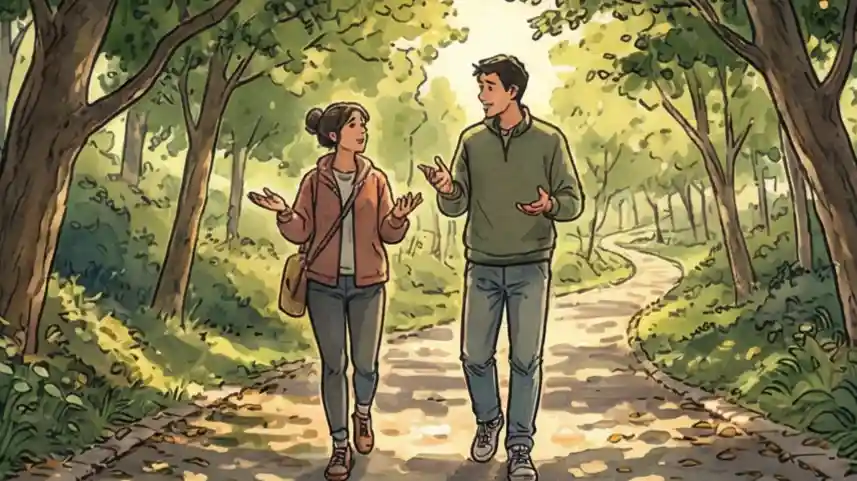
A walk and talk interview is an informal interview format where the hiring manager walks you through the office, campus, or work environment while asking questions and evaluating your responses. Unlike a sit-down interview, it tests your ability to think clearly, stay composed, and show genuine curiosity while moving through distractions.
Companies use this format for mid-level and senior roles because it strips away the safety net of a conference room. Research from the Journal of Applied Psychology confirms that interviewers form judgments about a candidate's suitability within the first 90 seconds, and 55% of that impression comes from non-verbal cues like posture, eye contact, and how you carry yourself. In a walking interview, every one of those signals is amplified because you can't hide behind a table.
Checking Your Steps: The Walk-and-Talk Mistake
When a hiring manager suggests a "casual walk," many people fall into the "Friendly Mistake." They hear "informal" and stop being serious, thinking it's a friendly chat. By the time they relax or share personal stories, they have changed from a top candidate into "a nice person." According to a 2025 flair.hr analysis of hiring data, 50% of interviewers reject candidates based on how they dress, act, or walk through the door. In a walking interview, that window of judgment never closes.
This walk is not a break from the interview. It is a real-time test of your "ability to function smoothly." Leaders need to know if you can handle important business plans while dealing with everyday noise and movement. If you can't keep your focus while walking, they worry you will fail when a real problem happens. Losing this test does not cost you one job. It costs you the reputation that opens doors to future roles, because you look like someone who needs structure instead of a natural leader.
"When candidates are distracted by their surroundings, you get to the authentic, un-adorned person faster. That's the whole point."
Robert Wendover, Hiring strategist and Managing Director at the Center for Generational Studies
To succeed, you must change from being an applicant to acting like a consultant checking out the site. Instead of answering questions, look around and ask how the office setup affects the way people work together. This changes who is in charge. You are not a visitor being guided; you are a partner checking the situation, proving you are always thinking about the business, even when you aren't sitting at a desk. If you're also preparing for other informal formats like the lunch interview, the same principle applies: casual settings are still evaluation settings.
The Office Walk: Three Steps to Winning
See the walk as looking around for clues, not just a tour. Your goal is to stop thinking like "a candidate being led" and start thinking like "a consultant visiting a location." You aren't just looking at the office; you are checking out how the business actually works day-to-day.
Before the interview, look at social media pictures or "Life at [Company]" videos to see what the office looks like. Find three specific things you might see (like a certain software on a screen, how desks are arranged, or the coffee brand) that you can connect to a main business goal.
"I'm looking forward to the walk. As we go through, I’m especially interested in seeing how the way your team is set up supports the quick teamwork you mentioned earlier."
Managers use the walk to get past the prepared interview answers. They check if you notice the company's mood without being told what it is. If you just look down or act like a tourist, they assume you don't have the awareness needed for a leadership job.
This tests if you can "keep it together." You must show you can talk about serious business strategy while dealing with real-life things like opening doors, stepping around people, or loud noises. The goal is to use the environment to prove you are always thinking about the business.
Practice the "Link to Surroundings." Every few steps, point out something you see and turn it into a business question. If you see a whiteboard full of ideas, don't walk past it. Ask how they handle teamwork problems. This puts you in control and shows you already think like an owner.
"I noticed the engineering team has their project timelines out in the open. That kind of openness usually makes meetings better. Is that on purpose for how you built your culture here?"
This is where the manager's gut feeling meets the formal process. They are secretly asking, "Can I trust this person to represent us at a big meeting or with a client?" If you stop looking professional during the walk, you fail this hidden test.
Because these walks are casual, they don't leave notes, which worries HR. You need to turn the "feeling" from the walk into solid business facts. You must change what the manager casually felt into clear points they can use to defend their good feeling about you to the rest of the team.
Within four hours, send a follow-up email that focuses on an "Observation from the Site Visit." According to a TopResume survey, 68% of hiring managers say a thank-you note matters, and 16% have ruled out candidates who didn't send one. Mention one specific thing you saw during the walk that wasn't in the job description and explain how your skills will fix or improve that specific thing. This shows you weren't chatting; you were actively checking things out. Building this kind of confident follow-through starts before the interview: positive self-talk during preparation helps you stay in the consultant mindset under pressure.
"Walking through the office today gave me a clear look at the team's energy. Seeing the real-time teamwork in the product area made me sure that my background in managing projects quickly is exactly what you need to connect your design and development teams better."
Managers often can’t explain why they like a candidate after a casual chat. By sending a summary of what you noticed, you are actually writing the "reason to hire you" memo for them. You make it easy for them to hire you by giving them the professional words they need to show HR that you are the right fit.
How Cruit Helps You Prepare for the Walk and Talk
Step 1: Check Out the Place
Job Analysis ToolGets you ready with "Things to Notice" by spotting skill gaps and what the company really needs from the job details.
Step 2: Keep Your Power
Interview PracticeUses an AI coach to help you practice your success stories (STAR method) so they come out smoothly when you "Link to Surroundings."
Step 3: Summarize Your Findings
Note Taking FeatureThe "Journaling Coach" helps turn casual walk details into a strong, professional email to justify why they should hire you.
Five Mistakes That Kill Your Walk-and-Talk Interview
You drop your guard, share personal stories, and stop selling yourself. The interviewer walks away remembering you as "fun" but not as someone who can lead a team under pressure.
Poor eye contact signals discomfort. Research by flair.hr shows 65% of interviewers have rejected candidates who failed to maintain eye contact, and this effect is stronger when you're moving.
Match the interviewer's pace. Rushing signals anxiety; dragging behind signals hesitation. Walk beside them, not behind, so you project partnership instead of subordination.
The office tour is not decoration. If you pass a whiteboard full of sprint plans and say nothing, you missed the chance to ask a sharp question that proves you think like an owner.
A walking interview feels informal, so many candidates skip the thank-you note. That is a mistake: 16% of hiring managers have ruled out candidates for not sending one, according to TopResume.
Frequently Asked Questions
What is a walk and talk interview?
A walk and talk interview is an informal interview format where the hiring manager walks you through the office or work environment while asking questions. It tests your ability to stay composed, think clearly under distraction, and show genuine interest in how the company operates. Companies use it for mid-level and senior roles to see how candidates behave outside a structured setting.
Will acting like a consultant seem pushy?
Not if you do it well. Asking sharp questions about what you observe (how desks are arranged, what tools are on screens) shows your brain is wired to analyze business problems. Top leaders don't want someone who agrees with everything. They want a partner who spots things they might have missed. If a company thinks being strategic is "too pushy," their culture probably rewards average work. Walk away.
How should I dress for a walking interview?
Wear business casual or one level above the company's daily dress code. Choose shoes you can walk in comfortably for 20-30 minutes. Avoid anything that restricts movement or makes noise (loud heels on hard floors, jangling jewelry). You want your appearance to signal professionalism without distracting from the conversation.
What if the interviewer says "just relax"?
This is a trap. "Relax" is the trigger for the Friendly Mistake. The "real you" they want to see is someone who stays professional and focused even when the formal rules disappear. Be warm and personable, but keep your stories short and focused on results. Never complain. Your "real self" should be a leader who is always ready.
How do I ask strategy questions without company data?
Your eyes are your data source. Turn what you see into business questions. If you see quiet offices, ask if the company is shifting to remote work and how that affects team cohesion. If you see an open-plan area buzzing with activity, ask how they protect time for deep work. You don't need internal numbers to judge how smoothly things are operating. Asking about what you observe in real time proves you connect small details to the big picture.
Should I take notes during a walking interview?
No. Taking notes while walking makes you look detached and slows the conversation. Instead, mentally tag two or three specific observations (a piece of software on a screen, a team layout, a whiteboard) and write them down immediately after the walk ends. Use those details in your follow-up email to show you were paying close attention.
Move from Being a Guest to Being the Leader
Companies want a trusted partner, not someone nice. Making the "Friendly Mistake" means thinking "casual" means "not serious," which makes you give up your authority to be liked. Your worth is shown by how you act after the formal interview is over.
Master the consultant mindset to show that your strategic thinking never stops, even when moving through hallways and open floors.
Stop acting like a guest waiting for permission and start acting like the leader they need.