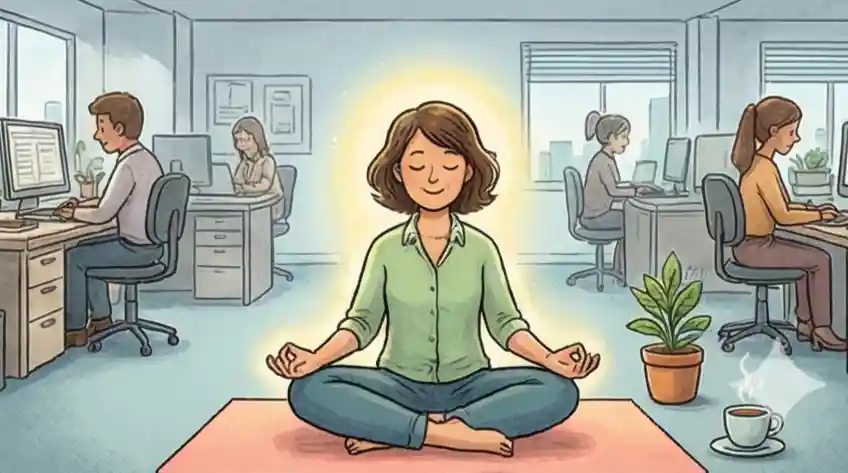
Ways to Hit Reset on Your Focus
-
01
The Tab Reset When switching between different work tasks, close your eyes for thirty seconds. This helps "turn off" the mental files from the work you just finished so old thoughts don't sneak into your new work.
-
02
The Tactile Anchor Pick one object on your desk. Touch it and silently describe it to yourself for one minute whenever you feel worried or stressed. This brings your brain back to the real room instead of a digital worry.
-
03
The Breath-to-Enter Use the few seconds right before you click to join a meeting to take one deep breath into your belly. This creates a small physical wall to keep the annoyance from your last task out of the new conversation.
-
04
Visual Funneling Look at one spot on a wall that isn't moving for sixty seconds. This physically narrows what your eyes see, telling your brain to stop looking around for distractions and get ready to concentrate deeply.
The Hidden Cost of Distraction Residue
You're three minutes into an important meeting, but your mind is still stuck on an angry email you got at ten in the morning. You hear your name, but the words feel slow and fuzzy. This is the stickiness of attention residue: your focus is glued to an old problem even as you try to start something new.
Attention residue is what happens when part of your cognitive attention stays fixated on a previous task after you've moved on to a new one. Research by Professor Sophie Leroy at the University of Washington Bothell coined the term to describe how incomplete tasks drain mental bandwidth, reducing performance on whatever comes next.
The usual advice is to download an app and "make time" to relax, but when your whole day is booked with back-to-back calls, adding another chore just makes you feel more tired. You don't need more things to do; you need a way to stop your constant start-stop work cycle from draining your brainpower. A 2023 McKinsey Health Institute survey of more than 30,000 employees across 30 countries found that 51% reported low holistic health, high burnout, or both — and the culprit isn't always workload. It's the cognitive cost of never fully arriving at the task in front of you.
To get back in control, you have to treat focus not like a relaxing break, but as a planned quick clean-up: a series of very fast mental cleanings designed to wipe the residue off your mind before you move to the next thing.
What Really Works: Quick Fix vs. Long-Term Hope
Most advice tells you to get a relaxation app and find ten minutes to meditate. Let's be real: that's a useless fix. If your calendar is packed with back-to-back meetings and your email is overflowing, telling you to "just breathe" is like giving someone a glass of water when they are standing in a house fire. It’s just one more thing to do on a list that is already too long.
Telling people to use meditation apps or deep breathing for stress. This advice fails because it only treats the symptoms (stress), not the real problem (a bad, demanding schedule). It just adds another task to an already heavy list.
This is about clearing mental clutter. It means doing fast clean-ups, like the 60-second pause between calls or closing all your browser tabs before starting focused work. These are steps designed to stop "attention residue" from hurting your immediate performance.
If you feel like you need a mental break every twenty minutes just to handle the constant interruptions, you are putting up with a bad schedule, not just managing focus. Constant resets mean something is structurally wrong.
When you keep putting off setting healthy limits, you aren't just dealing with stress; you are making burnout certain. Stop trying to get good at being miserable and start planning your way out. If you're rethinking the whole structure of your day, the ideas in Work-Life Integration go deeper than balance alone.
Use Cruit to Help You Focus on Your Career
For Looking Back
Journaling ToolWrite down what you achieved each day. Our AI automatically finds the skills you used and turns your thoughts into professional descriptions.
For Getting Clear
Career Advice ToolAn AI mentor asks smart questions to help you create a real plan and break down big goals into small, clear actions.
For Staying Focused
Application TrackerTurns the job search into an easy visual map. It updates statuses automatically so you don't have to keep track of everything in your head.
Common Questions
Won’t stopping for these exercises just make me fall further behind on my work?
No. Taking 60 seconds to clear your head is not "wasted time." It's an investment in working faster later. When your mind is cluttered, you make more errors and take longer on every task. A quick mental clean-up lets you work quicker and more accurately, actually saving you time overall.
Can these short clean-ups really help my performance, or is this just feel-good advice?
Yes. This isn't about finding peace; it's about being more efficient. Clearing "attention residue" between tasks lowers your stress hormones and keeps the logical part of your brain in charge. You'll notice you can move between projects without that heavy mental drag, leading to smarter choices and better results when things get tough.
How long does attention residue last after switching tasks?
Research from UC Irvine found that it takes an average of 23 minutes to fully regain focus after a single interruption or task switch — without any intentional reset. The good news: a deliberate 60-second mental clean-up (like the Tab Reset or Three-Breath Check-in) can cut that recovery time dramatically by giving your brain a clear "close" signal for the previous task.
Is mindfulness at work the same as meditation?
No, and this distinction matters. Meditation is a scheduled, extended practice — typically 10-20 minutes — aimed at long-term mental training. Mindfulness at work, as described here, is about micro-practices embedded directly into your workflow: a 30-second body shake, one deep breath before a meeting, a 60-second visual focus. You don't need a meditation app or a quiet room. You just need 30-90 seconds and the intention to hit reset.
What if I work in an open office and can't close my eyes or shake my arms?
All of these resets have a low-visibility version. Instead of closing your eyes, let your gaze go soft and stare at your screen without focusing on anything for 20 seconds. Instead of shaking your arms, press your feet firmly into the floor under your desk. The Tactile Anchor (touching one object and silently describing it) is completely invisible to anyone around you. The goal is the mental reset — the physical action is just a trigger for it, and any subtle version of that trigger still works. For deeper stress that goes beyond focus, see how financial wellness connects to career stress in a related guide.
Take Charge of Your Focus
Getting better at focusing isn't about finding more hours in your day; it's about taking back the mental clarity you already have. These quick clean-ups turn your attention into your most valuable work tool. Don't let your career run you.
To truly master your career, you must stop reacting to the mess and start controlling your focus with planned, fast mental resets.
Start Mastering Now