What You Should Remember
Protect your job and income by getting paid from different places—like selling things you create, coaching people, or using ads—so you don't rely only on what one website or platform decides to do.
It's better to have a small group of people who really care about you than a massive crowd that just glances at your stuff. This small group gives you steady and reliable money.
Start treating your creative work like a real business. Set clear rules for when you work and keep track of how much money your time actually makes.
To make money from what you love doing, you must clearly help others solve a problem or give them a real benefit. This turns your personal interest into a real sale.
What Is the Creator Economy?
The creator economy is the ecosystem of independent content creators, educators, and professionals who build audiences and earn income directly from their work — through courses, memberships, sponsorships, and consulting — rather than through traditional employment. It represents a structural shift of economic power from institutions to individuals.
The creator economy now encompasses over 200 million active creators worldwide, according to Goldman Sachs research. The global market is valued at $250 billion as of 2025, with projections to reach $528 billion by 2030. But the income picture is far from equal: more than half of all creators earn under $15,000 a year, and only about 4% reach six-figure income, according to Influencer Marketing Hub's Creator Earnings Report 2025. Those numbers make one thing clear — audience size alone isn't a business strategy.
The Change in Making Money Online
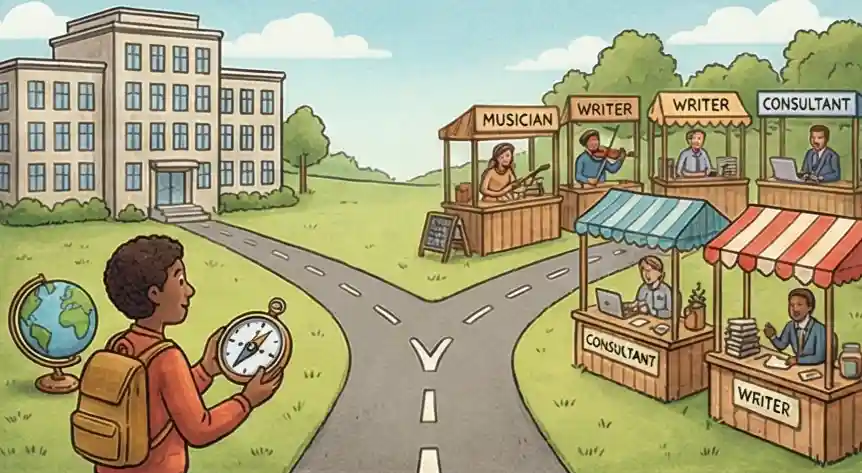
Many people treat the creator economy like a game of chance. They think if they just follow their passion and post content often, a company will pay them eventually. This is the trap for people who aren't serious. By focusing too much on things like likes and how many followers they have, they are basically running a business that takes a lot of work but doesn't make much profit, and it all depends on a website's rules. You aren't really an owner; you are just someone doing a fun activity for a computer program, mistaking having many viewers for having a real business.
In the actual business world, this isn't about leaving your normal job just to become famous online. It's about moving power away from big companies and toward individuals. When you create your own way to reach people, you take control from the corporation and become a "Business of One." If you don't learn how to do this, you don't just lose a side job — you lose your ability to earn well over your lifetime. You stay a replaceable part of a system that is becoming more and more threatened by its own employees building their own brands.
"Creators who have a hyper-specific niche that solves a genuine problem for people will still be able to build and grow an evergreen online business."
To succeed, you have to fight against your own instincts, because old company rules and legal agreements still try to take ownership of what you create. They see your personal brand as something that might leave them or cause problems. To get past this, you must stop being a creator who does everything and start building a "Business that Owns Its Small Area."
The Smart Change
- The change is moving from trying to get "fans" to selling specific fixes for important, high-cost problems.
- You don't quit your job to "make stuff"; you use your professional career as a test room to learn deep secrets, which you then turn into something you can sell easily. This is the same logic behind rethinking how you structure work entirely.
- By making yourself known as the top expert in one small area instead of just a content machine, you stop fighting for attention and start building a system where you are the only real choice for a certain problem.
The Three Steps to Being Your Own Boss
Before you build anything, you must make sure your contracts allow it. Most workers are "owned" by their contracts, meaning the company can claim anything they work on. You need to figure out the exact "Type of Expert" you want to be and make sure it doesn't overlap with what your current boss does, so they can't shut you down before you even start.
Check your employment agreement for the part about "Ideas and Company Property." Highlight anything that says the company owns work done on your own time or with your own tools. Once you see that, decide on the "Niche Topic" you want to be known for—make sure it is related to your job but does not use any secret company information.
"I plan to start a personal professional newsletter about [Specific Topic]. Since this is not part of our company's main business and I'll be doing it outside of work hours, I want to get written permission that the ideas I create will belong only to me, so there are no misunderstandings later."
We often worry about high-performing employees leaving the moment they start building a public name. But if you bring this up yourself to show how you can help "boost the company's image as a leader," we often see you as a valuable person we want to keep, rather than someone we need to control.
Stop trying to get "likes" and start fixing "expensive problems." Instead of being a general person who talks about everything, focus on an area where you are the only one solving a specific, important professional difficulty. You aren't just a content creator; you are a known expert who uses social media just to share your special ways of solving things.
Create a "Map of a Problem and Fix." Find one specific problem you solved at your regular job that would be worth at least $10,000 to another company. Write a short guide or a 3-step plan that explains the fix without sharing company secrets. This is your first "Product"—now, only talk about this problem and your unique way to solve it.
"I notice many companies struggle with [Specific Problem]. I have created a special way to fix this, and I will be sharing my knowledge about this exact topic to become a known expert in this field."
In the trend of power moving to individuals, we look for "Lighthouse People." These are people whose public brands act like a beacon, drawing other top talent to join the company. If your "Area of Control" makes our company look like the best place for smart people to work, you become someone they won't fire during cuts.
Use your growing reputation to change your role from an "Employee" to an "Expert Partner." Once your personal brand starts bringing in its own leads or money, you no longer need the company's permission to exist; they need your reach to stay important. The goal is to switch from working set hours to a role based on what you actually deliver, meaning you control your own time.
Do a "Leverage Check." Compare how many messages you get from your personal brand to the tasks you do at your job. Once what people want from you outside is greater than what your job demands, suggest a "Dual-Role Agreement." This changes your role from a full-time worker to an expert you hire part-time, letting you grow your creator business while keeping the safety of a company job. If this path appeals to you, read our guide on whether freelancing or consulting is the right move before making the leap.
"My online presence has grown enough that I’m bringing attention to our work here. I want to talk about changing my job to a 'Special Advisor' role. This lets me keep doing great work for you while I manage my outside projects, which ultimately makes our company look better."
Bosses get scared when they might lose their best workers to the creator world. If you give them a way to keep half of your talent instead of none, they will usually agree. We would rather have a genius working for us half the time than a full-time replacement who doesn't understand the business.
How Cruit Helps Your Creator Strategy
To Keep Your Ideas Safe
Career Guidance ToolWorks as your coach 24/7 to practice tough talks with your employer, making sure you ask for permission with the right confidence.
To Build Your Expert Status
Journal ToolRecords your daily successes and uses an AI Coach to look closely at details, pointing out and labeling the real-world skills you use in your important fixes.
For Public Expert Status
LinkedIn Profile MakerTurns your proven achievements into a strong public brand, creating expert titles and summaries that attract attention from your industry.
Frequently Asked Questions
Can you make a living in the creator economy?
Yes, but the odds are tougher than most people expect. According to Influencer Marketing Hub's Creator Earnings Report 2025, only about 4% of creators earn over $100,000 a year, and more than half earn under $15,000. The creators who do make a sustainable living typically specialize in a narrow, high-value niche and sell solutions directly to clients — not just ad impressions to platforms.
Does my employer own content I create outside of work?
It depends on your contract. Many employment agreements include IP assignment clauses that claim ownership of work done on company time, with company tools, or in the same field as the company's business. The safest path: use your own devices and personal time, and focus your public content on your method and knowledge — not on your employer's proprietary processes or client data. If you're unsure, have an employment attorney review your contract before you publish anything.
How many followers do you need to make money as a creator?
Far fewer than you'd think — if you're selling the right thing. Kevin Kelly's "1,000 True Fans" framework suggests that 1,000 people willing to pay $100 per year equals a $100,000 business. For high-ticket professional services, you need even less: 100 clients paying $5,000 for a solution to a costly problem they can't solve alone. Follower count matters for ad-based income. For expertise-based income, depth beats reach every time.
Will building a personal brand hurt my career at my current job?
It depends on how you frame it. If your public content positions you as a thought leader in your field, many employers see it as free PR — your reputation attracts talent and clients to the company. The risk comes when your content directly competes with your employer or suggests you're already halfway out the door. Frame your work as "building industry thought leadership" that reflects well on the firm. If they still push back, that's a signal worth paying attention to.
What is the best niche for the creator economy?
The best niche is the intersection of three things: a problem you've personally solved, a problem that costs others significant money or time, and an area where you have real professional credibility. Generic niches like "productivity" or "career advice" are overcrowded. Specific niches like "supply chain optimization for mid-size manufacturers" or "regulatory compliance for SaaS startups" have smaller audiences but far higher willingness to pay. The narrower and more specific, the better.
Control Your Niche, Build Your Business Empire
Get out of the "HOBBYIST TRAP" of chasing likes and waiting for someone's permission. Real career success requires the "EXPERT SHIFT": see yourself as an important business partner, not just an employee. Top companies want experts who know what they are worth and speak confidently, not workers who just follow orders.
- If you stick to "hobbyist" habits, you become easy to replace.
- This costs you power and future money.
- Owning your small area secures your future as someone they must keep.
Stop trying to entertain a crowd and start building your own controlled business today.
Start Your Empire