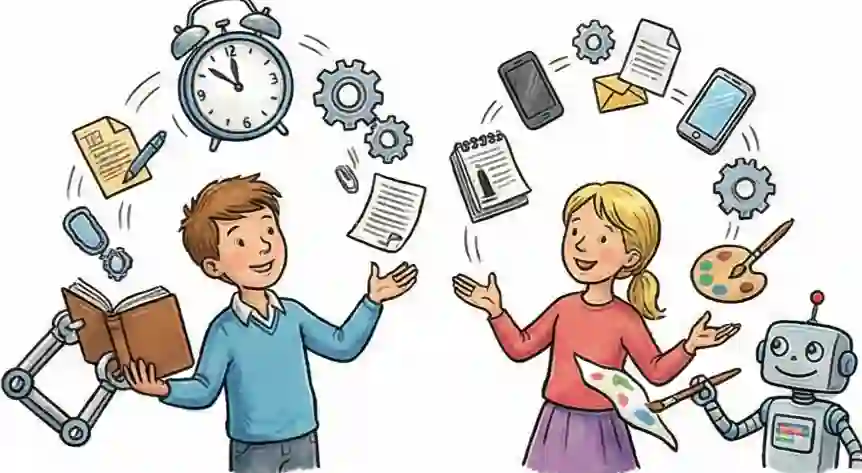
Key Ideas for Staying Strong in the Market
Main Points to Remember
-
01
Your Role is Flexible (How You Think) Don't just stick to your job title. See yourself as someone who can solve different kinds of problems. This helps you move your main skills to new jobs quickly when your current field changes.
-
02
Move Your Skills (How You Work) Focus on understanding the main rules and ideas behind your job, not just the specific programs or tools. Knowing the "why" lets you get results on any system or in any team.
-
03
Show What You Achieved (Proof) Keep a clear record of real results you delivered, not just a list of tasks you did. Good proof of your success makes your value clear and easy to explain to any new boss.
-
04
Stay Useful by Mixing Skills (Future Value) Combine deep expert knowledge with general people skills like communicating clearly and thinking ahead. The ability to write well about your work compounds across every role and industry. This balance keeps you valuable even if automation handles your specific technical tasks.
What is a T-Shaped Skill Set?
A t-shaped skill set describes a professional with deep expertise in one discipline (the vertical bar of the T) combined with broad, working knowledge across multiple adjacent fields (the horizontal bar). This combination makes you both irreplaceable in your specialty and adaptable enough to contribute across teams.
The term gained traction after IDEO's Tim Brown used it to describe ideal design thinkers: experts who could also collaborate across disciplines. Today it defines the standard for career resilience. According to IBM, the half-life of a professional skill dropped from 10 to 15 years in 2010 to under five years by 2025, with some tech roles seeing half-lives as short as two and a half years. Building a t-shaped skill set is a direct response to that compression: your deep skill generates income today, while your horizontal breadth protects it when the market shifts.
The Idea That Your Job Can't Be Replaced Is Wrong
Many workers spend years becoming experts in one small area, convinced that one deep specialty makes them safe. Career experts call this the "I-shape," the opposite of a t-shaped skill set. They get good at their job, learn just enough confusing words to sound smart in meetings, and believe their career is secure. They think they built a safe tower. But really, they just built a small room they are stuck in.
The hard truth is that being great at just one thing stops working when the world changes faster than you can update your job title. Staying safe doesn't depend on how much you know right now; it depends on how fast you can move what you know into a new situation later. The wide part of your skill set shouldn't just be random facts: it must be your ability to use your deep skills in completely new types of jobs.
If your value relies only on one specific tool or area, you aren't a bonus to the company; you are a risk if that one thing fails. If your field changes or a smart program starts doing your detailed work, knowing a bit about other things won't save your salary. Being too specialized is no longer a good thing; it just means you become old news quickly when the market moves on.
How Modern Hiring Systems Actually Work
Behind the scenes, the computer programs that run job sites like LinkedIn and the systems that read resumes (ATS) don't see your career as just one main skill. They see you as a collection of connected ideas, which we call a Semantic Cluster.
McKinsey reports that 87% of companies already face a skills gap or expect one within a few years. Yet most job seekers build profiles optimized for the job they have, not the roles they will need next. The hiring system picks up on that mismatch and deprioritizes narrow profiles in cross-functional searches.
Real Connection vs. Just Words
Computer Word CheckWhen a hiring person searches, the computer uses NLP (Natural Language Processing) to look past simple matching words. If you say you know about "Marketing" but your other skills don't connect to it, the Semantic Search sees your marketing knowledge as just random words because it doesn't fit with related skills. To the computer, you aren't skilled in many areas; you're just a specialist with confusing extra words on your profile.
How Skills Move and Same-Meaning Words
Importance ScoreThe "computer" actually cares most about Skill Portability. The best candidates, according to the system, are those whose wide skills show they can use their main expertise in new areas. If your main skill is Data Analysis (the deep part), the system checks how that skill works in Finance, Health, or Product roles. If your profile shows you can use that depth in new places, the AI gives you a higher Importance Score in searches for many different jobs.
Connection Strength Over Simple Word Lists
Safety ScoreThe "Movable Pillar" is what stops you from being kicked out by tough search filters when your main job area slows down. A regular worker relies on one simple set of words (like "Java" AND "Bank"). A strong worker builds a profile that matches many different types of skill needs. The system isn't just counting how many skills you have; it measures your Connection Strength, measuring how well your main deep skill links up to new, growing job areas in the market.
To keep your job safe long-term, you must map out the basic, usable parts of your main skill and show how they fit into many different types of industries.
Taking Apart Misconceptions About the T-Shaped Career
Because the world changes fast, you should focus on knowing a little bit about everything instead of being a true master of one thing.
Without one deep skill area to rely on, you are just a generalist, and generalists are often the first people replaced by computers or cheaper workers. Career safety comes from having one high-value "main skill" that pays the bills, while your broad knowledge just helps you work well with other teams.
Use the Career Exploration tool to find out what your main "anchor" skills are and see which deep expertise areas are popular right now.
If you have experience in many areas, hiring people will just know how those skills fit into a different job.
Hiring managers and computer screening programs (ATS) don't guess; they look for clear proof that your broad skills solved specific problems. If you don't clearly explain how your broad skills (like how "handling a classroom" is actually "managing a complex project"), your T-shape stays hidden from the market.
Use the Resume Tailoring Tool to have an AI coach help you change your general experiences into the specific language that hiring people are searching for.
The best way to make your "T" wider is to finish as many online courses as you can in different subjects.
Knowledge is only useful when you apply it; companies value "applied breadth," meaning they want to see how your extra knowledge helped you finish a task in your main job. A marketing person who used basic data skills to boost sales is T-shaped, while someone who just finished a "Data 101" course just has a hobby. Building genuine data literacy takes deliberate practice across multiple contexts, not a single course.
Use the Journaling Tool to record real wins as they happen, which lets the AI pull out the actual skills you showed so you can prove your breadth with facts, not just certificates.
The 30-Second “Silo Test”
Most people think being the best specialist makes them safe. But being too focused (an "I-shape") makes you easy to replace. The World Economic Forum's 2025 Future of Jobs Report found that 59 out of every 100 workers will need significant retraining by 2030. The professionals who avoid that forced retraining are the ones who built their T-shape before the market demanded it. Use this audit to see if you are stuck in a silo.
Check your Slack, Teams, or Email "Sent" folder.
Review the last 10 people you messaged about a work problem.
How many work in your immediate team or have similar roles?
What Your Results Mean
If 8 to 10 people are in your department: You are too specialized ("I-shaped"). You lack the broad skills (strategy, sales) to easily shift roles if your niche changes or is automated. High risk.
If 0 to 2 people are in your department: You might be too general. You communicate across teams, but may lack the deep expertise that makes you essential.
If 4 to 6 people are in your department: You are T-Shaped. You have deep expertise (vertical line) while regularly communicating across teams (horizontal bar). This builds career resilience.
Cruit AI Helper for Building Your T-Shaped Skills
For Skills Variety Career Exploration
Helps you build the "wide" part of your T by finding your hidden skills that can be used in other industries.
For Deep Skills Job Analysis Tool
Makes your main "deep skill" stronger by checking your resume against job needs and showing you exactly what extra skills you need.
For Planning Career Guidance Tool
Acts like a guide who is always available to help you see your blind spots and create a clear plan for your long-term goals.
Common Questions
How can I make my deep skills useful in other areas?
Don't just talk about the tools you use; focus on the problems you solve.
For example, if you write code, your "deep skill" is not just the writing itself, but solving problems logically and designing systems. If you can explain how your work saves a company money or gets more customers, you can explain that value to almost any other team or industry.
Should I deepen my expertise or learn new skills?
You should do both, but focus on how fast you can learn.
Spend most of your time getting better at your main skill (80%), but use the rest of your time (20%) to practice applying that skill to a nearby field. This way, you don't rely on just one thing, and you can move easily if your current area changes.
Will my specialized skills become useless if I don't change my skill set?
Yes, this is called "Hyper-Specialization Fragility." It's a real danger.
If all your value is tied to one specific tool or method, a new program or a market change could make your job pointless quickly. Your safety comes from your "horizontal bar," your ability to move your deep knowledge into a new area before the old one fades away.
How do I know if I'm T-shaped or I-shaped?
Take the 30-second Silo Test above: check the last 10 people you messaged about a work problem.
If 8 to 10 are in your own department, you're I-shaped. If you regularly communicate across 4 or more different teams or functions, you're closer to a T-shape. The sweet spot is 4 to 6 contacts from different teams: that's the profile of a genuinely T-shaped professional.
Can I become T-shaped later in my career?
Yes, and it's often easier because you already have your deep skill built.
The work is adding breadth through cross-functional projects, stretch assignments, or applying your expertise to adjacent fields. You don't need to start over. You need to expand sideways. Even one strong collaboration outside your department, documented with real results, starts building your horizontal bar.
Staying Relevant in a Changing Market
The biggest mistake people make is trying to "win" their career by building one fixed T-shape. They build one deep skill, learn a few trendy words for meetings, and think they are good for life.
As we've seen, this Mainstream Myth is a trap. Real career success isn't about reaching a final point where you stop growing; it's about always staying useful.
"The future belongs to those who can learn, unlearn, and relearn faster than the pace of change."
— Erik Brynjolfsson, Professor, Stanford Institute for Human-Centered AI
The shift from "knowing stuff" to "learning and sharing knowledge" is what makes skills portable, able to survive any market disruption. Don't let yourself become a liability by staying in one place. For most people, the hardest part is fitting that growth into a full-time job. Learning a new skill while working is a system, not just willpower.
Know what truly matters.
Handling today's career world requires smart plans. Cruit gives you AI tools to handle these planning tasks so you can focus on building a good career.
Start Using CruitFurther Reading
Data Literacy: The Must-Have Skill for Every Modern Professional

Becoming a Better Writer: A Foundational Skill That Boosts Every Career